Industries / Figureheads
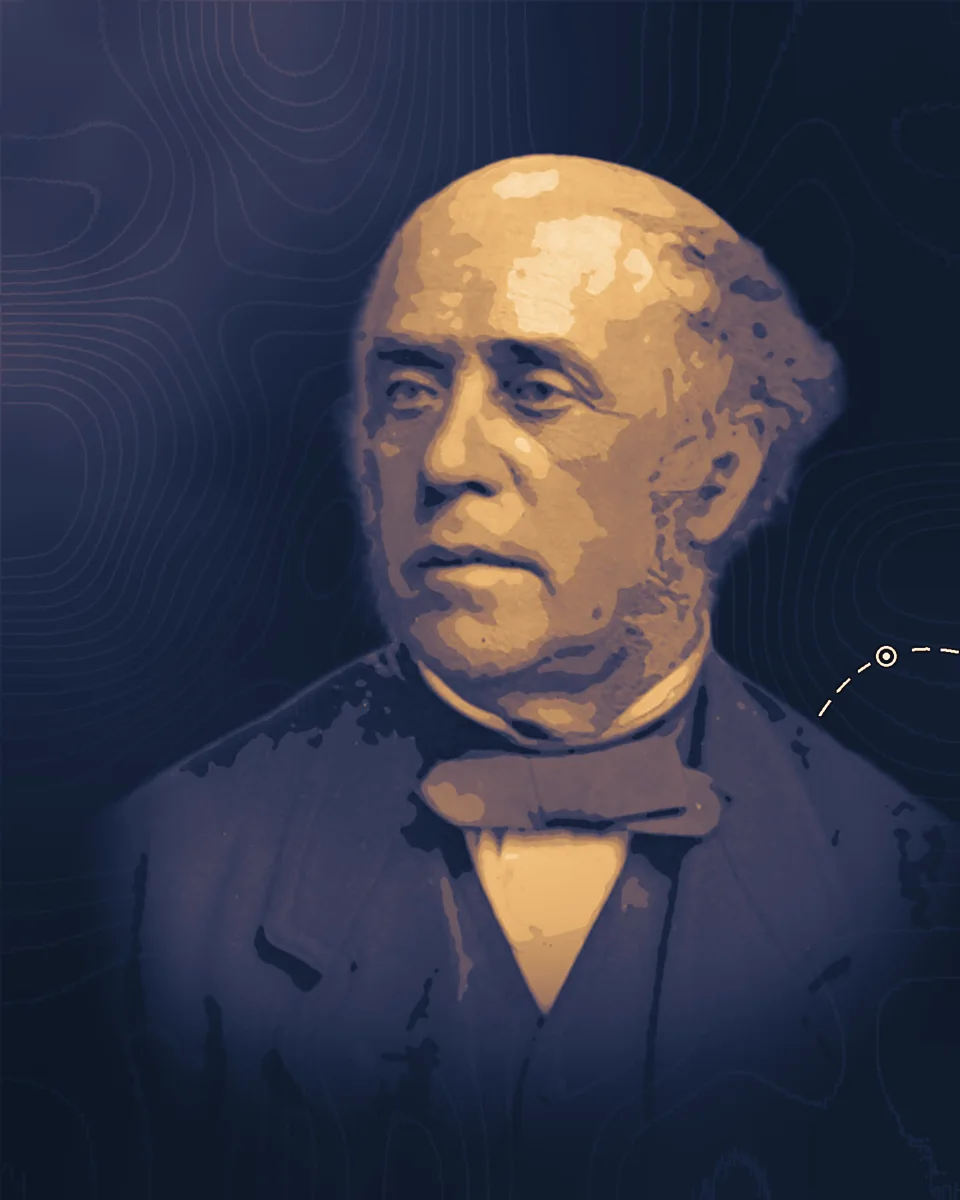
Thomas Cook
He sold railway trips, and later whole tours abroad, as one package with the travel, rooms and guiding arranged for the traveller.
1808–1892
What they changed
1841
A hired excursion train
On 5 July 1841 Cook hired a special train to take members of the Leicester Temperance Society to a meeting in Loughborough, 12 miles away, for one shilling each. Leicester City Council's history counts 485 passengers and calls it "the first railway excursion"; the Railway News obituary of 1892 counts 570.
1845
Excursions sold for profit
His first trip run as a business, in the summer of 1845, took a party to Liverpool, Caernarfon and Mount Snowdon. In 1851 he brought workers to London for the Great Exhibition: about 150,000 people by the council's count, 165,000 by The National Archives'.
1855
Tours led abroad
In 1855 he escorted his first tourists on a circular tour of Europe, crossing from Harwich to Antwerp. He tried out a North American tour in 1865, took his first party up the Nile on two hired steamers in 1869, and in 1872 led a tour round the world that took 222 days.
1868
Coupons for hotels
In 1868 Cook introduced the hotel coupon, a voucher bought before the trip and handed over at the hotel in place of cash. In 1874 came the circular note, which a traveller could cash abroad much as a traveller's cheque is cashed now. The National Archives describes his business as having grown "from temperance daytrips to multi-stage Continental package tours".
Life
Thomas Cook was born on 22 November 1808 at Melbourne, Derbyshire, to a poor family. His father died when he was four. At ten he worked in a village garden for a penny a day, and he later learned wood-turning and worked for John Winks, a printer and publisher in Loughborough. In 1828 he became a Bible reader and village missionary in Rutland.
He married in 1832 and moved to Market Harborough, where he went on turning wood and joined the Baptist congregation. He gave up alcohol in 1836 and worked for the temperance movement for the rest of his life. The idea of the excursion came to him on 9 June 1841, as he walked 15 miles from Market Harborough to a temperance meeting in Leicester. Later that year he moved to Leicester and set up as a bookseller and printer. In 1853 he opened a temperance hotel and hall on Granby Street.
He was not the only one running excursions. The National Archives notes that the railway companies competed hard for passengers. Susan Major's 2012 doctoral thesis at the University of York studied the excursion crowds of the 1840s and 1850s through the press of the time. It found railway companies, other agents, voluntary societies and churches organizing them, and it judges Cook's role to have been less dominant than often assumed.
His son John Mason Cook, who was on the 1841 train at the age of seven, built up the business from a London head office at Ludgate Circus. Father and son often argued over where the firm should go, and their partnership had ended by 1878, when Thomas retired to Leicester. He died at his house, Thorncroft, in Leicester on 18 July 1892, aged 83. He was buried in Welford Road Cemetery. John died in 1899 and the business passed to his three sons.
The travel group that carried his name collapsed in September 2019. Its archive, which runs from the founding in Leicester in 1841, went to the Record Office for Leicestershire, Leicester and Rutland.
Read more
5 accounts
The Business of Travel: A Fifty Years' Record of Progress, W. Fraser Rae, Thomas Cook and Son, 1891.
The firm's own history for its fiftieth year, written from documents the firm supplied.
archive.org
Obituary of Thomas Cook, Railway News, 1892.
The trade paper's notice five days after his death, with his early life and the first excursion.
todayinsci.com
Thomas Cook: 150 Years of Popular Tourism, Piers Brendon, Secker and Warburg, 1991.
A full history of the man and the firm for its 150th year.
archive.org
'The Million Go Forth': Early Railway Excursion Crowds, 1840-1860, Susan Major, University of York, 2012.
A doctoral thesis that sets Cook among the many people who ran excursions.
etheses.whiterose.ac.uk
The Romantic Journey: The Story of Thomas Cook and Victorian Travel, Edmund Swinglehurst, 1974.
A history of the firm's first decades and of Victorian travel.
archive.org