Industries / Figureheads
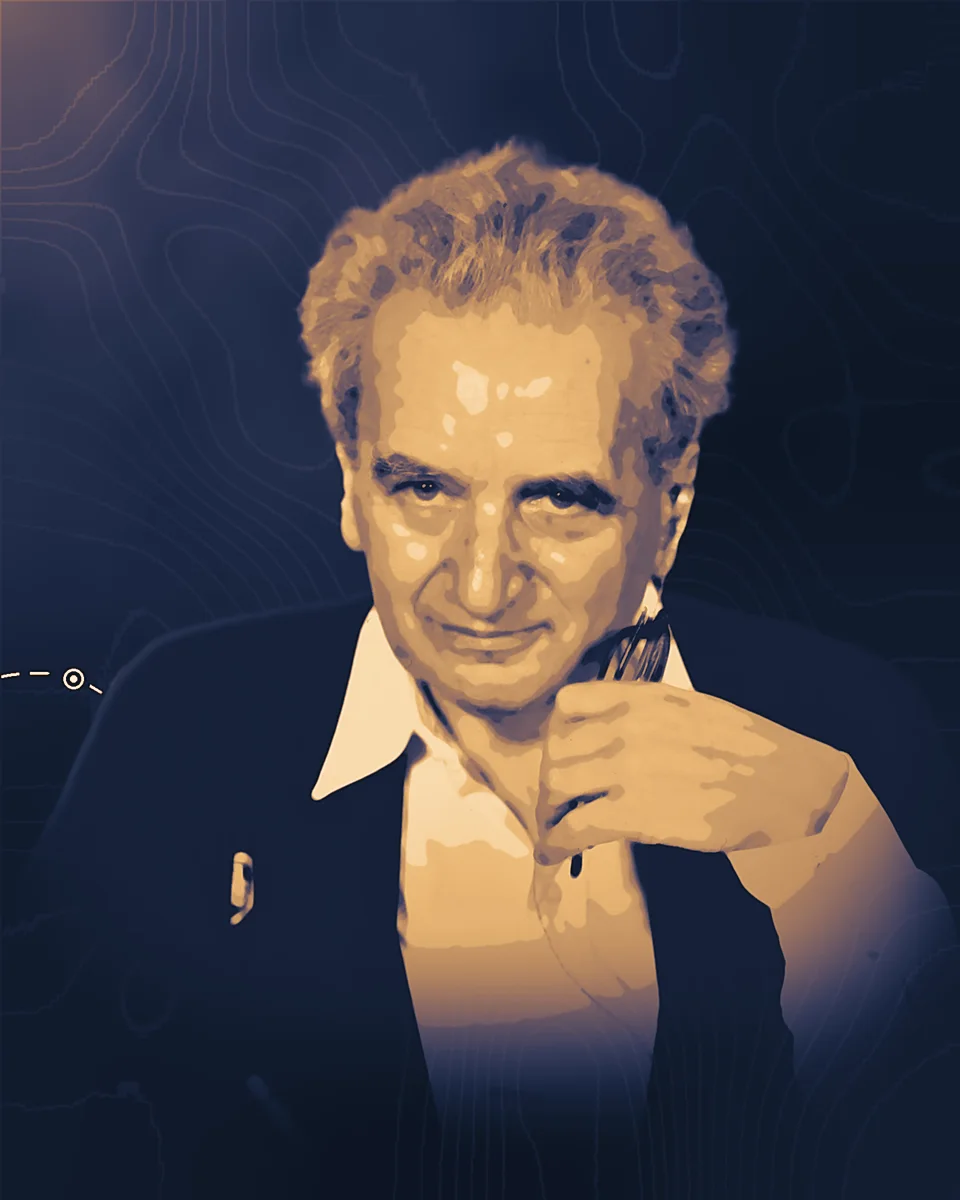
Theodore von Kármán
He made a university laboratory the place where aircraft makers tested their designs, and from it started American rocket engineering and the body that advises NATO on aeronautics.
1881–1963
What they changed
1911
The vortex street
At Göttingen von Kármán worked out why the eddies shed behind a cylinder in a stream line up in two staggered rows, and showed that only that arrangement is stable. Others had described the pattern; his calculation gave it his name. The alternating push of such eddies makes power lines, chimneys and suspension bridges vibrate.
1930
A laboratory the industry used
In 1930 he became director of the Guggenheim Aeronautical Laboratory at the California Institute of Technology in Pasadena. NASA's Jet Propulsion Laboratory says aircraft companies used its wind tunnel to test models of their designs. He ran it until 1949.
1941
Rockets that lift aircraft
From 1936 he let his student Frank Malina and two rocket enthusiasts, John W. Parsons and E. S. Forman, build rockets at the laboratory. On 12 August 1941 the group made the first successful American test of rockets strapped to an airplane to shorten its takeoff. In 1942, having failed to interest existing firms, he and a few colleagues founded Aerojet, which the National Academy of Sciences' memoir calls the first US firm formed to develop rockets. The group became the Jet Propulsion Laboratory, with von Kármán as its first director.
1945
A research plan for airpower
In 1944 General H. H. Arnold asked him to form a group of scientists to study what jet engines, rockets and guided missiles meant for the US air force. Its reports, Where We Stand and Toward New Horizons, set out a long-term technical policy. The group became the Air Force Scientific Advisory Board, which he chaired until 1954.
1952
Shared research across NATO
In 1951 he brought together the heads of aeronautical research of the NATO countries. The result was the Advisory Group for Aeronautical Research and Development, based in Paris, which he chaired from 1952 until his death. Hugh Dryden wrote that it revived aeronautical research in Europe through the exchange of results.
Life
Theodore von Kármán was born in Budapest on 11 May 1881. His father, Maurice von Kármán, was a philosopher and educator who helped found Hungary's state school system. In 1906 he went to the University of Göttingen, where Ludwig Prandtl taught, and took his doctorate there in 1908 with a study of how columns buckle. He saw his first airplane flight in Paris in those years and turned toward aeronautics.
In 1912 he became professor and director of a new aerodynamics institute at the technical university in Aachen, Germany, which grew to rival Göttingen and drew students from many countries. He served in the Austro-Hungarian army in the First World War. He first visited the United States in 1926, at the invitation of Robert Millikan of Caltech and Harry Guggenheim, to advise on courses and on the design of a wind tunnel. From 1928 he divided his time between Aachen and Pasadena. In 1930 he settled in California, and he became a US citizen in 1936.
He insisted on being called an engineer. JPL quotes him: "The scientist describes what is; the engineer creates what never was." His own research ran from turbulence and the friction of air on a surface to the flow of air near and above the speed of sound. Dryden wrote that he consulted for industry and government throughout his career.
Much of his later work served the military. JPL began in 1944 under a US Army contract to develop rocket weapons, and the reports for General Arnold dealt with future air warfare, including missiles. Dryden notes that the founders' stakes in Aerojet, said to be 1,250 dollars each, grew into small fortunes as rockets became central to ballistic missiles.
He never married, and lived with his mother and his sister Josephine. In 1963 President Kennedy gave him the first National Medal of Science. He died in Aachen on 7 May 1963, four days before his eighty-second birthday.
Read more
4 accounts
Theodore von Kármán 1881–1963, Hugh L.
Dryden, National Academy of Sciences Biographical Memoirs, 1965. A forty-page life by a fellow aerodynamicist, with a chronology and a full list of his papers.
nasonline.org
The Wind and Beyond, Theodore von Kármán with Lee Edson, 1967.
His autobiography, finished after his death.
archive.org
Dr. Theodore von Kármán (1881–1963), NASA Jet Propulsion Laboratory, Faces of Leadership, read in 2026.
The laboratory's account of its first director and the rocket work.
jpl.nasa.gov
Slice of History: Happy Birthday, Dr. von Kármán, NASA Jet Propulsion Laboratory archives, 2021.
A short note from the archive with the 1957 office portrait.
jpl.nasa.gov