Industries / Figureheads
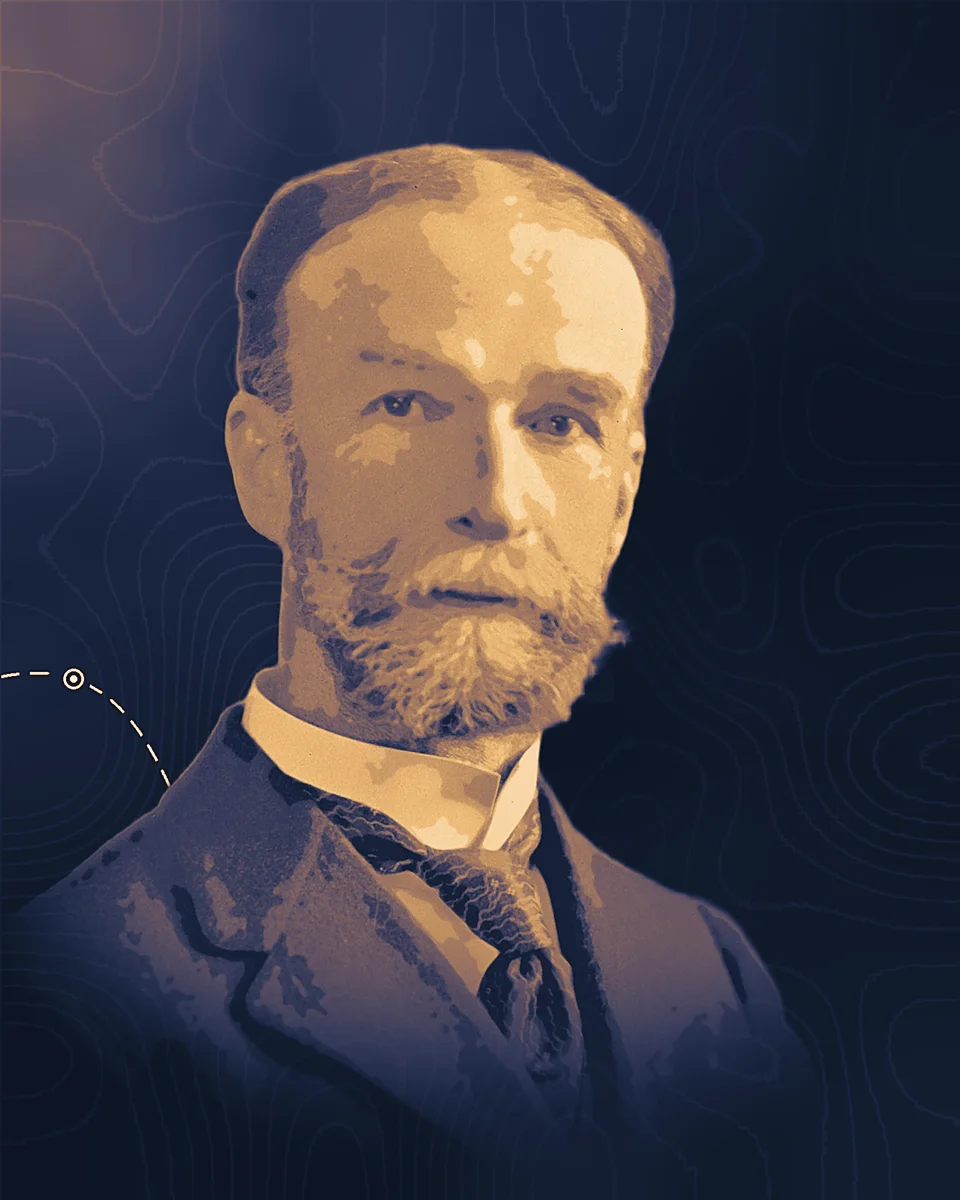
Theobald Smith
With his colleagues at the US Bureau of Animal Industry he showed that a tick carries Texas cattle fever, the first disease shown to be passed by an arthropod, so herds could be freed of it by dipping out the tick.
1859–1934
What they changed
1886
Killed germs that immunize
Working with his chief at the Bureau of Animal Industry, Daniel Salmon, Smith showed in 1886 and 1887 that animals could be made immune with dead bacteria, killed by heat at 56 °C, or with the liquid the bacteria had grown in. Hans Zinsser's memoir for the National Academy of Sciences says the finding, taken further by others, gave most of the methods then used to immunize people.
1893
Ticks carry cattle fever
Texas cattle fever killed northern cattle that met southern herds on the drives to the Kansas and Midwest stockyards. In pen and field trials from 1889, Smith and the veterinarian Fred Kilborne put northern cattle with southern ones that had ticks or had been cleaned of them, and with ticks spread on pasture: only ticks passed the fever. Smith found the parasite in the red blood cells, now called Babesia bigemina. Their 1893 report, Bureau Bulletin No. 1, was the first proof that an arthropod carries an infection, by the accounts of the Academy's memoir and the US Centers for Disease Control and Prevention.
1898
Bovine tuberculosis set apart
Robert Koch held that people and cattle carried the same tuberculosis germ. By 1898 Smith had shown from cultures that the bovine type differed from the human type in shape, growth and how badly it sickened cattle. The Academy's memoir says the work changed ideas about how tuberculosis passes in milk and shaped practical control.
1906
Ticks dipped out of herds
Once the tick was known to carry the fever, killing it on the cattle stopped the disease. The CDC's account says the tick's life cycle "soon paved the way for control of the disease by dipping cattle to kill the ticks". In 1906 the Bureau and the states began a campaign that ran cattle through vats of tick-killing dip. By 1943 the fever ticks were confined to a strip along the Rio Grande, more than 500 miles (800 km) long, which is still a quarantine zone.
pmc.ncbi.nlm.nih.govencyclopediaofarkansas.netanimalscience.tamu.edu
1922
Colostrum saves newborn calves
At Princeton, Smith and Ralph Little found that all 10 calves allowed to suck colostrum, the first milk, survived, while 8 of 12 kept from it died. Smith then showed that calves are born with no antibodies and take them in from colostrum in their first days.
Life
Theobald Smith was born in Albany, New York, on 31 July 1859, the son of Philip Smith, a German immigrant who kept a small tailor's shop. He won a free place at Cornell University at 18 and graduated in 1881. He took his medical degree at Albany Medical College in 1883, spending a spring term in the biology laboratory at Johns Hopkins, and went back to Cornell for graduate study.
In 1884, aged 25, he joined the new Bureau of Animal Industry in Washington, set up within the Department of Agriculture to fight hog cholera, pleuropneumonia, Texas fever and tuberculosis in farm animals. He knew little bacteriology and taught himself from the papers of Pasteur and Koch, and within a year he had brought Koch's culture methods into American laboratories. From 1886 to 1895 he also taught bacteriology at Columbian University, now George Washington University.
Credit for the work at the Bureau is disputed both ways. In his first years there Smith found the bacterium he took for the cause of hog cholera, but his chief, Daniel Salmon, claimed it, and the genus Salmonella is named after Salmon. The cattle fever work, on the other hand, is often told as Smith's alone. Zinsser's memoir and the CDC's account both call it a collaboration: Kilborne ran the transmission trials with him, and the entomologist Cooper Curtice had already reported cattle dying in pens where Texas cattle had stood and worked out the tick's life cycle. Ranchers had long suspected the ticks. By Zinsser's account Smith never claimed the work as his own.
The campaign built on the finding was forced on farmers. In Arkansas, the state encyclopedia records, small farmers who called themselves "kickers" refused to dip, dynamited dipping vats and burned the property of those who supported the work. The vats were charged with arsenic, and the encyclopedia warns that soil at old vat sites can still poison.
In 1895 Smith moved to Massachusetts to run the state's antitoxin laboratory and to teach comparative pathology at Harvard, where he worked on diphtheria antitoxin and on tuberculosis. He turned down the directorship of the new Rockefeller Institute in 1901, then in 1915 took charge of its Department of Animal Pathology at Princeton, New Jersey, which he ran until he retired in 1929. There he studied contagious abortion in cattle, now called brucellosis, and scours in calves.
The CDC's account counts 305 publications, most of them under his name alone, and records the Royal Society's Copley Medal among his honours. His last book, Parasitism and Disease, came out in 1934, the year he died.
Read more
6 accounts
Biographical Memoir of Theobald Smith, 1859–1934, Hans Zinsser, National Academy of Sciences, 1936.
A memoir by a fellow bacteriologist, with a careful account of who did what on cattle fever and a full list of his papers.
nasonline.org
Investigations into the Nature, Causation, and Prevention of Texas or Southern Cattle Fever, Theobald Smith and F. L. Kilborne, US Bureau of Animal Industry Bulletin No. 1, 1893.
The report itself, with the pen and field trials.
archive.org
Theobald Smith, Myron Schultz, Emerging Infectious Diseases, 2008.
A short life by a CDC physician, with the disputes over credit.
pmc.ncbi.nlm.nih.gov
The Significance of Colostrum to the New-Born Calf, Theobald Smith and Ralph B. Little, Journal of Experimental Medicine, 1922.
The calf trial behind the advice to feed colostrum early.
pmc.ncbi.nlm.nih.gov
Suppressing the Diseases of Animals and Man: Theobald Smith, Microbiologist, Claude E. Dolman and Richard J. Wolfe, Harvard University Press, 2003.
The full biography.
wellcomecollection.org
Texas Tick Fever Eradication, Encyclopedia of Arkansas. How the dipping campaign was run, and resisted, in one state.
encyclopediaofarkansas.net