Industries / Figureheads
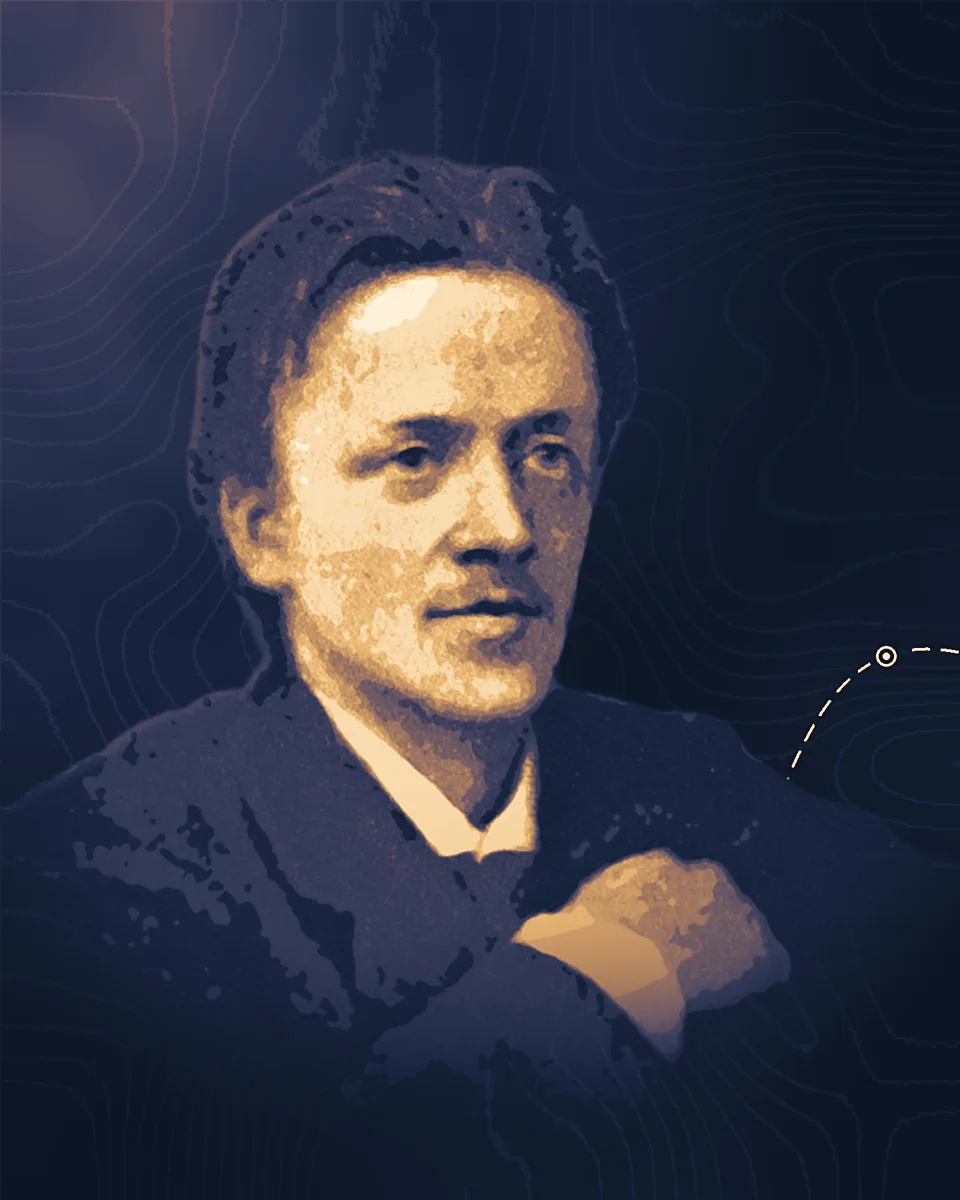
Sidney Gilchrist Thomas
A police-court clerk who worked out, with his cousin Percy Gilchrist, how to take phosphorus out of iron in the converter, so that the common phosphoric ores could be made into steel.
1850–1885
What they changed
1875
A lining that takes phosphorus
Bessemer's converter had a lining rich in silica, and it left phosphorus in the steel. Late in 1875 Thomas reached what the Dictionary of National Biography calls a provisional solution: a basic lining, such as lime or magnesian limestone, in place of the siliceous one. The phosphorus then leaves the metal for the slag, the molten waste that floats on it.
1878
Proved at Blaenavon
His cousin Percy Gilchrist, chemist at the Blaenavon ironworks in Wales, ran the trials there, with help from the works manager Edward Martin from early 1878. Thomas took out a first patent in November 1877. On 2 October 1878 Edward Windsor Richards, manager of Bolckow, Vaughan and Co's works in Cleveland, watched three casts at Blaenavon and wrote that he "saw sufficient to convince me that iron could be dephosphorized at high temperatures".
1879
Shown at full scale
Richards put up a pair of converters holding 30 hundredweight (about 1.5 tonnes) each at Middlesbrough. By his account the delay came from making basic bricks for the lining, because the magnesian limestone shrank so much. On 4 April 1879 the trials there succeeded, and Thomas and Gilchrist read their paper to the Iron and Steel Institute in London that May.
1880s
Steel from phosphoric ore
Output of steel by the basic process reached 864,700 tons in 1884 and 2,274,552 tons in 1889, by the Dictionary of National Biography's figures.
1880s
Slag sold as fertiliser
The slag from the basic process holds the phosphorus. It came to be called basic slag and proved, in the Dictionary of Welsh Biography's words, "a most useful soil fertiliser". The Dictionary of National Biography says most of it went onto the land.
Life
Sidney Gilchrist Thomas was born on 16 April 1850 at Canonbury, London. His father, William Thomas, was a Welshman in the solicitors' department of the Inland Revenue, and his mother was Melicent Gilchrist. He went to Dulwich College and left at seventeen, after his father died in 1867. After a few months teaching in a school in Essex he became a clerk at Marlborough Street police court, and in 1868 moved to the Thames court at Stepney in east London. He kept that post until May 1879.
He studied chemistry after office hours. At the Birkbeck Institution a teacher, Mr Chaloner, told a class that "The man who eliminates phosphorus by means of the Bessemer converter will make his fortune." Thomas worked on the problem from about 1870. The trials needed an ironworks. His cousin Percy Carlyle Gilchrist (1851–1935) had trained at the Royal School of Mines and from 1876 was chemist at Blaenavon, and the experiments were made there. The process carries both names, the Thomas-Gilchrist process, and the obituary of Gilchrist by the Institution of Mechanical Engineers calls him "one of the most notable pioneers in the manufacture of basic steel".
The trade did not listen at first. In March 1878 Thomas told a meeting of the Iron and Steel Institute that he had removed phosphorus in the converter, and the announcement, in the Dictionary of National Biography's words, "was disregarded". The cousins' paper for the Institute's Paris meeting that autumn was left unread. Richards later said that "so little importance was attached to it, and so little was it believed in, that the paper was scarcely noticed". It was Richards who took the process up and built the converters at Middlesbrough.
Thomas was not the first to think of a basic lining. George James Snelus took out an English patent in 1872 for lining a converter with lime and proved by experiment that it removed phosphorus, but by his obituary he "did not however follow up his discovery owing to want of time". William Jeans, writing in 1884, gave Snelus "the honor of having been the first to discover the principle of the basic process". In 1883 the Iron and Steel Institute gave its Bessemer gold medal to Snelus and Thomas together.
The process made Thomas rich and he did not live to use the money. His health failed. He spent the winter of 1883 to 1884 in Algiers and died of emphysema in Paris on 1 February 1885, aged 34. He was buried at Passy. He never married. He left his fortune in trust to his sister, mostly for philanthropic work, as what the Dictionary of National Biography calls a "sacred trust". After his death Gilchrist ran the company that held the patents, and he was elected a Fellow of the Royal Society in 1891.
Read more
5 accounts
Memoir and Letters of Sidney Gilchrist Thomas, Inventor, edited by R. W. Burnie, John Murray, 1891.
His letters to his mother and sister, with a memoir by a friend, published six years after his death.
archive.org
The Creators of the Age of Steel, William T. Jeans, 1884.
A chapter on Thomas written in his lifetime, with Richards's own account of the Blaenavon and Middlesbrough trials and a chapter on Snelus.
archive.org
Thomas, Sidney Gilchrist, R. W. Burnie, Dictionary of National Biography, 1898.
The national biography's entry, with dates of the patents and output figures.
en.wikisource.org
Thomas, Sidney Gilchrist, William Llewelyn Davies, Dictionary of Welsh Biography, 1959.
A short life that sets out his Welsh family and the work at Blaenavon.
biography.wales
Sidney Gilchrist Thomas, Materials Processing Institute, undated. A biography from the Teesside research body, the source the industry file uses.
mpiuk.com