Industries / Figureheads
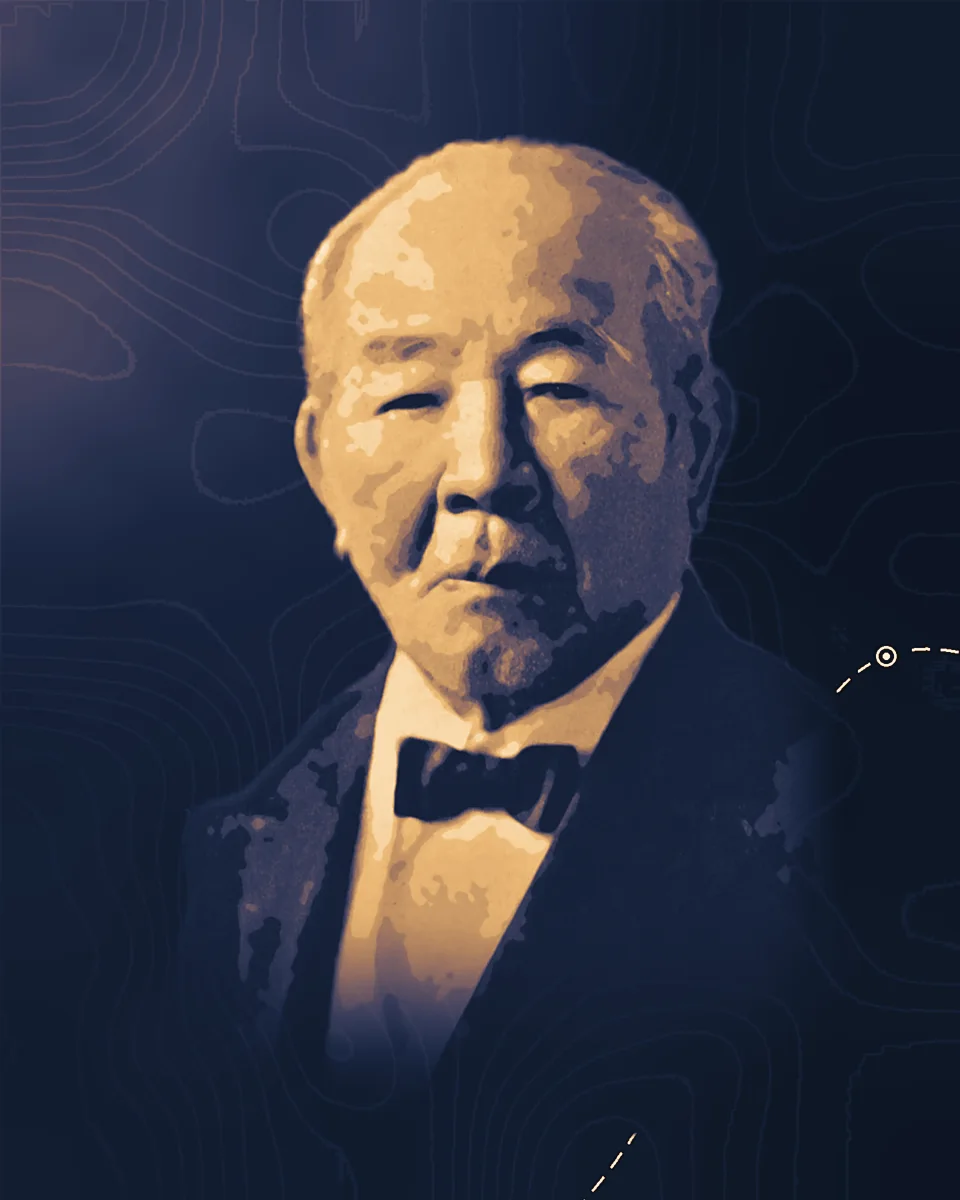
Shibusawa Eiichi
A Japanese finance official turned banker, he ran Japan's first bank from 1873 and used it and the joint-stock company to gather small savings into capital for hundreds of new firms.
1840–1931
What they changed
1867
1871
Pooling small capital
In the Ministry of Finance's Reform Office he pressed, in the National Diet Library's words, for "forming industrial capital by merging small capital", and promoted banks and joint-stock companies. In 1871 he published a guide to founding a company, and he rose to be a senior official of the ministry.
1873
Japan's first bank
He resigned from the ministry in 1873 and became superintendent of the Dai-Ichi Kokuritsu Ginko, the First National Bank, set up under the National Bank Ordinance of the year before, and its president in 1875. The Government of Japan's own magazine says he "established Japan's first bank in 1873". The bank became the Dai-Ichi Bank and is now part of Mizuho Bank.
1877
Banks organized together
In 1877 he founded the Takuzen-kai, the bankers' club that became the Tokyo Bankers' Association, and he chaired the Tokyo Clearing House when it opened in 1891, by his memorial foundation's chronology. The Government of Japan credits him with the Tokyo Stock Exchange, which opened in 1878 as Japan's first official exchange.
1870s
Bank money for industry
From the First National Bank he helped found Oji Paper, Osaka Spinning, Tokyo Gas, Tokio Marine Insurance and the Imperial Hotel, among nearly 500 companies by the Government of Japan's count. The National Diet Library notes that he "was not interested in the formation of conglomerates".
Life
Shibusawa Eiichi was born on 16 March 1840 in what is now Saitama Prefecture, the first son of a wealthy farmer. He learned Chinese studies from his cousin Odaka Atsutada. As a young man he joined the movement to expel foreigners and even planned an uprising, then fled to Kyoto and entered the service of the Hitotsubashi family. When its head, Yoshinobu, became shogun, Shibusawa became a retainer of the shogun and was sent to France.
The shogunate fell while he was abroad. In 1869 he joined the new government and worked on the plans for a modern state: telegraphs, railways, a postal system and prefectures in place of the feudal domains. He modelled his economic ideas on the France of the Second Empire, where industry was growing fast.
In business he argued for what he called the union of the Analects of Confucius and the abacus, the "harmony of morality and the economy". The Government of Japan's account describes his idea, gapponshugi, as raising capital through shares while pursuing the public interest and sharing profits with all stakeholders. He founded the Commercial Training School, now Hitotsubashi University, and supported higher education for women.
In Korea he is remembered differently. The Asia Pacific Foundation of Canada notes that he is known there for setting up the Dai-Ichi Bank in Korea and circulating its banknotes, which made it Korea's de facto central bank and "further eroded Korea's independence" before Japan annexed the peninsula in 1910. The Korean daily Asia Business Daily reports that the bank's notes of 1902 to 1904, forced on the Korean Empire, bore his portrait, and that he later headed Keijo Electric under colonial rule. When Japan chose him in 2019 for the new 10,000-yen note, issued from 2024, South Korean commentators objected.
He resigned the presidency of the Dai-Ichi Bank in 1916 and gave his later years to social welfare, education and private diplomacy, especially with the United States. His memorial foundation counts some 600 welfare, educational and international organizations he helped found. He was made a baron in 1900 and a viscount in 1920, and died on 11 November 1931.
Read more
5 accounts
SHIBUSAWA Eiichi, National Diet Library, undated. The library's short life, with sixteen portraits from his youth to his old age.
ndl.go.jp
Japan-French exchanges of business people, National Diet Library, undated. A digital exhibition that describes his Paris journey, his finance ministry work and the early books about him.
ndl.go.jp
Shibusawa Eiichi denki shiryō, Shibusawa Eiichi Memorial Foundation, digital edition, 2016.
The 68 volumes of his biographical materials, in Japanese, searchable in full.
eiichi.shibusawa.or.jp
Chronology of Shibusawa Eiichi, Shibusawa Eiichi Memorial Foundation, undated. A year-by-year list of his posts and the firms and bodies he founded.
shibusawa.or.jp
Lessons from SHIBUSAWA Eiichi, the Man Who Formed the Foundation of Japanese Capitalism, Government of Japan, 2022.
An account of his ideas, with comment from Christina Ahmadjian of Hitotsubashi University.
japan.go.jp