Industries / Figureheads
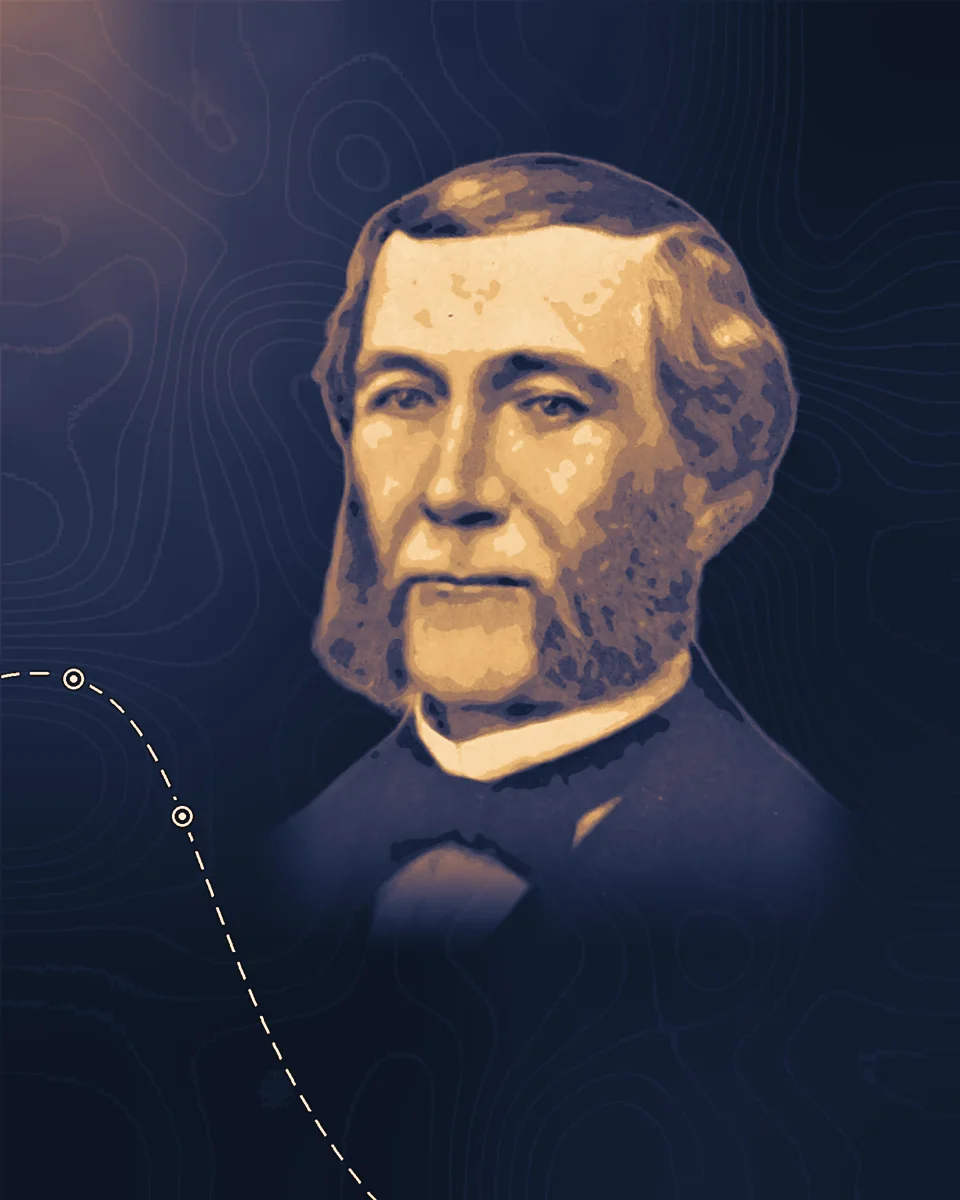
Samuel Van Syckel
He laid what historians of the oil region call the first successful oil pipeline, about five miles of two-inch iron pipe from the Pithole field to a railroad, and showed that pumping oil cost a fraction of hauling it by wagon.
1813–1894
What they changed
1865
Pipe beats the wagon
Van Syckel's line ran about five miles from the Pithole field to the Miller Farm railroad station, over about 400 feet of rise and fall. It used two-inch lap-welded wrought iron pipe in 15-foot joints and three Reed and Cogswell steam pumps, and began pumping on 10 October 1865 at 81 barrels an hour. He charged $1.00 a barrel; teamsters had charged about $4 or more for long hauls.
1865
Guards on the line
Teamsters, who hauled oil in barrels by wagon, tore the pipe apart at night with pickaxes, horses and chains. Van Syckel rebuilt it and hired the sheriff and armed guards, which ended the attacks, by the account of the historian Christopher Jones. Sue Beates of the Drake Well Museum estimates that about 500 teamsters lost their work within five weeks.
1865
A telegraph beside the pipe
A telegraph line was strung along the same right of way, the strip of land the pipe crossed, to pass shipment accounts and emergency messages between the ends. A second, nearly parallel line to Meridith, across Oil Creek from Miller Farm, began delivering oil on 8 December 1865.
1873
Refining without the light ends
Van Syckel patented an apparatus and process for treating petroleum, US patent 143,945, granted on 21 October 1873. It was meant to raise crude oil to a high fire test without first boiling off benzine, gasoline and other light liquids, or to separate those liquids at a chosen gravity.
Life
Samuel Van Syckel was born on 19 January 1813 in Little York, Hunterdon County, New Jersey, by the record of his grave. John J. McLaurin's history of the oil region, published two years after his death, calls him "a Jerseyite of inventive bent" who arrived at Titusville, Pennsylvania, in the autumn of 1864. He came as an oil buyer, a middleman between producers and refiners.
His line was not the first attempt. McLaurin records that J. L. Hutchings pumped crude through two-inch tubing from Tarr Farm to the Humboldt refinery in 1862, and laid a cast-iron line with lead joints from the Sherman well to Miller Farm in 1863, which lost three-fourths of its oil through the joints before teamsters tore it up. A five-inch cast-iron line laid by the Western Transportation Company in 1864 also leaked and was given up. Hutchings, McLaurin wrote, "died penniless and disappointed." OilHistory.com, Samuel T. Pees's history of the region, calls Van Syckel's line "the first successful one in the oil regions" for its distance, its climb, its pumps and its flow.
The work was shared. OilHistory.com credits William Snow with setting the pipe's specifications and the way it was laid. McLaurin names Mr. Wood and Henry Ohlen of New York as partners, the First National Bank of Titusville as lender, and J. N. Wheeler as the man who screwed the first joints together. NPR's account says Van Syckel raised $100,000 from a bank in the summer of 1865 and built the line in about five weeks. McLaurin dates the completion to August 1865, OilHistory.com dates the start of pumping to 10 October.
He did not keep it. His partners failed for reasons outside the business and the line carried about $15,000 of debt, so the bank ran it under an agreement to return it once the debt was paid. McLaurin writes that the failure of the Culver bank in May 1866 made the First National press its claim; the line passed to Jonathan Watson and was later bought by William H. Abbott and Henry Harley, who joined it to their own lines. Van Syckel then persuaded George S. and Milton Stewart to build a refinery at Titusville to test his idea of continuous distillation, which ended in failure, litigation and heavy loss.
He moved to Buffalo, New York, where he died on 2 March 1894. In 1904 Ida Tarbell printed his portrait with the caption "The first successful pipe line for gathering and transporting oil was completed by Mr. Van Syckel in 1865." In 1959 the American Petroleum Institute's annual pipeline conference gave a plaque to his memory, which stands at the Drake Well Museum in Titusville.
Read more
5 accounts
Sketches in Crude Oil, John J. McLaurin, 1896.
A history of the oil region written while many of its first oilmen were alive; the chapter "From the Well to the Lamp" tells the early pipelines one by one.
archive.org
The History of the Standard Oil Company, volume 2, Ida M. Tarbell, 1904.
Opens with the fight over the first seaboard pipeline and prints Van Syckel's portrait.
archive.org
Van Syckel, Samuel T. Pees, OilHistory.com, 2004.
The pipe, the pumps, the flow and the money, with a drawing of one of the pumps.
petroleumhistory.org
Even Pickaxes Couldn't Stop The Nation's First Oil Pipeline, Uri Berliner, NPR, 2015.
A radio report with the Drake Well Museum's curator and the historian Christopher Jones.
wfae.org
Benchmarks: October 9, 1865: First Successful U.S. Oil Pipeline, Nate Burgess, EARTH Magazine, 2015.
A short history of the line and the teamsters.
earthmagazine.org