Industries / Figureheads
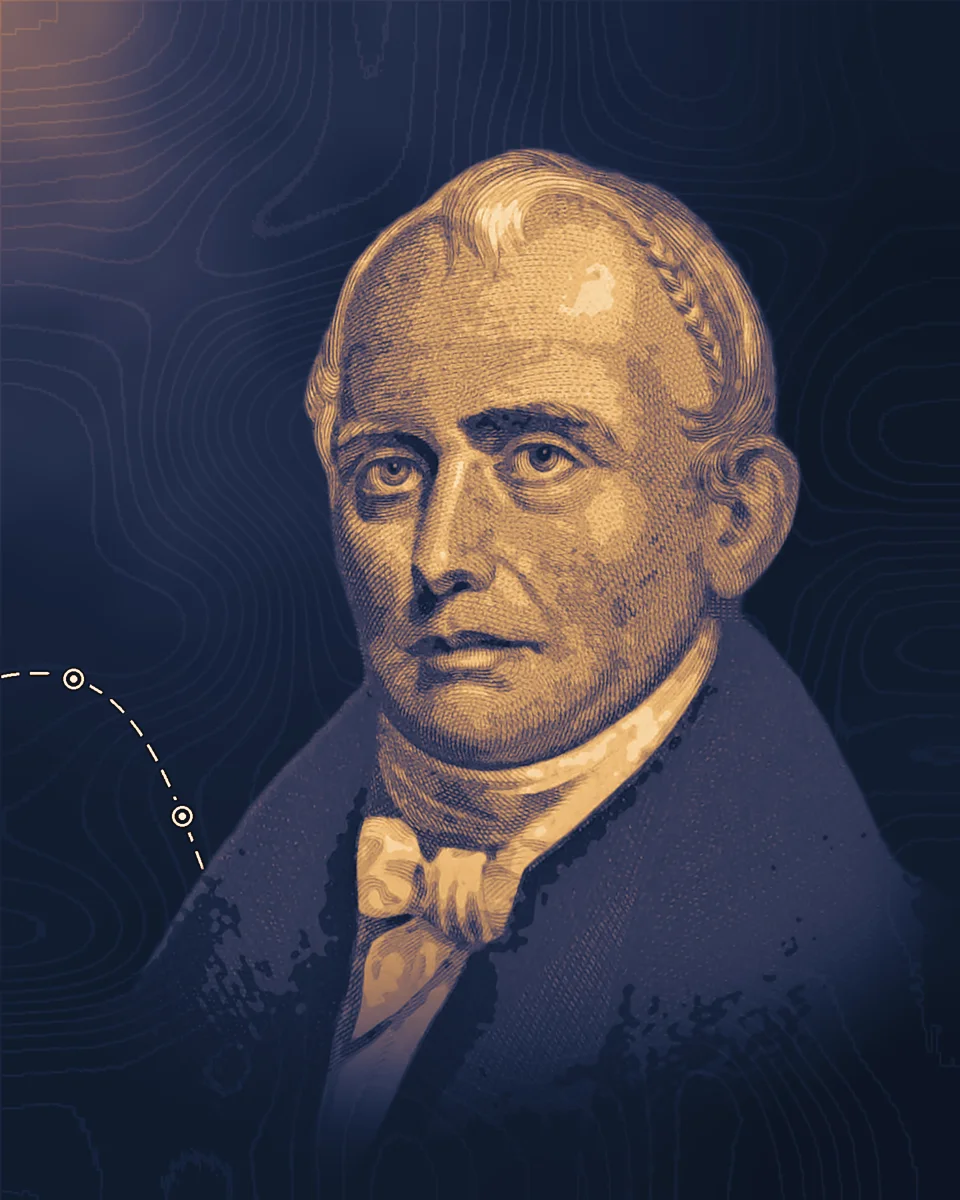
Samuel Slater
He carried the working knowledge of English water-powered cotton spinning to Rhode Island and built the first American mills on it, staffed by children and then by whole families.
1768–1835
What they changed
1789
Mill knowledge crosses the Atlantic
Slater had spent seven years in Jedediah Strutt's water-powered cotton mill at Belper, England, rising from apprentice to overseer of machinery and mill construction. At 21 he left for the United States disguised as a farmer, because, as the US National Park Service puts it, it was illegal for him to take that knowledge abroad.
1790
Water-spun thread in America
Moses Brown, of the Rhode Island firm Almy and Brown, hired him in December 1789 to make a failed set of spinning machines work. Slater judged them useless and built new ones with local mechanics, among them the Wilkinson family. In December 1790 they ran. "For the first time," the National Park Service says, "workers could produce thread on water powered machines in America."
1793
A purpose-built mill
The firm of Almy, Brown and Slater replaced its workshop with a new building at Pawtucket Falls, which the National Park Service calls the first water-powered textile mill in America. It worked as a textile mill until 1895 and still stands.
1800s
Families as the workforce
Slater's first hands were children, paid by the hour under his eye. As he added mills he hired whole families and housed them in villages around the mill, a way of staffing that came to be called the Rhode Island System. With his brother John he built Slatersville, which the National Park Service calls America's first planned industrial community.
Life
Samuel Slater was born on 9 June 1768 on a farm at Belper in Derbyshire, England, the fifth son of William and Elizabeth Slater. After school he went to work in the cotton mill of Jedediah Strutt, who taught him how the machines worked.
He landed in New York in 1789 and heard there of Moses Brown, whose family firm, Almy and Brown, had tried and failed to start a spinning mill at Pawtucket. What he brought was seven years of practice. The machines he built at Pawtucket were made on the spot, by American mechanics, to his direction.
The mills ran on children. The National Park Service's page on him says the first employees were children aged 7 to 12; its page on the mill says child workers aged 8 to 14 "earned steady wages" but lived under their employers' constant control. The family system that followed copied English practice and "used the entire family as working parts in the mill."
He went on to build mills and mill villages across southern New England. His first biographer, George S. White, gave his 1836 memoir the subtitle "the Father of American Manufactures," and the National Park Service calls him the "Father of the American Industrial Revolution." The invention was not his: he reproduced machines designed in England by others, and his own contribution was to make them work in a new country and to organize the labor around them. He died in April 1835.
Read more
4 accounts
Memoir of Samuel Slater, the Father of American Manufactures, George S. White, 1836.
The first biography, written the year after he died, with his letters and a history of cotton manufacture.
archive.org
Samuel Slater and the Origins of the American Textile Industry, 1790–1860, Barbara M.
Tucker, Cornell University Press, 1984. The standard modern study of his mills and their family labor.
archive.org
Samuel Slater, US National Park Service, Blackstone River Valley National Historical Park, read in 2026.
The park's short life.
nps.gov
Slater Mill, US National Park Service, Blackstone River Valley National Historical Park, read in 2026.
The mill, the machines of 1790 and the people who worked them.
nps.gov