Industries / Figureheads
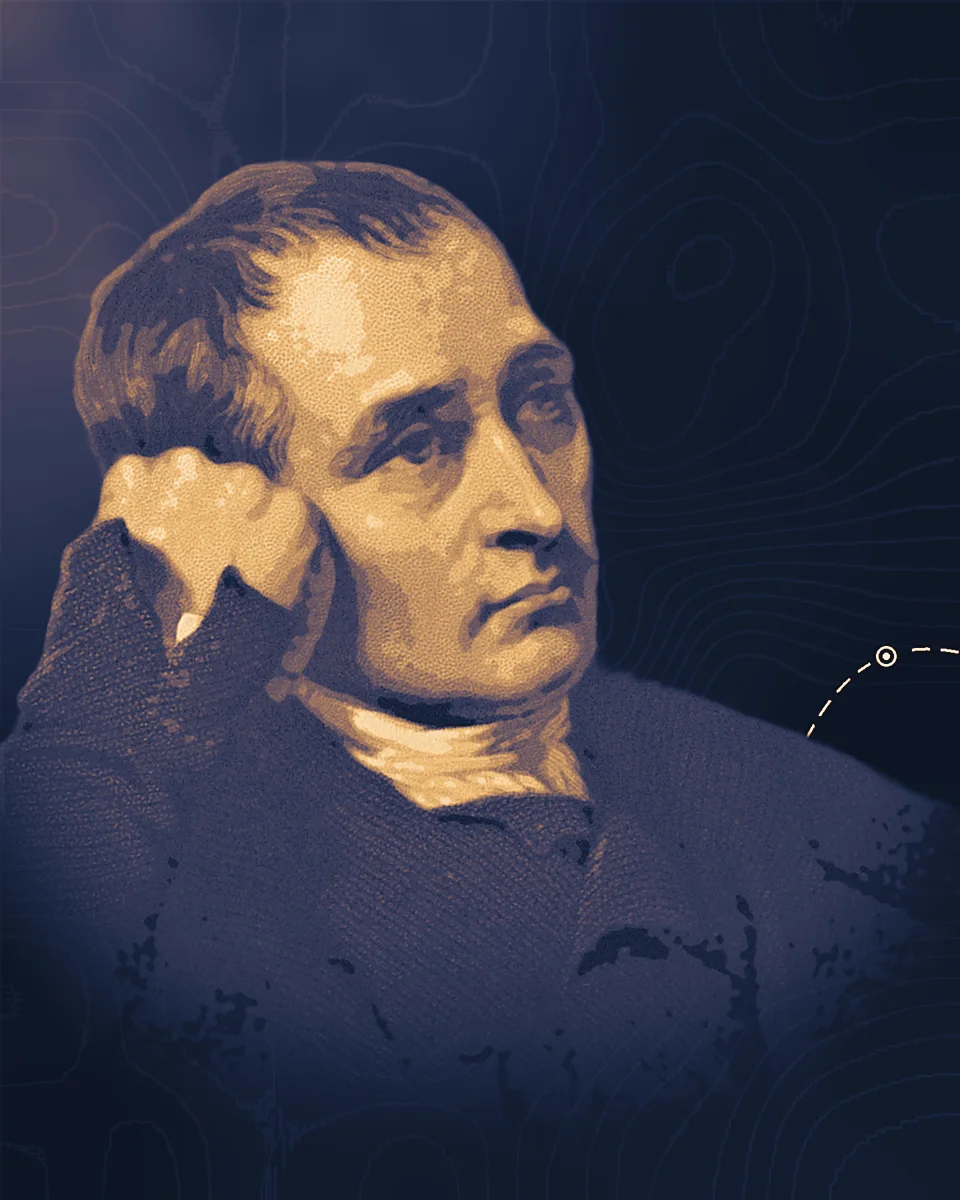
Samuel Crompton
He built the spinning mule, a machine that spun cotton yarn fine and even enough for muslin, and gave it to the trade without a patent.
1753–1827
What they changed
1779
Fine yarn from a machine
After five years of work at night, Crompton finished a spinning machine at Hall i' th' Wood, near Bolton. It joined the rollers of Arkwright's frame to the moving spindles of Hargreaves's jenny, and so was later called the mule. The part that was his own was a carriage that drew the spindles back as the rollers fed out the soft thread, so the thread was stretched without strain. The yarn was fine enough for muslin, a thin cloth then brought from India.
1780
Given up without a patent
He had no patent and, he wrote, no means to buy one. Pressed by people trying to see the machine, he showed it to the trade in return for a subscription from about eighty firms and manufacturers, who had signed a paper with no force in law. It brought him between £60 and £68. Anyone could then build a mule.
1811
A count of the spindles
To make a case for a reward he toured about 650 mills within 60 miles of Bolton and counted the spindles at work: 155,880 on the jenny, 310,516 on the water frame and 4,600,000 on the mule. The figures are his own.
1812
£5,000 from Parliament
A committee of the House of Commons reported in his favour and Parliament voted him £5,000. He had hoped for £50,000, and the costs of his tour and his stay in London came out of the grant.
Life
Samuel Crompton was born at Firwood, near Bolton in Lancashire, on 3 December 1753. His father farmed a little and spun and wove for the Bolton market, and died when Samuel was a small boy. The family lived as caretakers in part of an old house, Hall i' th' Wood. His mother sent him to a good day school and set him a daily task of spinning. From 1769 he spun on one of Hargreaves's jennies, whose thread kept breaking.
That fault set him to build a better machine for his own use. He worked on it from the age of 22 to 27, in secret and at night, and paid for tools by playing the fiddle at the Bolton theatre. The machine was working in 1779. He married in 1780, and he and his wife spun yarn finer than anyone else could sell.
He did not patent it. The Linda Hall Library says he would not risk a patent fight with Arkwright, who was rich and already held the patent on the water frame. He made the machine public and received the small subscription, then turned down an offer of work from Robert Peel of Bury, later the first Sir Robert Peel. He stayed a small spinner and weaver. The Dictionary of National Biography describes him as proud and soured, and records that in one fit of anger he broke up his machines.
Others grew rich on the mule. About 1800 to 1802 Manchester manufacturers, led by John Kennedy, who later wrote the first memoir of him, raised between £400 and £500 for him. After Parliament's grant he tried bleaching and cotton dealing and failed at both. In the 1820s friends in Bolton bought him an annuity of £63 a year. He died in Bolton on 26 June 1827; Bolton Libraries and Museums says his debts were greater than his goods, which were valued at £25.
The mule he built was worked by hand and knee. Later engineers made it work itself, and the Dictionary of National Biography, written in the 1880s, says Bolton's industry had been built largely on the mule "in its modern self-acting form." A bronze statue of him was given to the town in 1862.
Read more
5 accounts
The Life and Times of Samuel Crompton, Gilbert J. French, 1859.
The first full life, written from his papers by the Bolton man who raised his monument; admiring in tone.
archive.org
Lancashire Worthies, second series, Francis Espinasse, 1877.
Opens with a long chapter on Crompton set among the other Lancashire cotton inventors.
archive.org
The life of Samuel Crompton, Bolton Libraries and Museums. The account by the service that keeps Hall i' th' Wood and his papers, with the figures of his 1811 survey.
boltonlams.co.uk
Crompton, Samuel, Dictionary of National Biography, volume 13, 1888.
A short life by Francis Espinasse, with Crompton's own words on why he gave the machine up.
en.wikisource.org
History of the Cotton Manufacture in Great Britain, Edward Baines, 1835.
Prints John Kennedy's memoir of Crompton, with a drawing of the mule and this portrait.
archive.org