Industries / Figureheads
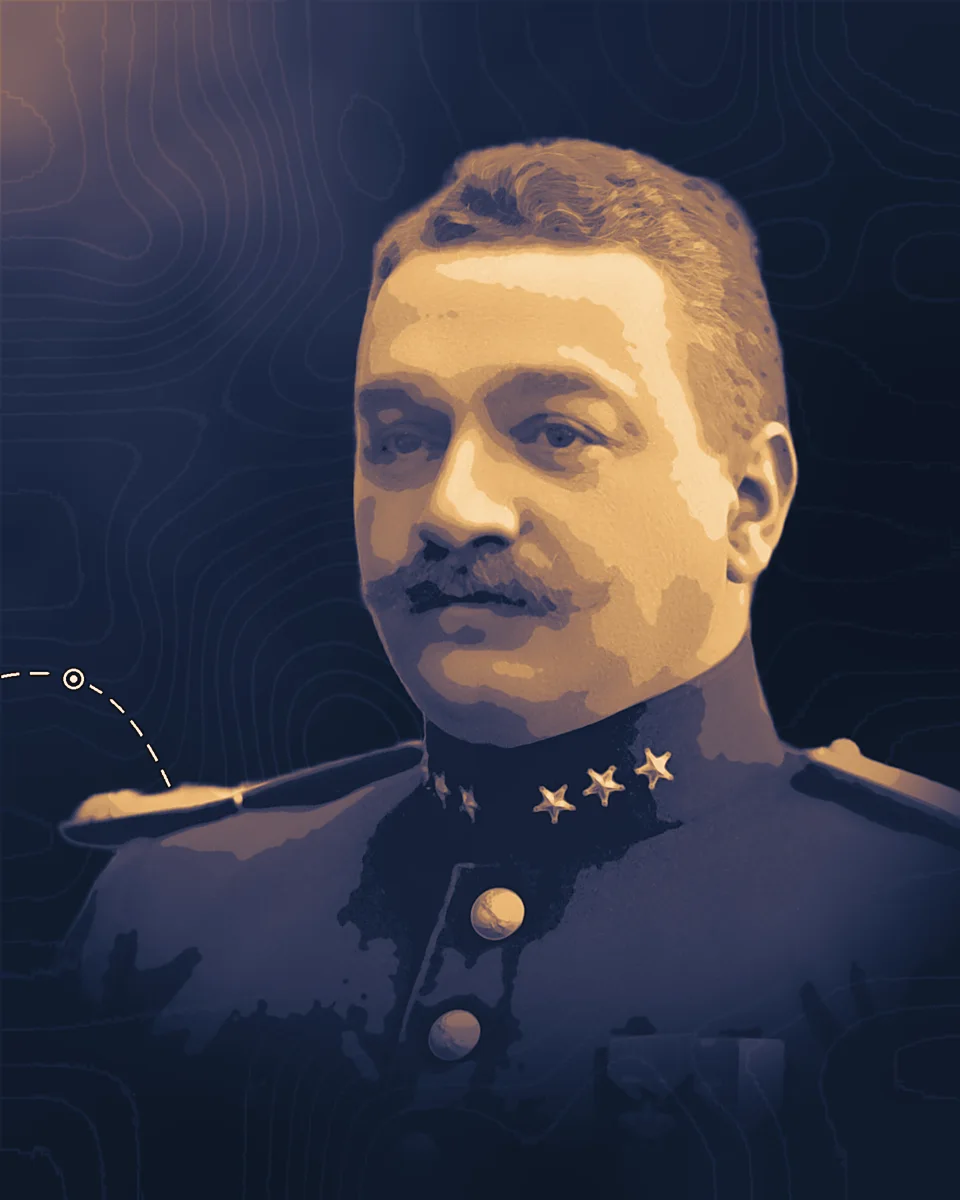
Sam Eyde
He raised the money, bought the waterfalls and built the company, Norsk Hydro, that made fertilizer from the nitrogen in the air at Notodden and Rjukan.
1866–1940
What they changed
1903
Waterfalls and an arc
Eyde, an engineer with his own office in Kristiania, bought the Vamma falls on the lower Glomma in 1902 and the Rjukan falls in 1903 with Norwegian and Swedish partners. At a dinner on 13 February 1903 he told the physicist Kristian Birkeland he wanted "the most powerful electrical discharge on earth". Within days the two had agreed to patent Birkeland's arc method of binding nitrogen from the air, and Eyde set about turning it into an industry.
1904
Money from Stockholm and Paris
Eyde founded Elektrokemisk, now Elkem, on 2 January 1904, with backing from the Wallenberg brothers' Enskilda Bank of Stockholm after BASF had judged the arc method "still too uncertain" for large sums. In 1905 the French bank Paribas sent a commission of 12 to inspect the work, and Eyde and the Wallenbergs came back from Paris with 2.5 million kroner. Hydro's history credits the Wallenbergs with winning the French money and Eyde with driving the project.
1905
Norsk Hydro
The papers founding Norsk Hydro were signed in Eyde's office on 2 December 1905, and he was made managing director for ten years. The share capital was 7.5 million kroner. Enskilda Bank held half the shares and Norwegians 8%, and Marcus Wallenberg chaired the board. Its plants at Notodden made nitric acid, calcium nitrate and nitrite, and the calcium nitrate was tested as a fertilizer in place of Chilean saltpeter.
1911
Rjukan built
In 1906 Eyde formed the Rjukan companies with the German firm BASF, and in 1911 the building of Rjukan passed to Hydro with Eyde in charge. UNESCO listed the power plants, factories, railways and company towns of Rjukan and Notodden as a World Heritage Site in 2015, as a complex built "to manufacture artificial fertilizer from nitrogen in the air" and "an example of new global industry in the early 20th century".
Life
Samuel Eyde was born in Arendal, in southern Norway, on 29 October 1866, the son of a shipowner. He went to the military academy in 1885 and left as a reserve officer, then trained as a civil engineer at the technical college in Charlottenburg, Berlin, and passed his final examination in 1891. He worked in Germany for some years on railway stations, canals and harbours, and opened his own engineering office in Kristiania in 1898.
Norsk Hydro was built on foreign money. Swedish and French capital founded it, and BASF of Germany was a partner in Rjukan until 1911. Norway's national encyclopedia says Eyde had little interest in modern administration and accounts and lacked diplomacy with the Germans, and that he drew sharp criticism in Hydro and the Rjukan companies. He was forced out as chairman of the Rjukan board in summer 1910, and out as Hydro's director general in autumn 1917.
The credit is disputed. The national encyclopedia says Birkeland did the development work and that how the honour should be shared between the two men "has been a disputed question". Hydro's own history calls Eyde "a vain man" who wanted full recognition, thought his part in turning the arc into an industry was underrated, and helped feed the quarrel. It calls his autobiography of 1939 "a statement of defense". The same history notes that some rank the banker Marcus Wallenberg as equal to Eyde, or above him, in founding the company.
During the First World War he led an industry committee and worked for a Norwegian explosives industry. In 1919 he was elected to the Storting for the Conservative Party and became Norway's minister in Warsaw. He took leave when he was drawn into the nickel affair, a scandal of the 1920s; he was cleared in law, but his name suffered, and he left the post for good in 1923.
Read more
4 accounts
Mitt liv og mitt livsverk, Sam Eyde, Gyldendal, 1939.
His memoirs, 535 pages, in Norwegian; the National Library's copy opens only in Norway.
nb.no
Sam Eyde, Ole Kristian Grimnes and Magne Brekke Rabben, Store norske leksikon, updated 2025.
A full biographical article by two historians, including the forced departures and the nickel affair. In Norwegian.
snl.no
1905: Three remarkable men, Norsk Hydro, undated. The company's portraits of Eyde, Birkeland and Marcus Wallenberg, and of the quarrel over credit.
hydro.com
Rjukan-Notodden Industrial Heritage Site, UNESCO World Heritage Centre, 2015.
The listing of the works his company built, with the case for their value.
whc.unesco.org