Industries / Figureheads
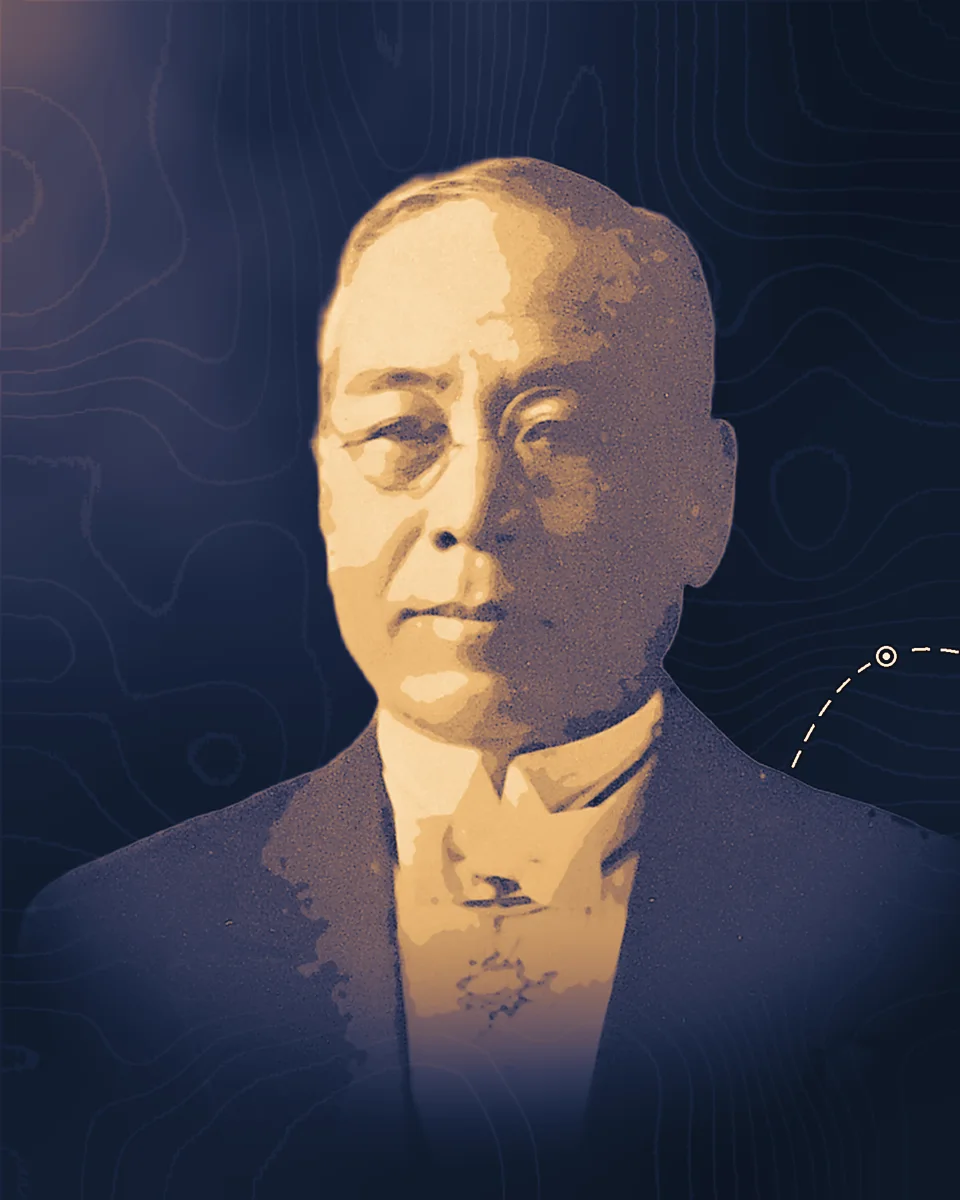
Sakichi Toyoda
He built looms that stop themselves when a thread breaks and change shuttles without stopping, so one weaver could tend many machines.
1867–1930
What they changed
1891
A hand loom patent
Toyoda, a carpenter's son, finished a wooden hand loom in the autumn of 1890 and received his first patent for it in 1891, aged 24. Japan's patent law was six years old. He had decided to become an inventor on hearing of it in 1885, by the account of the company he founded.
1896
A loom that stops itself
He completed a power loom, which the company he founded calls Japan's first power loom built of steel and wood, and fitted it with a device that stopped the loom when the weft thread broke. A stopped loom makes no faulty cloth, and a weaver who does not have to watch for breaks can mind more looms.
1903
A shuttle changed by machine
A shuttle carries the weft thread across the loom and must be replaced when its thread runs out. Toyoda built his first automatic shuttle-changing mechanism in 1903. A trial at the Kanegafuchi spinning company did not go well, and he spent twenty years more on the problem.
1924
The Type G loom
The Type G changed its shuttle at full speed and stopped at a broken thread. Japan's patent office calls its non-stop shuttle change "the first of its kind in the world." The Toyota museum in Nagoya counts 24 automatic, protective and safety devices on it, drawn from more than 50 of his earlier inventions. The first production loom was finished in November 1925.
1929
Britain buys the rights
Platt Brothers of Oldham, then a leading maker of textile machinery, agreed to buy the loom's patent rights for 100,000 pounds in four yearly payments. Sakichi's son Kiichiro signed in England on 21 December. In 1934 the unpaid balance was cut, and Platt paid 83,500 pounds in all, by Toyota's own history.
Life
Sakichi Toyoda was born on 19 March 1867 in the village of Yamaguchi, now part of Kosai in Shizuoka Prefecture. His father, Ikichi, farmed and worked as a carpenter, and the boy first worked beside him. In 1890 he went to see the machines at a national exposition in Ueno, Tokyo, and that autumn he finished his hand loom. A small weaving factory he opened in Tokyo in 1892 closed after about a year.
He paid for his work with other inventions and with other people's money, and he did not always keep control. A yarn-winding machine of 1894 funded the power loom. The trading house Mitsui set up a firm around the loom in 1899 with Toyoda as chief engineer, and in 1907 it backed Toyoda's Loom Works. He resigned from that company in 1910 over differences of policy and travelled to the United States and Europe. In 1913 he sold it his original patent for 80,000 yen.
Back in Nagoya he opened his own weaving mill in 1911 as a place to prove his looms in daily use, and added spinning in 1914. The mill became the company Toyoda Boshoku in 1918. He spent a year in Shanghai from 1919 and built a mill there. Toyoda Automatic Loom Works was founded in November 1926 to make the Type G, with his son-in-law Risaburo Toyoda as president and Kiichiro as managing director.
The Type G was not his work alone. Toyota Industries says Kiichiro and other staff worked with him on finishing it. Toyota's own history goes further: it describes the patents sold to Platt as those of the shuttle-change automatic loom "invented by Kiichiro." Japan's patent office and the Science Museum Group in Britain name the loom as Sakichi's.
A common story says the Platt money founded Toyota's car business. Japan's patent office and the Science Museum Group both tell it. The business historian Kazuo Wada argued in 2006 that the story is a fable. He wrote that the historical evidence does not support it "and in many ways contradicts it." What the car makers did take from the looms is a rule. Toyota traces jidoka, its practice of building machines and lines that stop at a fault, to Sakichi's loom.
econpapers.repec.orgcollection.sciencemuseumgroup.org.ukglobal.toyota
He died on 30 October 1930, aged 63.
Read more
5 accounts
The Story of Sakichi Toyoda, Toyota Industries Corporation. The founder's life year by year, as told by the company that still makes his looms.
toyota-industries.com
75 Years of Toyota, Part 1, Chapter 1, Toyota Motor Corporation, 2012.
The company history's chapters on the looms, the Type G and the Platt agreement, with footnotes to letters and records.
toyota-global.com
The Fable of the Birth of the Japanese Automobile Industry: A Reconsideration of the Toyoda-Platt Agreement of 1929, Kazuo Wada, Business History, 2006.
A historian's test of the story that loom money paid for the first cars.
econpapers.repec.org
Toyoda Sakichi den, Toyoda Sakichi-o Seiden Hensanjo, Nagoya, 1933.
The authorised biography in Japanese, published three years after his death and free to read at the National Diet Library.
dl.ndl.go.jp
Toyoda Automatic Loom, Science Museum Group. The record of a Type G loom kept in Britain.
collection.sciencemuseumgroup.org.uk