Industries / Figureheads
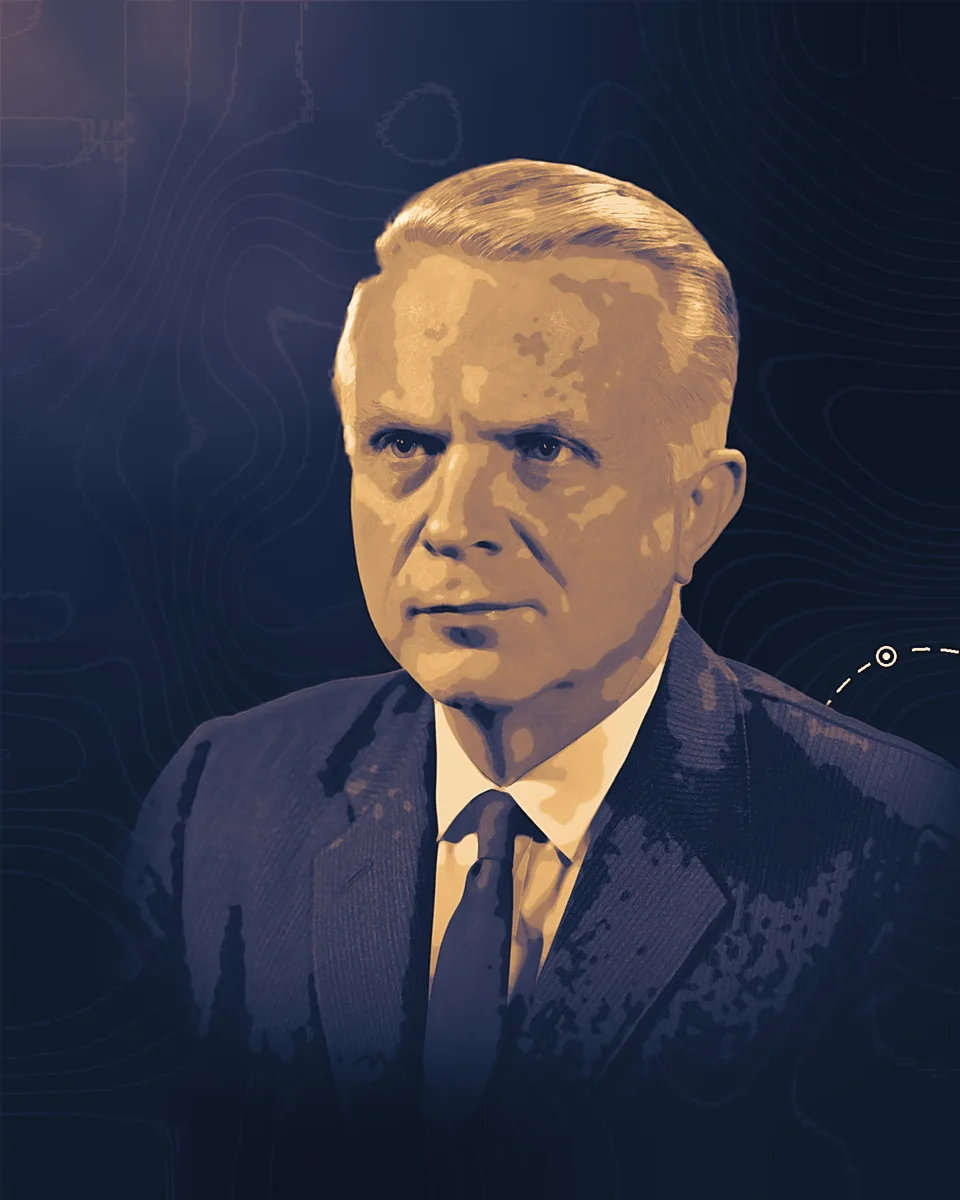
Richard T. Whitcomb
Working in one wind tunnel, he found three shapes that cut the drag of fast aircraft: the area rule, the supercritical wing and the winglet.
1921–2009
What they changed
1952
The area rule
Near the speed of sound an aircraft's drag rises steeply. In 1951, after a talk by the aerodynamicist Adolf Busemann, Whitcomb saw that this drag depends on how the cross-section of the whole aircraft, wings included, changes from nose to tail. Narrowing the body where the wings join, a "wasp waist", keeps that change smooth. A confidential research report followed in September 1952. The Convair F-102 fighter prototype had stuck at Mach 0.98; rebuilt to the rule, it passed the speed of sound in 1954 and gained about 25 percent in speed. Whitcomb received the Collier Trophy for 1954.
1969
The supercritical wing
In 1969 Whitcomb designed a new wing and airfoil shape that delays the rise in drag for aircraft cruising just below the speed of sound. Flight tests on a modified F-8 began in 1971 and showed 15 percent better performance at those speeds. NASA says wings based on his principles are used in almost every commercial airliner flying.
1979
Winglets
Whitcomb studied the airflow at the wing tips of soaring birds and designed small upturned fins for the tips of wings, which he called winglets. Tests in 1979 on a Boeing KC-135 lent to NASA increased its range by seven percent. Learjet fitted them to a business jet the same year, and Boeing and McDonnell Douglas later put them on the 747-400 and the MD-11.
Life
Richard T. Whitcomb was born in Evanston, Illinois, on 21 February 1921 and grew up in Worcester, Massachusetts, building rubber-powered model airplanes. He studied mechanical engineering at Worcester Polytechnic Institute, spent much of his time in its wind tunnel, and graduated in 1943.
That year he joined the Langley laboratory of the National Advisory Committee for Aeronautics, the forerunner of NASA, in Hampton, Virginia. The staff office assigned him to instruments; he insisted on aerodynamics and was sent to the 8-foot high-speed wind tunnel, where he worked for the rest of his career. He never married. He often worked double shifts and slept on a cot beside the tunnel.
He worked by picturing the air. "I'd just sit there and think about what the air was doing", he said. When he first presented the area rule to colleagues as a rule of thumb, Busemann remarked that Whitcomb "comes up with a brilliant idea and calls it a rule of thumb." The historian Richard Hallion notes that Whitcomb was not the first to try plates on wing tips, and credits him with understanding them better than those before him.
In the 1960s he designed a supersonic airliner for the US government's program, then withdrew from it, convinced that such an airplane could not pay its way. He went back to the drag of ordinary jet airliners, and the supercritical wing and the winglet followed.
President Nixon gave him the National Medal of Science in 1973. He was elected to the National Academy of Engineering in 1976 and retired from NASA in 1980. He died in Newport News, Virginia, on 13 October 2009, aged 88.
Read more
3 accounts
Richard Whitcomb's Triple Play, Richard P. Hallion, Air and Space Forces Magazine, 2010.
A former US Air Force historian on the three inventions and how each reached aircraft.
airandspaceforces.com
Richard T. Whitcomb 1921–2009, Richard H.
Petersen, National Academy of Engineering Memorial Tributes volume 15, 2011. The Academy's memoir, with his habits of work.
nationalacademies.org
Richard T. Whitcomb, NASA Langley Research Center Hall of Honor, read in 2026.
The laboratory's account of his career and the history of his wind tunnel.
nasa.gov