Industries / Figureheads
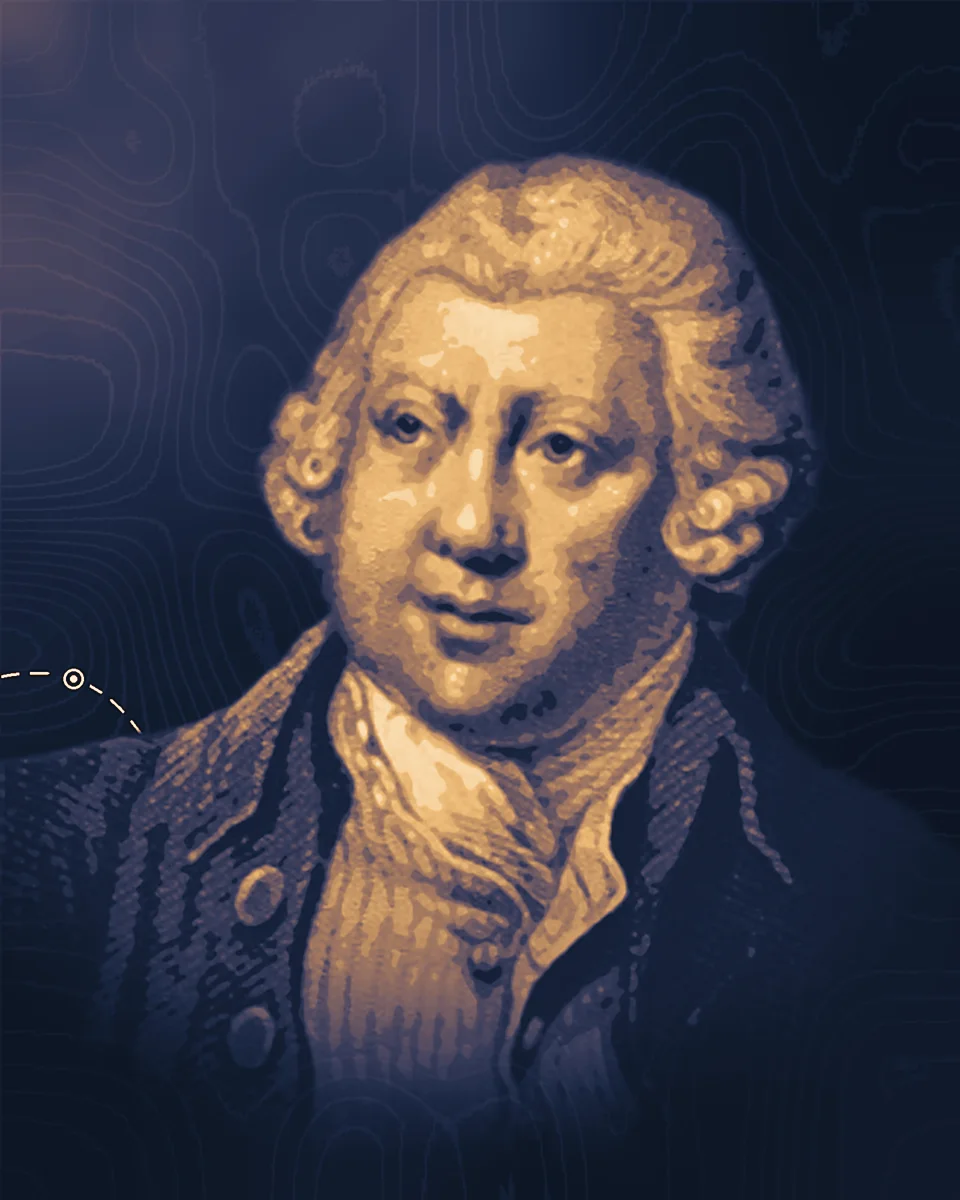
Richard Arkwright
He put roller spinning, carding and water power under one roof at Cromford, and the mill he organized there became the pattern for the factory.
1732–1792
What they changed
1769
Spinning by rollers patented
Arkwright took out a patent on 3 July 1769 for a spinning frame. Pairs of rollers, each pair turning faster than the one before, drew the cotton out thin, and spindles then twisted it into a hard yarn strong enough for warp, the lengthwise threads of a cloth. The clockmaker John Kay of Warrington built the first models for him in 1767.
1771
A mill driven by water
With two partners who held patents for making ribbed stockings, a Mr. Need of Nottingham and Jedediah Strutt of Derby, he built a water-powered spinning mill at Cromford in Derbyshire in 1771, and a second, larger one in 1776–77. UNESCO says "the modern factory owes its origins to the mills at Cromford."
whc.unesco.orgen.wikisource.orgcollection.sciencemuseumgroup.org.uk
1774
English cloth all of cotton
From 1773 his firm used its yarn as warp, where weavers had used linen, and so made calico wholly of cotton. Such cloth paid a double duty under a 1736 law meant to keep out Indian calicoes. In 1774 he obtained an act of Parliament that freed it from the extra duty.
1775
Cotton to yarn by machine
His second patent, of 1775, covered machines for carding (combing the fibers straight), drawing, roving (making a loose rope of fiber ready for spinning) and spinning, set to work one after another. He sold licences to spinners across the north and midlands of England.
1785
The patents are cancelled
Rival spinners brought his patent before the Court of King's Bench on 25 June 1785. The jury found against him and the patent was cancelled that November. By then, the Dictionary of National Biography says, about 30,000 people worked in mills set up without his licence. Spinning by his methods was open to all.
Life
Richard Arkwright was born in Preston, Lancashire, on 23 December 1732, by repute the youngest of thirteen children of a poor family. He was apprenticed to a barber and had little schooling. By about 1750 he had settled in Bolton, where he cut hair, made wigs and travelled the country buying hair, which he dyed by a method of his own and sold to wigmakers.
In 1767 he hired John Kay, a Warrington clockmaker, to make parts for a machine that would spin cotton with rollers. They built it in secret in a house in Preston in 1768, then moved to Nottingham, where Arkwright found partners and money. The first mill there was turned by horses. Cromford, begun in 1771, was turned by water, which is why the machine came to be called the water frame.
Whether the machine was his is disputed, and a court found that it was not. At the 1785 trial Thomas Highs, a reed-maker from Leigh, swore that he had devised the rollers and that Kay, who had made models for him, carried the idea to Arkwright. Kay said the same. Lewis Paul had patented a way of spinning with rollers in 1738. The judge put three questions to the jury: was the invention new, was it Arkwright's, and was it described well enough for others to build. He summed up against Arkwright on each, and it was shown that Arkwright had ordered the patent's description to be made obscure. The Dictionary of National Biography, writing a century later, doubted Highs's evidence and judged the whole chain of machines to be in substance Arkwright's. The Science and Industry Museum in Manchester puts it more plainly: he was accused of copying Highs, and the court cancelled his patents.
What nobody disputes is the mill. The Dictionary of National Biography dates the factory system from his mills, where many people worked set hours at divided tasks to the pace of the machines. That system had a cost. The Science and Industry Museum says that in the earliest days his mills ran around the clock on two 13-hour shifts, that almost 1,000 men, women and children worked in them by 1800, in heat, dust and noise, and that no effective law governed mill work until well into the next century. It also says the water frame relied on raw cotton grown by enslaved people.
en.wikisource.orgscienceandindustrymuseum.org.ukcollection.sciencemuseumgroup.org.uk
The machines were resisted too. In 1779 rioters in Lancashire sacked a mill he had built at Chorley. Losing the patents did not stop him: for some years other spinners followed the prices he set for yarn. He was knighted in 1786 and was high sheriff of Derbyshire the next year. He died on 3 August 1792, while building a house for himself, Willersley Castle.
Read more
6 accounts
The Arkwrights: Spinners of Fortune, R. S. Fitton, Manchester University Press, 1989.
The full modern biography of Arkwright and his son, written from the family and business papers.
archive.org
The Trial of a Cause Instituted by Richard Pepper Arden, Esq., His Majesty's Attorney General, to Repeal a Patent Granted to Mr. Richard Arkwright, 1785.
The printed record of the trial, with the evidence of Highs and Kay.
archive.org
History of the Cotton Manufacture in Great Britain, Edward Baines, 1835.
The first full history of the trade, with drawings of the machines and the portrait used here.
archive.org
Arkwright, Sir Richard, Dictionary of National Biography, volume 2, 1885.
A long life that weighs the trial evidence point by point.
en.wikisource.org
Richard Arkwright: Father of the Factory System, Science and Industry Museum, 2019.
A museum account built around the surviving machines, with the conditions of mill work.
scienceandindustrymuseum.org.uk
Derwent Valley Mills, UNESCO World Heritage Centre, inscribed 2001.
Why the Cromford mills are listed, and what survives of them.
whc.unesco.org