Industries / Figureheads
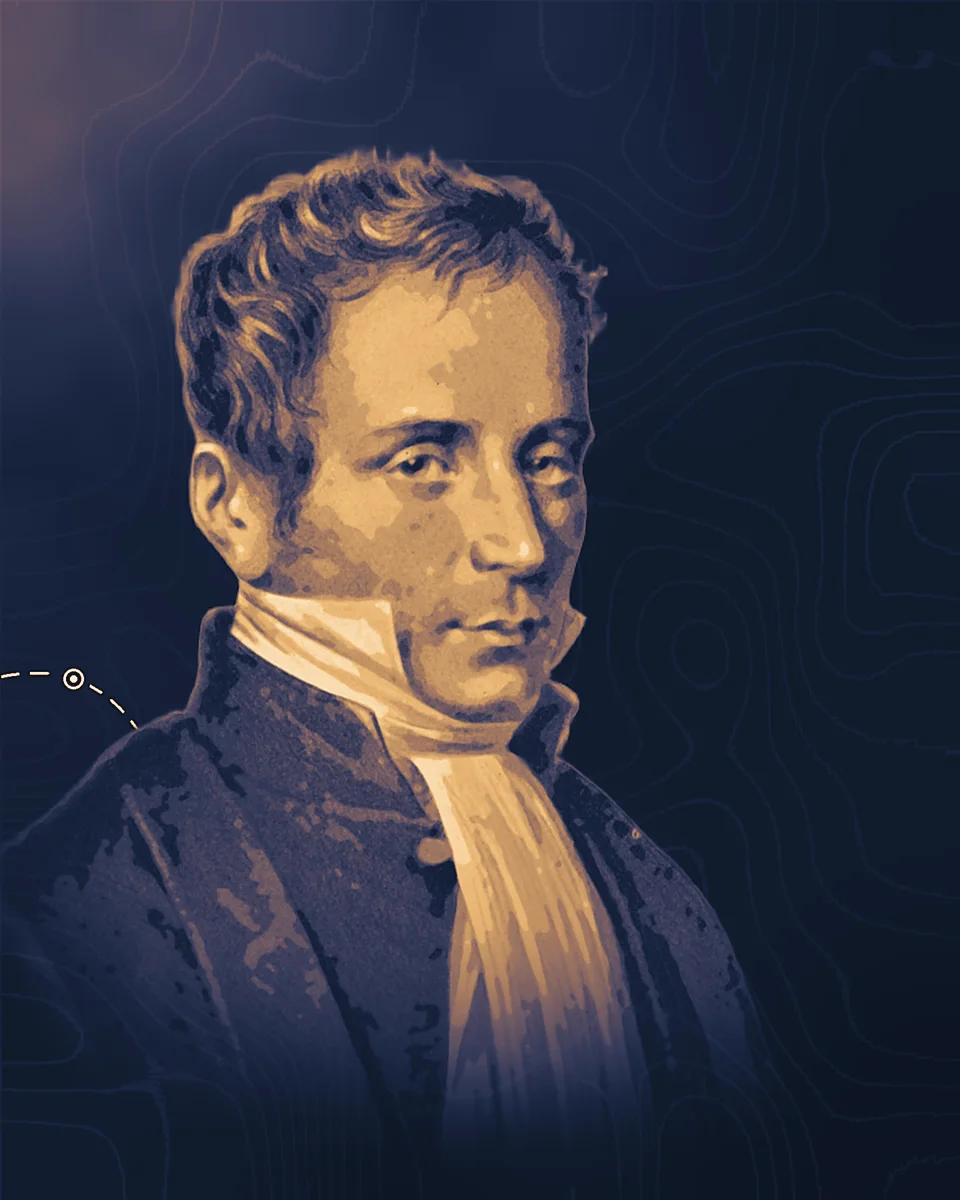
René Laennec
He invented the stethoscope at a Paris hospital in 1816 and taught doctors to read diseases of the chest from the sounds it carried.
1781–1826
What they changed
1816
A rolled paper tube
At the Necker Hospital in Paris, Laennec was examining a young woman with signs of heart disease. Tapping and feeling her chest told him little, and her age and sex ruled out putting his ear to it. He rolled a quire of paper into a cylinder, set one end over her heart and the other to his ear, and heard the heart "much more clear and distinct" than by ear alone. By his own account he began at once a series of observations at the hospital.
1819
A wooden tube
Laennec tried tubes of several materials over about three years and settled on hollow wood, 3.5 cm across and 25 cm long, made in parts that unscrewed for carrying, with a plug fitted when listening to the heart. The cardiologist Ariel Roguin calls it the first true stethoscope. Wooden ones stayed in use until rubber tubing came in, in the second half of the 19th century.
1819
A book of chest sounds
He published De l'auscultation médiate (On mediate auscultation, meaning listening through an instrument) in two volumes in Paris in 1819. It set the sounds he heard in living patients beside what he found in the same patients after death, and used them to tell apart pneumonia, bronchiectasis, pleurisy, emphysema, pneumothorax and tuberculosis. Alex Sakula, writing in Thorax for the bicentenary of his birth, regards it as the book from which modern chest medicine grew.
1821
The method reaches London
John Forbes's English translation was published in London in 1821, and physicians from across Europe came to Paris to learn the method first-hand.
1826
A revised second edition
In his last years he rewrote the book, matching each sound more closely to the disease found at autopsy, and the revised edition came out in 1826, the year he died.
Life
René-Théophile-Hyacinthe Laennec was born in Quimper, Brittany, on 17 February 1781. His mother died of tuberculosis when he was five. At twelve he went to Nantes, where his uncle Guillaume Laennec was dean of the medical faculty, and from the age of 14 he helped care for the sick and wounded at the city's Hôtel-Dieu hospital.
In 1800 he went to Paris to study medicine, and he qualified in 1804. His teachers included Jean-Nicolas Corvisart and Gaspard-Laurent Bayle, who turned him toward diseases of the chest. Corvisart had revived percussion, the tapping of the chest that the Viennese physician Leopold Auenbrugger had described decades earlier, and published a French translation of Auenbrugger's book in 1808. His teaching joined the examination at the bedside to the evidence of the autopsy, and Laennec followed it.
Listening at the chest was not new. Physicians since Hippocrates had pressed an ear to the patient, which was awkward, often useless through fat, and immodest with women patients. Laennec's change was the instrument and the record kept with it. Others then made the stethoscope doctors carry today: binaural tubes for both ears in the 1840s and 1850s, a rigid diaphragm in 1894, and the combined bell and diaphragm of Bowles and Sprague in 1925. Laennec also quarrelled with the surgeon Guillaume Dupuytren, who said Laennec's early paper on melanoma, a skin cancer, gave him too little credit.
He became a physician at the Necker Hospital in 1816, professor of medicine at the Collège de France in 1822, and professor at the Charité hospital in 1823, where as many as 50 doctors at a time waited for his rounds. He married in 1824. Jacalyn Duffin's biography, built on his patient records and lecture notes, finds that in his Collège de France lectures he criticised doctors who leaned on his method at the expense of the patient's own story.
He had tuberculosis himself, and in May 1826 his illness forced him to leave Paris for Brittany. He asked his nephew Mériadec to listen to his chest and describe what he heard, and left him his papers and "above all, my stethoscope, which is the best part of my legacy." He died at his house near Quimper on 13 August 1826, aged 45.
Read more
5 accounts
De l'auscultation médiate, R. T. H. Laennec, 1819.
The first edition of his book, in two volumes, scanned from a copy at Oxford.
archive.org
A Treatise on the Diseases of the Chest, R. T. H. Laennec, translated by John Forbes, 1821.
The first English translation, with his own account of the paper tube, in a 1979 facsimile.
archive.org
To See with a Better Eye: A Life of R. T. H. Laennec, Jacalyn Duffin, Princeton University Press, 1998.
The full biography, drawn from thousands of pages of his patient records, lecture notes and letters.
muse.jhu.edu
R T H Laënnec 1781–1826 his life and work: a bicentenary appreciation, Alex Sakula, Thorax, 1981.
A physician's account of his life and of the book.
pmc.ncbi.nlm.nih.gov
Rene Theophile Hyacinthe Laënnec (1781–1826): The Man Behind the Stethoscope, Ariel Roguin, Clinical Medicine & Research, 2006.
A short life, with a table of how the stethoscope changed after him.
pmc.ncbi.nlm.nih.gov