Industries / Figureheads
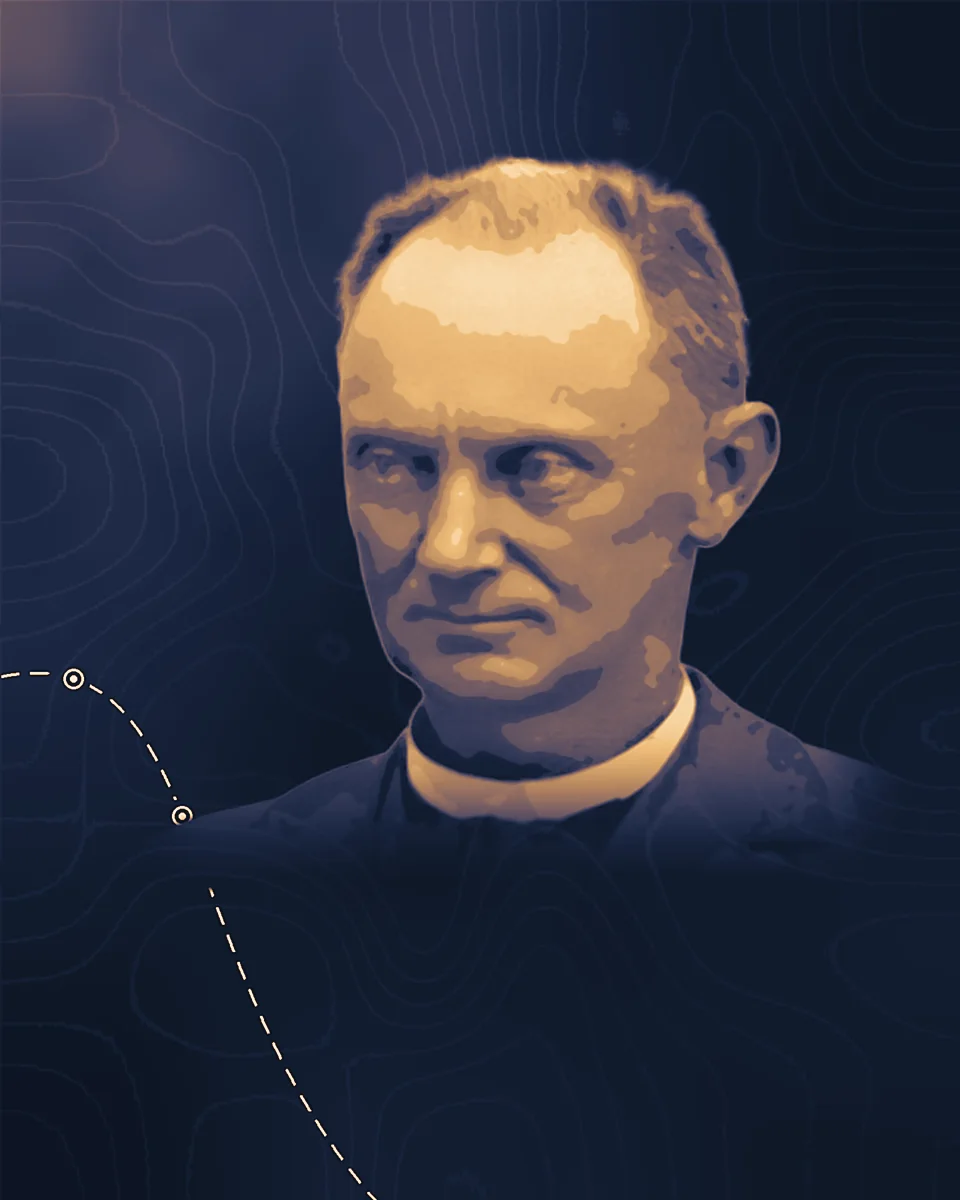
Poul la Cour
He made wind a source of electricity for the Danish countryside: he tested blade shapes in a wind tunnel, worked on how to store the power, and trained the electricians who built village power stations.
1846–1908
What they changed
1891
A test mill at Askov
La Cour asked the finance committee of the Danish parliament for money to build an experimental windmill at Askov, where he taught, and it was running in 1891. Its sails drove a dynamo. The Carlsberg Foundation calls him the first Dane to build a wind turbine that made electricity.
1890s
Wind stored as hydrogen
The wind does not always blow, so he passed the mill's current through water, split it into hydrogen and oxygen, and stored the gases in tanks. On windy days the plant made up to 1,000 liters of hydrogen an hour, which lit the school. After an explosion that blew out windows he turned to batteries, and concluded that a small battery holding a day's supply was the realistic answer.
1890s
Blades in a wind tunnel
He tried model blades in small wind tunnels and published the results in a book, The Test Turbine. He found that a mill for electricity should have few blades, turn fast, and have blades shaped like an aircraft wing. His museum says his "ideal" mill made three times the electricity of a farm windmill of the same blade length.
1897
A mill for a village
He was given money for a larger mill in 1897. After some years it was put to work at Askov's electricity plant, with an engine as backup for calm days. His museum says it made electricity for thirty years; it burnt down in 1929.
1903
Wind electricians
On 28 October 1903 he founded a society for wind electricity, with its office in the test mill. It advised villages building power stations and ran three-month courses for rural electricians, the first in May and June 1904. The Danish national encyclopedia says the society was central to the early electrification of the Danish countryside.
Life
Poul la Cour was born on 13 April 1846. He trained as a physicist and in 1872 became deputy head of the new Danish Meteorological Institute in Copenhagen. Weather reports had to travel fast by telegraph, and a line could then carry one message at a time. La Cour worked out a way for several operators to share a wire, each sending at a tone of his own, and won the gold medal of the Danish scientific society for it in 1874. In 1878 he added the phonic wheel, a motor that by his museum's account let up to 100 telegrams share one wire. He sought an American patent and lost to the American inventor Elisha Gray.
In 1878 he left to teach mathematics and science at the folk high school at Askov, in the Danish countryside. The move was a matter of conviction, by the national encyclopedia's account. He taught science through its history, which did not please everyone in a movement that held those subjects in suspicion.
The wind work had a social purpose. Industry was drawing people to the towns, and he wanted electricity to make life on the land easier: power for threshing, and light to read and work by in winter. He looked for small plants that a village or a farm could own. He was not the first to make electricity from wind. James Blyth in Scotland did so in 1887.
Not all of it worked as he hoped. He tried to make a business of selling hydrogen and oxygen and failed. After his death cheaper electricity and alternating current let the big town stations reach the countryside, and the windmill on every farm lost its appeal, though wind came back during the shortages of the First World War.
He was given the title of professor in 1894, and in 1907 became the first chairman of the government commission on electricity. He died on 24 April 1908.
Read more
4 accounts
Poul la Cour, Birgitte Wistoft and Thyge Winther-Jensen, Lex, Danmarks Nationalleksikon, 2024.
The Danish national encyclopedia's signed life, in Danish, covering the telegraph, the school and the mill.
lex.dk
The inventor who turned a folk high school into a laboratory, Carlsberg Foundation, 2026.
A chapter from the foundation's anniversary book, on the man it gave its first grant to in 1876.
carlsbergfondet.dk
Storing wind power, Poul la Cour Museum, Askov, undated. The museum in his test mill describes the hydrogen plant and the batteries.
poullacour.dk
The first wind tunnel, Poul la Cour Museum, Askov, undated. What the blade experiments found.
poullacour.dk