Industries / Figureheads
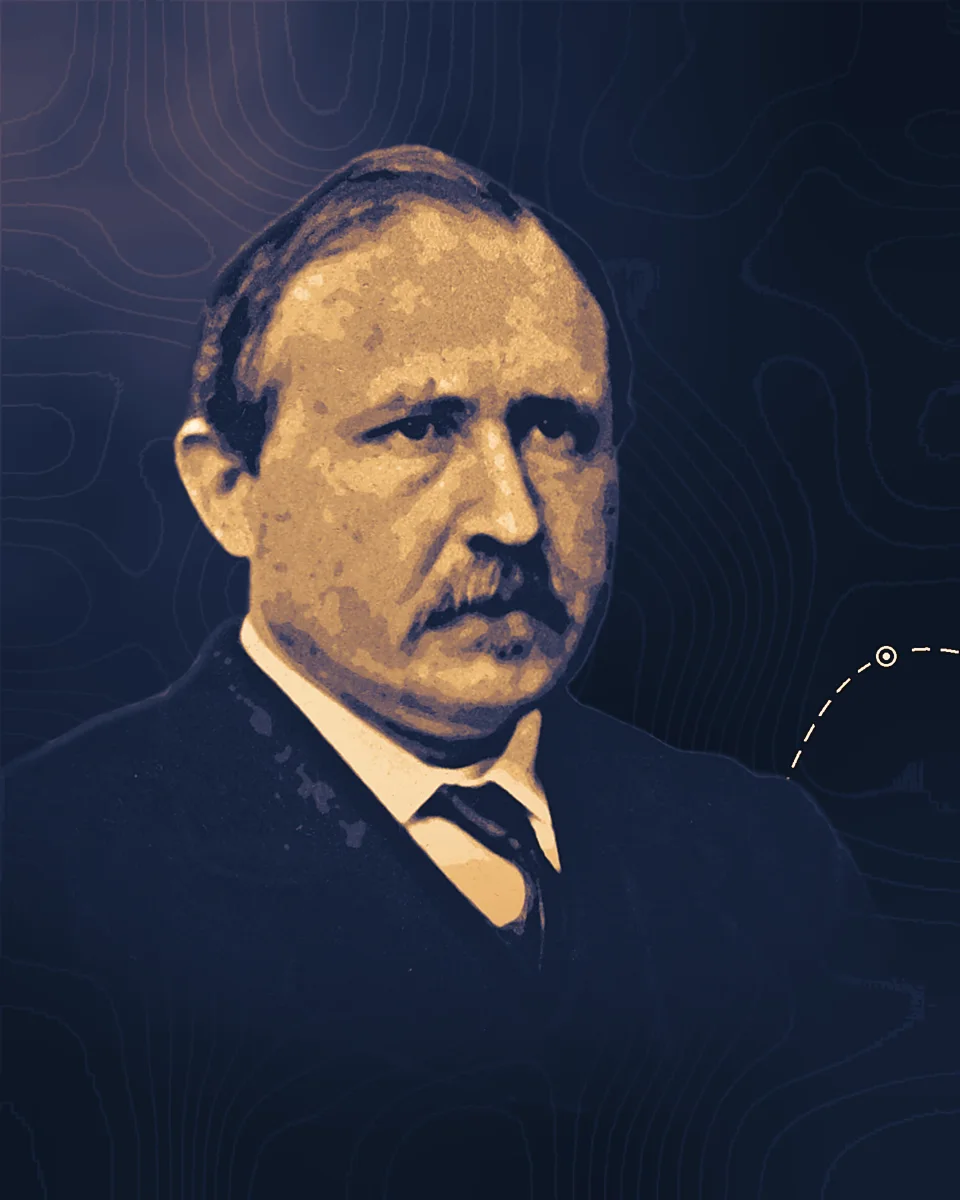
Peter Griess
He discovered the diazo reaction, the chemical step behind the azo dyes, which today are the most used class of dyes.
1829–1888
What they changed
1858
The diazo reaction
Working at Marburg in Germany under the chemist Hermann Kolbe, Griess treated aromatic amines, a family of chemicals obtained from coal tar, with nitrous acid and got a new kind of highly reactive compound. He named them diazo compounds. The step, called diazotization, is still the first step in making an azo dye.
1864
Coupling makes a dye
The Dictionary of Scientific Biography says that in 1864, by joining a diazo compound made from aniline to naphthylamine, Griess opened "the general way to a new class of coloring substances". The first azo dyes sold came from others in those same years: aniline yellow from Carl Alexander Martius and Manchester brown from Heinrich Caro.
1876
Dyes for BASF
While employed full time by a brewery, Griess held a contract with the German dye maker BASF from 1876 and offered it his new dyes first. A US patent he filed on 12 February 1879 for a crimson dye was assigned to BASF. In 1883 BASF offered him a post, which he turned down.
1884
Cotton dyed directly
In 1884 Griess, alongside Paul Böttiger, found azo dyes that colored cotton without a mordant, the metal salt until then needed to fix most dyes to the fiber. It was Böttiger who patented Congo red, the dye that opened the way to dyeing cotton directly.
Life
Johann Peter Griess was born on 6 September 1829 at Kirchhosbach, a village in the German state of Hesse-Cassel, into a family that owned its land. He went to the polytechnic at Kassel and then to the universities of Jena and Marburg. He was a poor student for years. He faced several disciplinary proceedings and was locked in the university's student jail, and at one point the family farm had to be sold to pay his debts.
About 1856 he took a job at Oehler's coal-tar works at Offenbach am Main, which burned down in 1857. He went back to Kolbe's laboratory at Marburg, and there found the diazo reaction. An early paper impressed August Wilhelm Hofmann, who in 1858 invited him to the Royal College of Chemistry in London.
In 1862 he became the chemist of Samuel Allsopp and Sons, brewers at Burton upon Trent in England, and held the post until he died. Alongside the brewery work he went on with dye chemistry, and Edwin and Andrew Yates, who studied his letters, found that he kept the two activities separate. The Royal Society elected him a Fellow in 1868, and he was one of the founders of the Institute of Chemistry.
He made little from the dyes. Frank Greenaway wrote in the Dictionary of Scientific Biography that "none of Griess's patents proved lucrative, although others made fortunes." His estate at death was just over 10,000 pounds, which the Yateses think came mostly from his brewery salary. He died suddenly on 30 August 1888 while on holiday at Bournemouth.
Azo dyes became the largest family of dyes. A 2020 review in the journal Heliyon says they "account for more than 60 % of total dyes". They also carry a hazard he could not have known. Some azo dyes break down into aromatic amines that can cause cancer, and from 11 September 2003 the European Union barred those dyes, above 30 parts per million, from textile and leather articles that stay in contact with the skin.
Read more
4 accounts
Johann Peter Griess FRS (1829–88): Victorian brewer and synthetic dye chemist, Edwin Yates and Andrew Yates, Notes and Records of the Royal Society, 2016.
The fullest modern account, built on his letters to Heinrich Caro and on brewery and probate records.
pmc.ncbi.nlm.nih.gov
Griess, Johann Peter, Frank Greenaway, Complete Dictionary of Scientific Biography, 2008.
A historian of chemistry on what Griess found and what others built on it.
encyclopedia.com
Zur Erinnerung an Peter Griess, A. W. von Hofmann and others, Berichte der Deutschen Chemischen Gesellschaft, 1891.
In German: the long memorial by chemists who knew him, with the portrait plate.
archive.org
Classifications, properties, recent synthesis and applications of azo dyes, Said Benkhaya, Souad M'rabet and Ahmed El Harfi, Heliyon, 2020.
A review of the dye family as it stands now.
pmc.ncbi.nlm.nih.gov