Industries / Figureheads
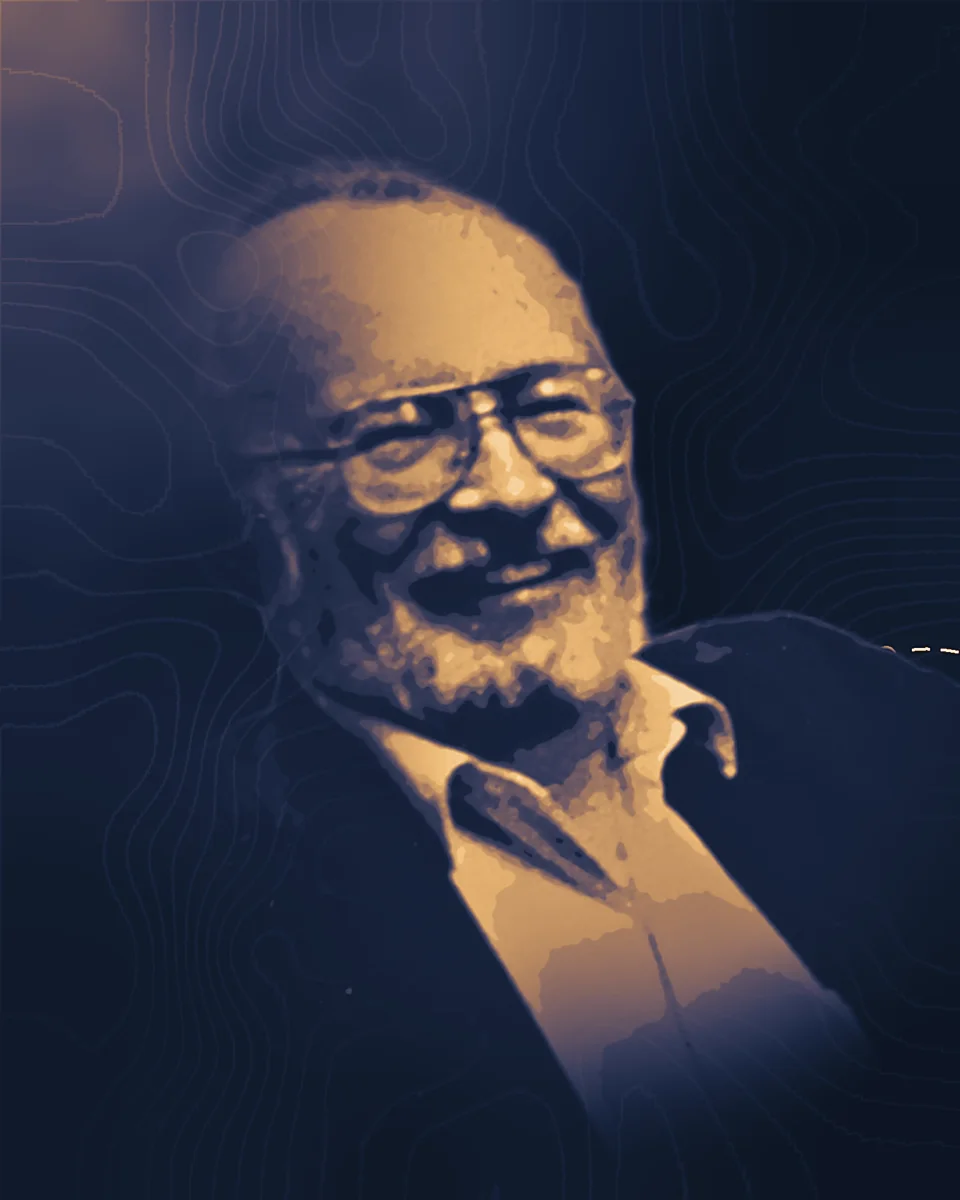
Paul Lauterbur
He showed in 1973 that a magnetic field graded across an object turns nuclear magnetic resonance signals into a picture, the idea magnetic resonance imaging (MRI) is built on.
1929–2007
What they changed
1971
Signals sorted by place
NMR, nuclear magnetic resonance, reads the radio signals that atomic nuclei give back inside a strong magnet. In early September 1971, at NMR Specialties, a small instrument company near Pittsburgh that he was then running, Lauterbur watched Leon Saryan of Johns Hopkins repeat Raymond Damadian's finding that rat tumours gave different NMR signals from normal tissue. That evening he saw that a magnetic field changing steadily across an object, a gradient, would mark each signal with the place it came from, so that a picture could be computed from readings taken in many directions.
1973
A picture from magnetic signals
At Stony Brook he tested the idea on two thin glass tubes of ordinary water inside a tube of heavy water, using the gradient controls of an ordinary laboratory NMR machine, and worked the image out with punched cards and hand-drawn contours. Nature rejected his paper, then published a revised version on 16 March 1973. The Nobel Assembly singles out this experiment, in which gradient magnets added to the main magnet made a cross-section of the tubes visible.
1973
An idea left open
The agent his university used for patents declined to file for the method, judging that it could not earn enough to pay for the application. His university did not answer his request to file on his own, and the deadline for a US patent after publication was close. He decided instead to encourage others: he invited visitors from industry, universities and government to his laboratory, sent out a bibliography of the work, and helped organize meetings to compare methods.
1978
Metals that change the contrast
With M. H. Mendonça Dias and A. M. Rudin he reported in 1978 that paramagnetic ions, metal ions strongly drawn into a magnetic field, added in the living body shorten the relaxation time of water in tissue, which changes how bright it shows. Physics Today's obituary counts the use of paramagnetic contrast agents among the applications he demonstrated.
2003
A shared Nobel Prize
Lauterbur and Peter Mansfield shared the Nobel Prize in Physiology or Medicine "for their discoveries concerning magnetic resonance imaging". The Nobel Assembly counted about 22,000 MRI scanners in use worldwide in 2002 and more than 60 million examinations that year.
Life
Paul Christian Lauterbur was born on 6 May 1929 in Sidney, Ohio, where his father was an engineer and part-owner of the Peerless Bread Machinery Company. He took a degree in chemistry at the Case Institute of Technology in Cleveland in 1951 and went to work at the Mellon Institute in Pittsburgh, in a group supported by Dow Corning that made silicon compounds. Drafted in 1953, he spent most of his army service at the Army Chemical Center in Maryland, where he worked with NMR.
Back at the Mellon Institute he published NMR spectra of silicon-29 in 1956 and, in 1957, the first study of carbon-13 NMR in more than 100 compounds, by Physics Today's account. He took his doctorate at the University of Pittsburgh in 1962 and in 1963 joined the new State University of New York at Stony Brook as an associate professor of chemistry.
The experiments that set him thinking rested on another man's work. In 1971 Raymond Damadian reported in Science that the NMR relaxation times of two kinds of malignant tumour in rats lay distinctly outside the range of six normal tissues, and Lauterbur's Nobel lecture opens its account with that finding. The 2003 prize left Damadian out. He answered with full-page newspaper advertisements, the first in The New York Times on 10 October 2003 under the headline "The Shameful Wrong That Must Be Righted", saying the committee had "disgraced itself". IIT Madras's magazine Shaastra notes that the radiologist Morton Meyers credits Damadian with "seminal contributions", among them the first full-body human MRI machine, and that Damadian's 1974 patent did not describe a way of making pictures. A Nobel decision cannot be appealed.
europepmc.orgnobelprize.orgshaastramag.iitm.ac.inaljazeera.com
In 1985 Lauterbur and his second wife, the physiologist Joan Dawson, moved to the University of Illinois at Urbana-Champaign. He writes that his hopes there were "immediately dashed": the whole-body scanner he was to use was tied up in a legal dispute, and he worked with a small animal-scale machine instead. In his last years he returned to an old interest, the chemical origin of life.
He was elected to the National Academy of Sciences and received the National Medal of Science and the Albert Lasker Clinical Research Award. He died of kidney disease at his home in Urbana on 27 March 2007.
Read more
5 accounts
Image formation by induced local interactions: examples employing nuclear magnetic resonance, Paul C. Lauterbur, Nature, 1973.
The two-page paper in which he set out the method and its first pictures.
nature.com
All science is interdisciplinary: from magnetic moments to molecules to men, Paul C. Lauterbur, Nobel lecture, 8 December 2003.
His own account of the idea, the rejected paper and the patent that was never filed.
nobelprize.org
Paul C. Lauterbur: biographical, Paul C. Lauterbur, Nobel Foundation, 2003.
His autobiography, from Sidney, Ohio, to Urbana.
nobelprize.org
Paul Christian Lauterbur, Edwin D. Becker, Physics Today, 2007.
An obituary by an NMR scientist that sets out his chemistry as well as his imaging.
physicstoday.aip.org
2003: an ignoble tussle over a Nobel, Shaastra, IIT Madras, 2023.
An account of Raymond Damadian's campaign against the prize and of what his supporters and critics said.
shaastramag.iitm.ac.in