Industries / Figureheads
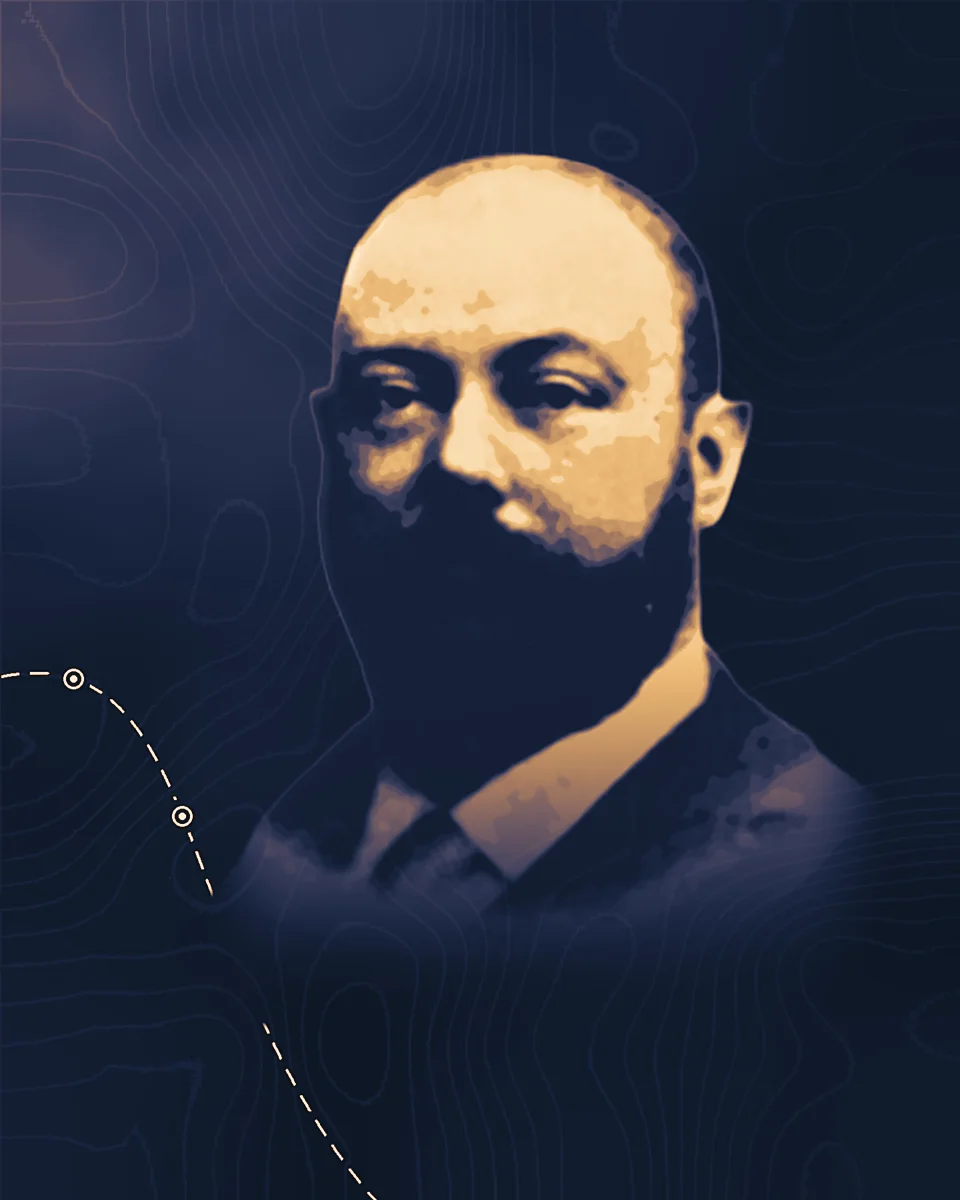
Paul Héroult
He found the electrolytic way to make aluminum in the same year as Charles Martin Hall, and then built the electric arc furnace that melts scrap into steel.
1863–1914
What they changed
1886
Aluminum by electrolysis
Héroult applied for a French patent on 23 April 1886, aged 23. It describes passing current through alumina dissolved in molten cryolite at about 1,000 °C, in a carbon-lined crucible that serves as one electrode, with a carbon rod as the other. The metallurgist Georges Chaudron wrote of it in the Dictionary of Scientific Biography: "This is exactly the procedure followed today."
1887
From patent to smelters
In 1887 he became technical manager of the aluminum works at Neuhausen in Switzerland, which ran on his process. He then started a plant at Froges, in the French Alps, for the Société Électrométallurgique Française, and ran its larger works at La Praz, which drew 3,000 horsepower from falling water in 1892 and 13,000 in 1895.
1900
Steel from an electric arc
At La Praz on 9 October 1900 he made the first industrial use of the electric arc to make steel. The furnace held 2,500 kg and ran at 110 volts and 4,000 amperes. The French engineering reference Techniques de l'Ingénieur says it was the first able to make steel from scrap.
1910
The furnace crosses the Atlantic
The United States Steel Corporation bought the American rights to his steel furnace in 1910, and the first direct-arc furnace installed in the United States was a Héroult. Electric furnaces made 30.3% of the world's crude steel in 2025, by the World Steel Association's count.
Life
Paul Louis Toussaint Héroult was born on 10 April 1863 at Thury-Harcourt in Normandy, the son of a tanner. He spent part of his boyhood in England, where his grandfather lived. At 15 he read Henri Sainte-Claire Deville's book on aluminum, then a metal as dear as silver. He entered the École des Mines in Paris in 1882, where Henry Le Chatelier taught him, and did not finish. The accounts differ on why. His 1914 obituary says his father's death forced him home to run the tannery. Later writers say he failed his first year, his mind being on aluminum.
He turned the tannery buildings at Gentilly, near Paris, into a laboratory. His mother gave him her savings to buy a dynamo. In April 1886 he made his first aluminum. Charles Martin Hall in Ohio had done the same two months earlier, and neither knew of the other. Héroult's patent was the earlier filing and held in France. In the United States the Patent Office gave priority to Hall, who proved his February date. The two met later and became friends, and Héroult crossed the Atlantic in 1911 to see Hall receive the Perkin Medal.
At Froges and La Praz his aluminum furnace became a tool for other products. In it he made the first commercial calcium carbide in France, then artificial corundum, ferrosilicon and ferrochrome, and from there he went on to steel. The arc itself was not new. William Siemens had patented a crucible heated by an arc in 1879 and shown it in London in 1880 as a way to fuse platinum, steel and iron. Héroult's part was a furnace that worked in a steelworks. For decades it was kept for special steels: Techniques de l'Ingénieur notes that the price of electricity still held it to quality steels in 1939.
He came to the United States for the St. Louis World's Fair of 1904 and afterwards lived by turns there and in France. He advised a Canadian government trial of smelting iron ore by electricity at Sault Ste. Marie, an electric steel company in California at a place named Heroult in his honour, and a new aluminum works in North Carolina, until his health failed. France gave him the Legion of Honour, and the technical university at Aachen an honorary doctorate.
He died on 9 May 1914, aged 51. Hall died in December of the same year. The American journal he had long written for took up the question people asked about him and Hall, why two men found one process at once, and answered that "humanity was ripe for the birth of industrial electrochemistry".
Read more
5 accounts
Paul Héroult, Metallurgical and Chemical Engineering, June 1914.
The obituary by the American journal he wrote for, with the fullest list of his works and travels, and an editorial on the same man at the front of the issue.
archive.org
Héroult, Paul Louis Toussaint, Georges Chaudron, Complete Dictionary of Scientific Biography, as carried by Encyclopedia.com, 2019.
A short life by a French metallurgist, with what the 1886 patent says.
encyclopedia.com
Hall and Héroult and the Discovery of Aluminum Electrolysis, Theodore R. Beck, The Electrochemical Society Interface, 2014.
Two pages that set the two inventors side by side.
electrochem.org
Paul Héroult and Charles Hall: Turning a Rarity into a Commodity, Claudia Flavell-While, The Chemical Engineer, 2013.
The Institution of Chemical Engineers' profile of both men.
thechemicalengineer.com
History of the arc furnace, Patricia Ayed, Claude Ouvradou and Jacques Astier, Techniques de l'Ingénieur, 2005.
The opening of a reference article on electric steelmaking; the rest is behind a paywall.
techniques-ingenieur.fr