Industries / Figureheads
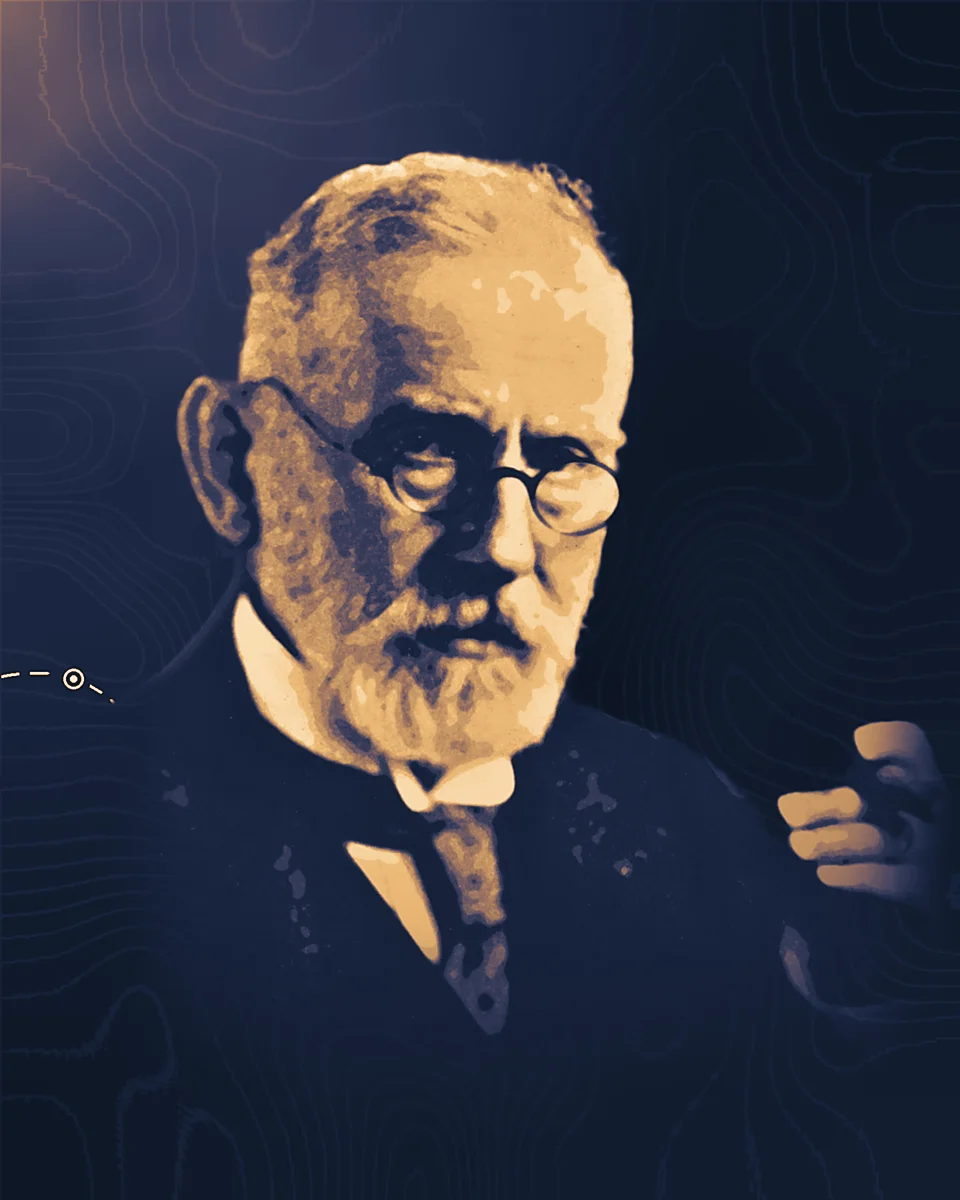
Paul Ehrlich
He set out to find chemicals that kill a germ and spare the patient, had compounds made and tested by the hundred, and with Salvarsan in 1910 showed that a drug could be found that way and made in a factory.
1854–1915
What they changed
1878
Dyes that pick cells
His doctoral thesis was on staining animal tissue with aniline dyes, the synthetic colours made from coal tar. He showed that the dyes fell into classes that each stained some cell parts and not others. The Nobel Foundation's biography says his later drug work rested on the same idea: a chemical's make-up decides which cells it clings to.
1890s
A standard for serum
Diphtheria antitoxin, a blood serum used as a medicine, varied in strength from batch to batch. As head of a new state institute for checking sera at Steglitz, Berlin, from the end of 1896, he set a fixed reference standard and measured each batch against it in units. The Nobel Foundation's biography says his methods "formed the basis of all future standardization of sera".
1906
A plan called chemotherapy
He proposed starting from a chemical with some known effect on a germ, making variants of it, and testing each one. He called this chemotherapy, and he called the drugs he hoped for "magic bullets" that would go straight to the germ. The Georg-Speyer-Haus opened in Frankfurt in 1906 as an institute for this work under his direction.
1909
Compound 606
His chemist Alfred Bertheim made an arsenic compound in 1907 that was tested, judged useless and set aside. In 1909 Ehrlich asked a visiting Japanese bacteriologist, Sahachiro Hata, to test it again on rabbits infected with syphilis. Hata found it better than every other drug tried. It went on sale in 1910 as Salvarsan.
1910
Tested, then released
Wary after the poorly controlled launch of an earlier remedy, Koch's tuberculin, he arranged for doctors in several cities to treat patients and keep careful records before the drug was sold. He sent samples to other doctors only after quality checks in his own laboratory. By the end of 1910 some 65,000 doses had been given to more than 20,000 patients, and the chemical firm Hoechst was filling 12,000 to 14,000 ampoules a day, by Keith Williams's account for the James Lind Library.
Life
Paul Ehrlich was born on 14 March 1854 at Strehlen in Silesia, then in Prussia and now Strzelin in Poland. He studied medicine at Breslau, Strasbourg, Freiburg and Leipzig and took his doctorate in 1878. The pathologist Karl Weigert, a cousin on his mother's side, had begun using aniline dyes to stain tissue, and Ehrlich worked in his laboratory.
From 1878 he worked at the Berlin Medical Clinic. In 1882 he published a way to stain the tuberculosis germ that Robert Koch had just found. In 1890 Koch took him on as an assistant at the new Institute for Infectious Diseases, where he began the work on immunity that brought him a share of the 1908 Nobel Prize in Physiology or Medicine, with Ilya Mechnikov. An early infection with tuberculosis had cost him two years, which he spent in Egypt. In 1899 he moved to Frankfurt as director of the Royal Institute of Experimental Therapy.
Salvarsan was the work of a team. Bertheim made the compounds, Hata ran the animal tests, and Ehrlich directed the search and decided what to try next. By the James Lind Library's account, two assistants had tested compound 606 before Hata and found nothing, and Ehrlich was furious that their poor methods had delayed the result. A more soluble compound, the 914th, followed in 1912 as Neosalvarsan.
The drug was an arsenic compound and it did harm as well as good. Patients sometimes had fever and shaking chills after an injection, which was traced to dead bacteria in the distilled water used to dissolve it. The London doctor James McDonagh, who used it more than anyone in Britain in its first years, gave chapters of his 1912 book to toxic reactions and to deaths after injection. The Nobel Foundation's biography says Ehrlich had to battle much opposition before the drug was accepted. For twenty years Salvarsan and Neosalvarsan were the only chemical treatments for a bacterial infection, by the account of the physician and historian Robert Gaynes.
He married Hedwig Pinkus in 1883 and they had two daughters. His secretary Martha Marquardt recorded that he ate little and smoked 25 strong cigars a day. He had a slight stroke at Christmas 1914 and died of a second on 20 August 1915 at Bad Homburg. The Frankfurt street named after him lost its name under the Nazis because he was a Jew.
Read more
5 accounts
Paul Ehrlich, Martha Marquardt, 1951.
A memoir of his working life in Frankfurt by his secretary, with an introduction by Sir Henry Dale.
archive.org
The introduction of 'chemotherapy' using arsphenamine, the first magic bullet, Keith J. Williams, James Lind Library, 2009.
How Salvarsan was tested, made, released and argued over, with the early clinical reports.
jameslindlibrary.org
Nobel lecture, Paul Ehrlich, 1908.
His own account of his theory of how cells bind chemicals.
nobelprize.org
Die experimentelle Chemotherapie der Spirillosen, Paul Ehrlich with Sahachiro Hata, 1910.
The book that reported the animal experiments behind Salvarsan, in German.
archive.org
Paul Ehrlich: biographical, Nobel Foundation, 1967.
The prize body's life of him, with his posts and dates.
nobelprize.org