Industries / Figureheads
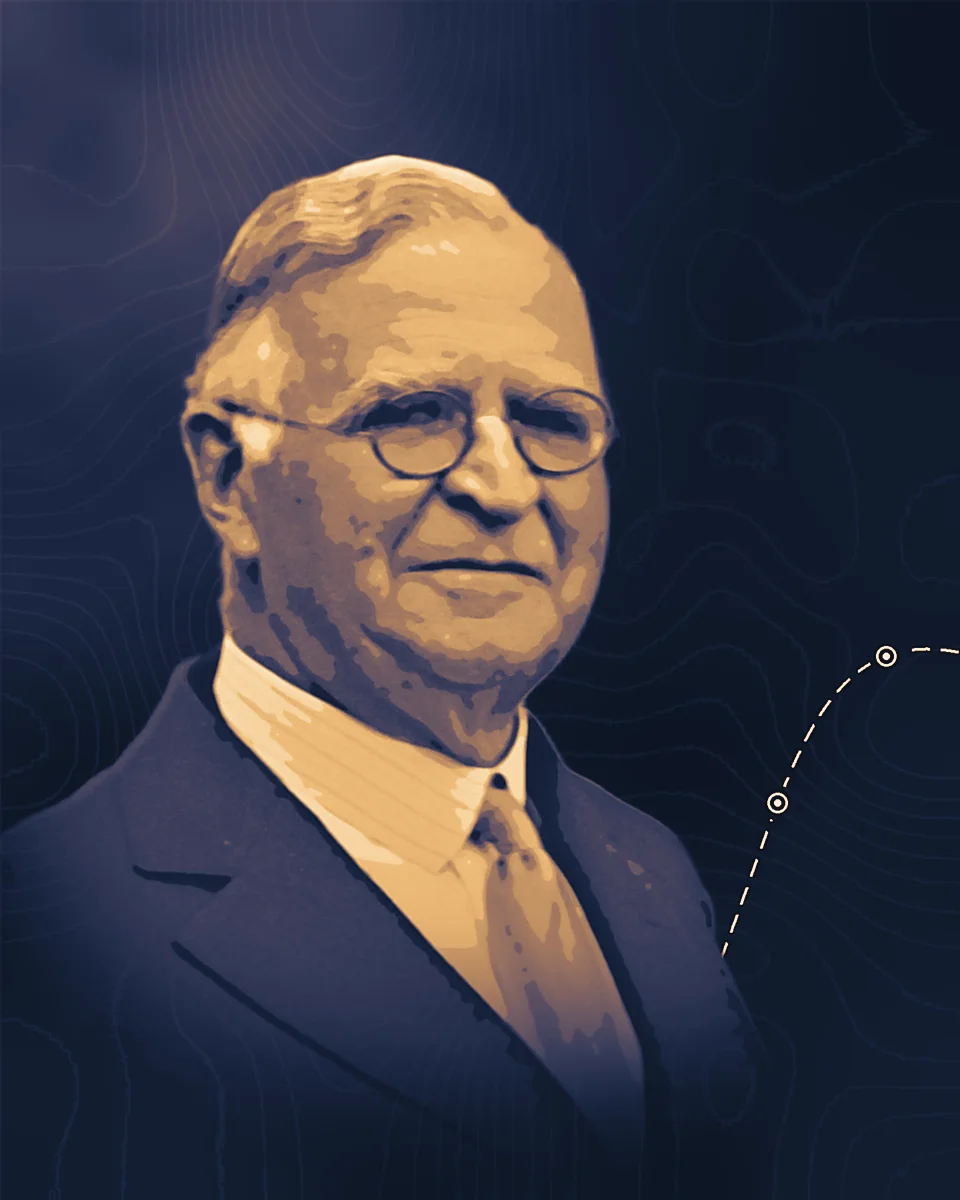
Paul D. Cravath
He ran his New York law firm on salaried associates hired straight from law school, trained in the office and either made partner or sent away, the model that large law firms and consulting firms still follow.
1861–1940
What they changed
1899
Associates on salary
Before Cravath came to the firm, law students and some admitted associates worked for no pay and lived on whatever business they found for themselves. Cravath ended this. The firm's historian Robert Swaine wrote that he "abolished the study of law within the office, and every associate, including the man fresh from law school, was put on salary," and that "all the business in the office must be firm business."
1899
Hiring straight from school
Cravath insisted that the staff "be recruited, so far as possible, from men just out of the law schools," because men trained elsewhere might bring habits that did not fit his methods. His first choice was a Phi Beta Kappa graduate who had edited the law review at Harvard, Columbia or Yale. Swaine says that when Cravath came to the firm in 1899 such standards "were regarded as somewhat eccentric."
1900s
Training by parts
Young lawyers were not left alone with small routine matters. Under the "Cravath system," in Swaine's words, "a young man watches his senior break a large problem down into its component parts, is given one of the small parts and does thoroughly and exhaustively the part assigned to him."
1900s
Partner or leave
Cravath used to say that, apart from a few scholars and specialists, no one should stay in the office more than six years unless the partners had decided to make him a partner. Most partners admitted up to 1926 had served five or six years. The legal historian Eli Wald counts this "up or out" rule among the features of the large firm that Cravath was among the first to put together.
1920
The model for large firms
Swaine says other New York offices took up the same principles, which led about 1910 to bidding for the top graduates of the leading law schools. Wald writes that by 1920 the Cravath System "dominated the expanding world of large law firms" and that by the 1960s it had become "synonymous with the notion of the large law firm." The historian John Oller calls it a set of management principles "still in use today by law firms and consulting companies."
Life
Paul Drennan Cravath was born at Berlin Heights, Ohio, on 14 July 1861. His father, the Rev. Erastus Milo Cravath, was a clergyman who became president of Fisk University in Nashville; his mother, Ruth Jackson, was the daughter of an abolitionist. He graduated from Oberlin College in 1882, read law in Minneapolis until illness stopped him, and worked in business for more than a year. He entered Columbia Law School in 1884 and graduated in 1886 with its first prize in municipal law.
He clerked with the New York firm of Carter, Hornblower & Byrne, and on 1 January 1888 opened Carter, Hughes & Cravath with his mentor there, Carter. Through an uncle who was an officer in George Westinghouse's companies, he met Westinghouse, who wanted a lawyer for his legal battles with Thomas Edison; by Oller's account the work made Cravath's name. In 1904 he was counsel to the Westinghouse Air Brake Company, the Westinghouse Electric and Manufacturing Company and several electric lighting companies.
In 1899, aged 37, he became the newest partner of a Wall Street firm known as the Seward firm, which took the name Guthrie, Cravath & Henderson in 1901. He was its presiding partner from 1906 until 1940. He drove his lawyers hard. Swaine records that young lawyers often waited at his house at night, went over papers with him until past midnight, and were told to be back at eight in the morning with a new draft.
The system claimed to judge lawyers on merit alone, and Cravath told Harvard law students in 1920 that family influence and wealth counted for little at the New York bar. Its record was narrower. Besides grades, Cravath wanted recruits with "warmth and force of personality and physical stamina." Wald finds that until 1945 every large New York firm was a white Protestant firm, and that large firms used such personality standards "to systematically exclude" qualified candidates who were not young, white, Anglo-Saxon Protestant men from affluent homes.
In 1893 he married Agnes Huntington, a concert singer, and they had one daughter, Vera. He served Fisk University as a trustee for decades, was a founder of the Council on Foreign Relations, and in the First World War was counsel to the Inter-Allied Purchases Commission. He remained head of the firm until his death in 1940.
Read more
5 accounts
The Cravath Firm and Its Predecessors, Robert T. Swaine, 1946–1948.
The firm's own three-volume history by one of its partners; the chapter that sets out the Cravath system is reproduced for teaching by the law professor Thomas D. Russell.
houseofrussell.com
The Rise and Fall of the WASP and Jewish Law Firms, Eli Wald, Stanford Law Review, 2008.
How the Cravath System became the shape of the large firm, and whom its hiring left out.
stanfordlawreview.org
White Shoe, John Oller, Financial History, 2020.
A magazine excerpt from Oller's book on the first Wall Street corporate lawyers, with Cravath's early career.
fhmagazine.org
Tournament of Lawyers: The Transformation of the Big Law Firm, Marc Galanter and Thomas Palay, University of Chicago Press, 1991.
The standard study of how the big firm and its race for partnership grew.
press.uchicago.edu
Paul Drennan Cravath, Prominent and Progressive Americans, volume 2, 1904.
A biography written in his lifetime, with a portrait.
archive.org