Industries / Figureheads
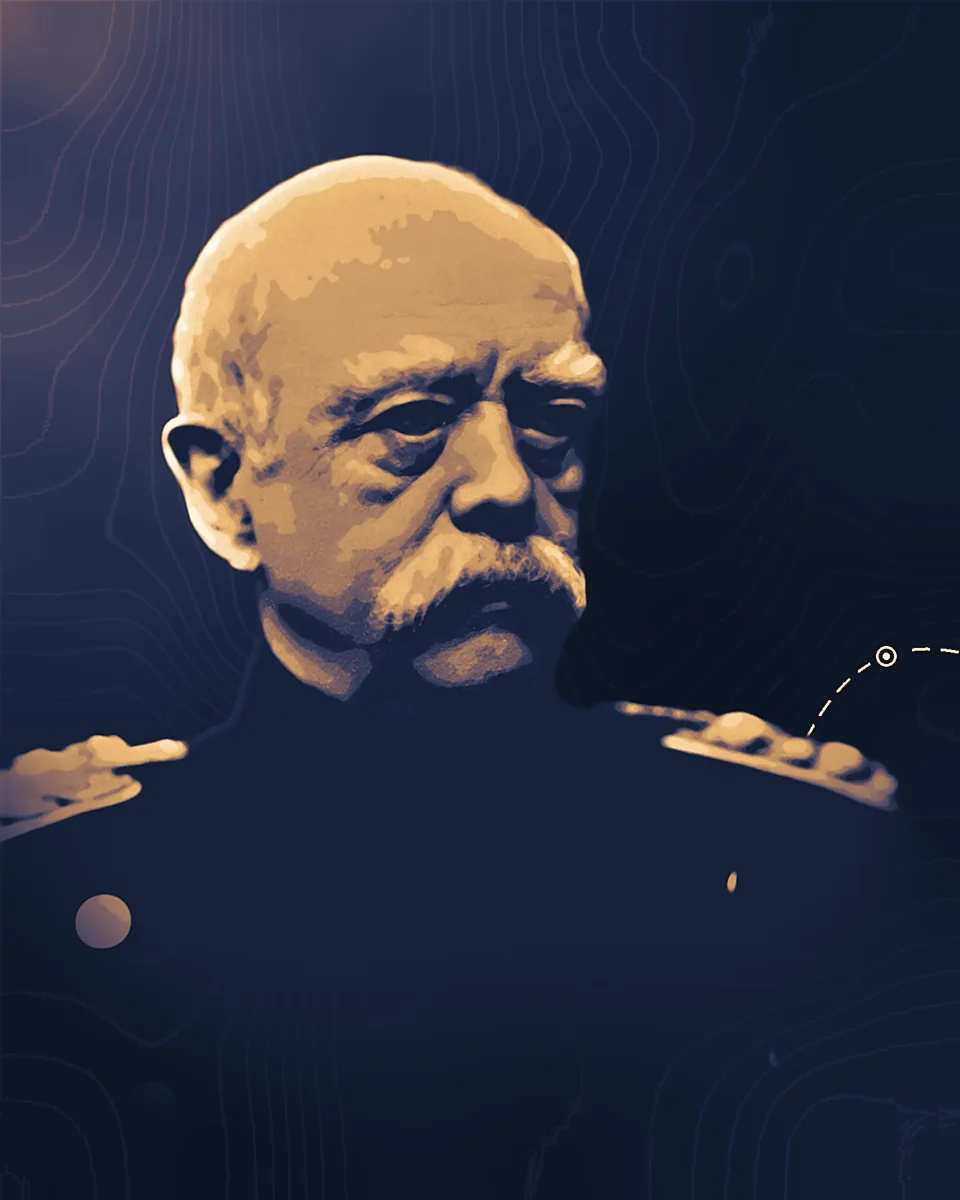
Otto von Bismarck
As German chancellor he drove through the laws of 1883, 1884 and 1889 that made insurance against sickness, accidents at work, disability and old age compulsory for workers, paid for by contributions, the model of social insurance that Germany and many other countries still follow.
1815–1898
What they changed
1881
Social insurance announced
On 17 November 1881 Bismarck read the Kaiser's message to the new Reichstag, standing in for the ill Wilhelm I. He had done the main work of writing it. It called for laws to insure workers against sickness, accidents, disability and old age, and said that those unable to work through age or disability had "a well-founded claim" to more care from the state. The German Bundestag's research service calls it the real starting point of the state social policy that Germany, and later other countries, took up.
1883
Health insurance by law
The first of the three laws, in 1883, set up statutory health insurance for workers, run through sickness funds, as the message had promised.
1884
Insurance for accidents at work
Accident insurance passed in 1884, at the third attempt. Defending the bill in the Reichstag on 15 March 1884, Bismarck said he had cut it to "the most limited and necessary scope" so that it would pass, hoping that Germany might make "a beginning in this area and thereby" take "the lead among European states". He traced the field back to Germany's law on employers' liability of 1871.
1889
Pensions for age and disability
On 22 June 1889 the Reichstag passed the law on disability and old-age insurance, which took effect in 1891. It covered wage earners from the age of 16 and salaried staff earning up to 2,000 marks a year. Workers and employers paid contributions graded by wage, and the state added a subsidy. A disability pension came after five years of contributions; an old-age pension at 70, after at least 30. Germany's state pension grew from this law.
1890s
Life
Otto von Bismarck was born on 1 April 1815 at Schönhausen in the Altmark, the son of a landowner. Wilhelm I made him minister-president of Prussia in 1862, and he governed without an approved budget until 1866. After wars against Denmark, Austria and France, he became the first chancellor of the German Empire on 21 March 1871.
Social insurance was one half of a policy whose other half was repression. In the 1870s he led the "Kulturkampf", a campaign with the Liberals against the Catholic Church and the Catholic Centre party. On 18 October 1878 the Anti-Socialist Law banned the Socialist Workers' Party and the labour movement; the German Historical Museum says his aim of destroying social democracy failed. The museum says he built the state welfare system "to take away the base" of the Social Democrats. In 1884 he told the Reichstag it would be "an injustice" to hinder the self-defence of the workers and not offer them aid. In his collected works he spoke openly of an attempt to bribe the working class into quiet, by the Bundestag research service's account.
The laws were not drafted by him alone. Theodor Lohmann (1831–1905), the official responsible in the Reich Office of the Interior, had a decisive share in writing them and advised Bismarck until 1883, when they fell out and Bismarck sidelined him. Lohmann's superior, Robert Bosse, kept Bismarck's trust and stayed in charge until the pension law passed. Karl Heinrich von Boetticher, the state secretary of the interior, did much to shape the old-age and disability insurance, and the Centre party pressed its own ideas on the bills. The laws had gaps: no rules to protect workers in the workplace and no insurance against unemployment.
Bismarck also took Germany into colonies. In 1884 he backed the first colonial acquisition, Angra Pequena on the coast of south-west Africa, and with the French prime minister Jules Ferry he called the Berlin conference of 1884–85, which set up a Congo state under King Leopold II of Belgium. After Wilhelm II came to the throne, the two quarrelled, among other things over social policy, and Bismarck was dismissed on 20 March 1890. He died at Friedrichsruh, near Hamburg, on 30 July 1898.
Read more
5 accounts
Bismarck's Reichstag Speech on the Law for Workers' Compensation, 15 March 1884, German History in Documents and Images, German Historical Institute Washington. His own defence of accident insurance, in English, with its tie to the Anti-Socialist Law.
germanhistorydocs.org
Sozialpolitik aus christlicher Überzeugung?, Wissenschaftliche Dienste des Deutschen Bundestages, 2012.
The German parliament's research service on the Imperial Message, the three laws and who wrote them, in German.
bundestag.de
Otto von Bismarck 1815–1898, Dorlis Blume, Deutsches Historisches Museum, 2014.
The national history museum's year-by-year account of his life, in German.
dhm.de
Bismarck: A Life, Jonathan Steinberg, Oxford University Press, 2011.
A full modern biography.
archive.org
Bismarck and the Development of Germany, Otto Pflanze, Princeton University Press, 1990.
A three-volume study of his politics and his part in building the German state.
archive.org