Industries / Figureheads
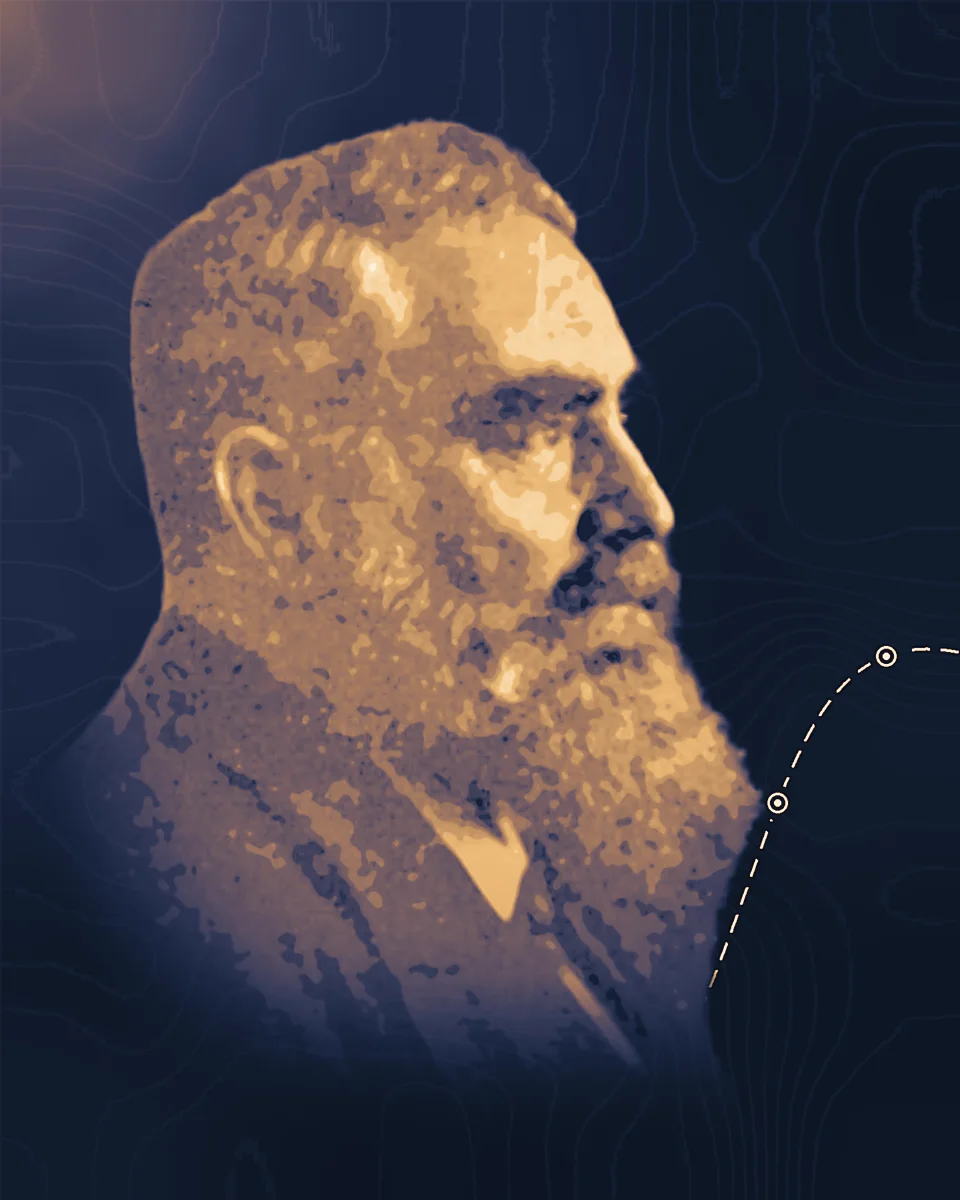
Oskar von Miller
He organized the demonstrations of 1882 and 1891 that sent electric power 57 km and then 175 km, and later planned a shared high-voltage grid for all of Bavaria.
1855–1934
What they changed
1882
Power sent 57 km
For the electrical exhibition he organized in Munich's Glaspalast, a generator at Miesbach sent direct current over 57 km of telegraph wire to a motor in the hall, which pumped water for an artificial waterfall. W. Petersen wrote in 1930 that the French engineer Marcel Deprez built it at Miller's suggestion. VDE, the German electrical engineering association, puts the voltage at 1,350 to 2,000 V and dates the first run to the evening of 25 September 1882. Germany's national biography says the test proved power could be sent a long way, at an efficiency of only about 22%.
1891
Three-phase power over 175 km
For the Frankfurt electrical exhibition, which he helped organize, water power from the Neckar at Lauffen was sent 175 km to Frankfurt as three-phase current, on machines from AEG of Berlin and Maschinenfabrik Oerlikon of Zurich. Silvanus Thompson's 1895 account names Miller as the engineer of the line and of the Lauffen station. A commission under H. F. Weber tested it that autumn, mostly at about 8,000 V, and found that 68.5% to 75.2% of the energy the turbine gave out at Lauffen arrived at Frankfurt. IEEE says the demonstration directly influenced the later worldwide dominance of three-phase AC transmission.
1892
A town on three-phase supply
The same Lauffen generators then fed Heilbronn, about 9 miles away, at 5,000 V. The town took the power at 1,500 V, and small transformers in about 25 pillars along the streets lowered it to 100 V for lamps and motors. Thompson, who had the details from Miller, wrote in 1895 that for many months this was the only general supply of three-phase current from a central station. Miller's own report on the Lauffen–Heilbronn works is dated 1892.
1924
One grid for Bavaria
In a 1916 memorandum to the Bavarian government he proposed that Bavaria's power companies join in one "Bayernwerk" with a high-voltage network across the state east of the Rhine, and worked out that pooled generation would cost about 20% less than separate plants. The Bayernwerk, founded in 1921, ran a 110,000 V ring line about 1,000 km long across Bavaria, with links to the grids of neighboring states planned in. Its main source was the Walchensee hydro plant, which Miller laid out on earlier plans by Rudolf Schmick and Feodor Maria von Donath. Building began in November 1918, the first machine set started on 24 January 1924, and the plant reached 124 MW.
Life
Oskar von Miller was born in Munich on 7 May 1855, the tenth son of Ferdinand von Miller, the royal bronze founder whose works include the Bavaria statue on the Theresienwiese. He studied engineering at the Munich Polytechnic from 1874 to 1878, among other things railway, hydraulic and bridge building, and joined the Bavarian state service in 1878. Germany's national biography says he had no prospect of a well-paid post there, and turned to electrical engineering, which he taught himself, after visiting the Paris electrical exhibition of 1881 for the Bavarian government.
The Miesbach line was a shared work. The memorial stone that VDE set up in Munich in 1952 names "Oscar v. Miller und Marcel Deprez" as its makers, and Michael Dolivo-Dobrowolsky of AEG wrote in 1891 of "the Marcel Deprez experiments". Accounts of the line differ. VDE says a steam engine at the Miesbach coal mine drove a 2-horsepower Gramme dynamo, and that the line ran only a few days, until the motor in Munich was wrecked by a short circuit on 10 October. Petersen says a small water power drove a 1.5-horsepower generator, and a second VDE page gives the voltage as 150 to 200 V. The year after, Miller asked the Bavarian ministry for a state office to develop Bavaria's water power for electricity, and was turned down.
From 1883 to 1889 he was technical director of the Deutsche Edison-Gesellschaft in Berlin, which Emil Rathenau had founded and which became AEG. His main work there was building central stations to supply small districts of cities. The Elektrotechnische Zeitschrift's 1930 tribute gives the years as 1884 to 1890. In 1890 he opened his own engineering office in Munich, which grew into one of Europe's leading planners of power plants, among them the Etschwerke (1897–98), the Pfalzwerke (1910–12) and the Walchensee plant. In 1930 he wrote a report for the German government on a single electricity supply for the whole country, carrying the Bayernwerk's idea of a shared grid to the national level.
The Frankfurt line was the work of many. Thompson names Charles E. L. Brown of Oerlikon as the designer of the generators and Dolivo-Dobrowolsky as the designer of the 100-horsepower motor at Frankfurt, and says the Imperial German Post Office, with the Württemberg post, helped lay out and build the line, which crossed four states on about 3,000 poles. A history at the Karlsruhe Institute of Technology says instead that AEG built the line "under the leadership of Dolivo-Dobrowolsky". Petersen wrote in 1930 that the test went into the exhibition's programme at Miller's suggestion.
The work that made him widely known, by the 1930 tribute's account, was the Deutsches Museum of masterpieces of science and technology in Munich, founded in 1903. Germany's national biography says his plan became known across the country at a meeting of the Association of German Engineers (VDI) in Munich that year, and that the museum's chief novelty was working originals, models and demonstrations that visitors set going by pressing a button. Kaiser Wilhelm II laid the foundation stone of its building in 1906, and the building opened in 1925, on Miller's 70th birthday. He chaired the VDI from 1912 to 1914 and was honorary president of the second World Power Conference in Berlin in 1930.
On 22 January 1919 the Bavarian council government (Räteregierung) named him its state commissioner for the Walchensee project and the Bayernwerk; he had begun building the plant two months before. From the 1920s the Nazis attacked him and the museum, whose international character they disliked. He refused to set up a Bismarck monument in the museum, because Bismarck had been neither an engineer nor a scientist, and refused to show the "Bremen", the aircraft that first flew the Atlantic from east to west in 1928. The Nazis called him "red Oskar", after his post under the council government, and the national biography says the threats against him were unmistakable. In 1933 he stepped down from the museum's leadership, ostensibly for reasons of health. He died in Munich on 9 April 1934.
Read more
6 accounts
Miller, Oskar von, Wilhelm Füßl, Neue Deutsche Biographie vol. 17, 1994.
Germany's national biography: his engineering office, the Bayernwerk, the museum and the attacks on him.
deutsche-biographie.de
Die Verwertung der Walchensee-Wasserkraft für ein Bayernwerk, Oskar von Miller, Elektrotechnische Zeitschrift, 1916.
His memorandum to the Bavarian government proposing one shared grid for the state, with his cost figures.
archive.org
Polyphase Electric Currents and Alternate-Current Motors, Silvanus P. Thompson, 1895.
A contemporary account of the Lauffen–Frankfurt line and the Heilbronn supply, drawn from the exhibition's official report and from Miller.
archive.org
Entwicklung der Krafterzeugung und Kraftübertragung der letzten 50 Jahre in Deutschland, W. Petersen, Elektrotechnische Zeitschrift, 1930.
A jubilee lecture on fifty years of German power transmission, from Miesbach and Lauffen on.
archive.org
Gedenkstein Miesbach–München, Bernhard Thiem, VDE, 2018.
The engineering association's account of the 1882 line and its memorial stone, with the sources it rests on.
vde.com
Oskar von Miller, Elektrotechnische Zeitschrift, 1930.
The trade journal's tribute on his 75th birthday, with the photograph this portrait is based on.
archive.org