Industries / Figureheads
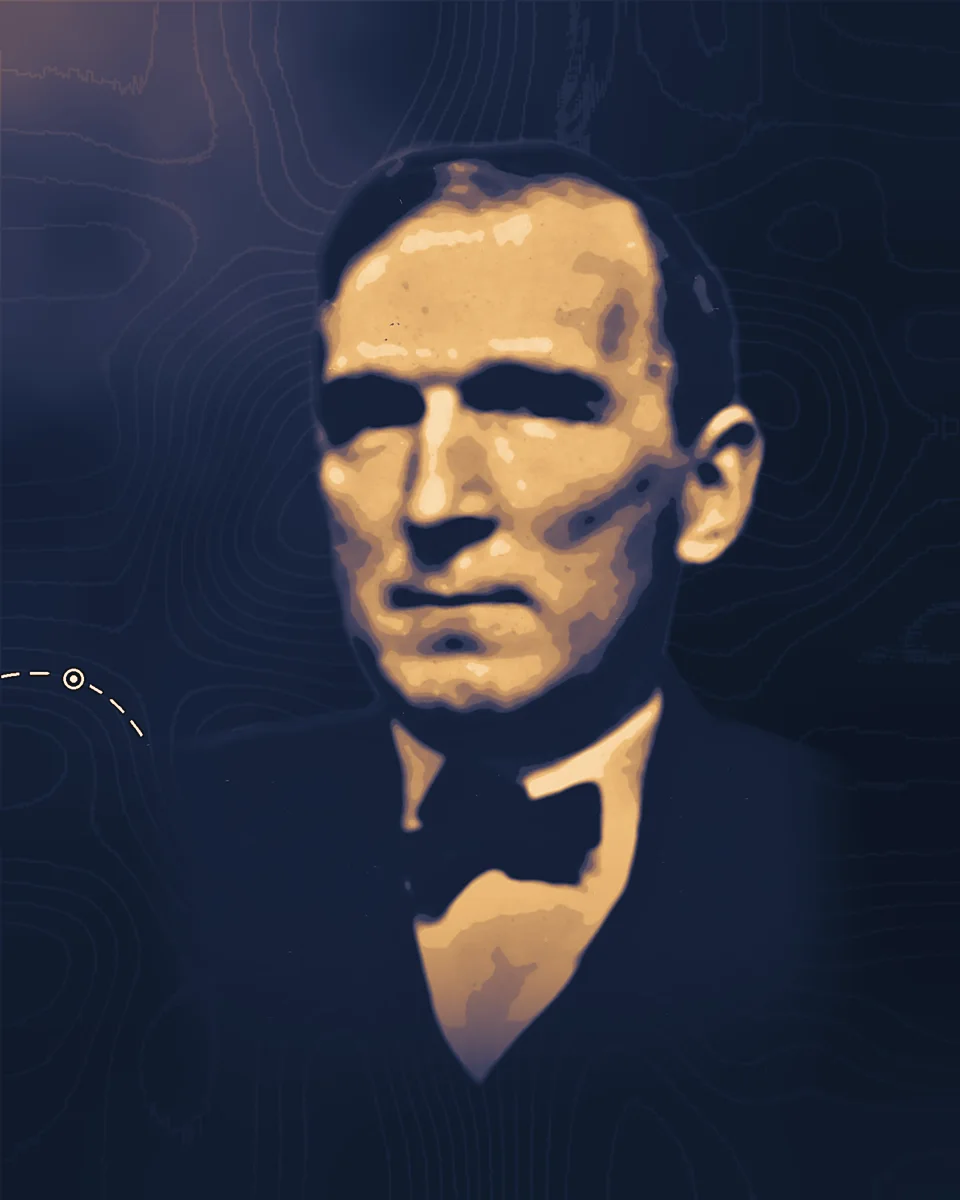
Oscar Sund
He put an echo sounder over the Lofoten cod grounds in 1935 and drew the fish, which opened the way to counting fish stocks by sound.
1884–1943
What they changed
1910s
Ages for cod
Johan Hjort hired Sund as a scientific assistant at Norway's fisheries directorate in 1908. Sund took part in working out the ages of cod, and those age readings were part of the material behind Hjort's 1914 theory that catches follow the size of each year's brood of fish.
1920s
Shortcuts for sea measurements
While he ran the directorate's routine measurements of the sea in the 1920s, Sund made aids that saved labour: correction charts for deep-water thermometers, and a slide rule and a calculating wheel for working out the specific gravity and volume of seawater.
1935
Cod drawn by echo
An echo sounder sends a pulse of sound down and times the echo. Around 1934 Sund heard that one could be used to "see fish". In 1935 he recorded spawning cod off Lofoten as a thin layer in the water, lying where the temperature was 4 to 6 °C, and published the result in Nature the same year. After 1945, by the account of Norway's national encyclopedia, sounding by echo changed the way marine scientists observe fish stocks and estimate their size.
Life
Oscar Sophus Sund was born on 19 April 1884 at Gildeskål in northern Norway and grew up in a fishing community, which marked his science and his politics. He began zoology at the university in Kristiania in 1902, moved to Bergen Museum in 1908 and graduated in 1911 with a thesis on the biology of the sprat.
He met Johan Hjort at an international course in marine research in Bergen. Hjort took him on at the fisheries directorate in the spring of 1908. Sund had a permanent post there from 1912, became fisheries consultant in 1918, and from then until his death was the scientific leader of Norwegian marine research. Money was short for many years, so he worked across the field: cod above all, herring from 1938, crustaceans, and the physics and chemistry of seawater.
He was not the first to find fish by sound. A United States teaching site on underwater sound records that P. Portier in France suggested in 1924 that sardine and herring schools might return echoes, that the French navigator Raymond Rallier du Baty put odd signals on his echo sounder down to cod on the Grand Banks, and that K. Kimura in Japan published "the first successful experiment demonstrating the acoustic detection of fish" in 1929. Sund's part was a clear record of a commercial fish at sea, tied to a water temperature and printed where other scientists would read it.
He pushed for new gear that coastal fishermen could use on their own boats. He rejected socialism, and he also feared that an industrial Norwegian trawl fleet would turn independent fishermen into hired hands, as he believed had happened in Britain and the Soviet Union. He wrote and spoke on fishing trials, diet, fish recipes and hygiene at sea, and his last book was written for young people of the coast. He sat on committees of the International Council for the Exploration of the Sea and was one of Norway's two delegates from 1938.
Read more
3 accounts
Oscar Sund, Vera Schwach, Store norske leksikon, undated. The life by the historian of Norwegian marine research, in Norwegian.
snl.no
Echo Sounding in Fishery Research, Oscar Sund, Nature volume 135, page 953, 1935.
His own one-page letter with the record of cod off Lofoten.
nature.com
Between World War I and World War II: the 1920s and 1930s, Chris Knowlton, Discovery of Sound in the Sea, University of Rhode Island, 2018.
The earlier attempts to detect fish by sound, from Portier to Kimura.
dosits.org