Industries / Figureheads
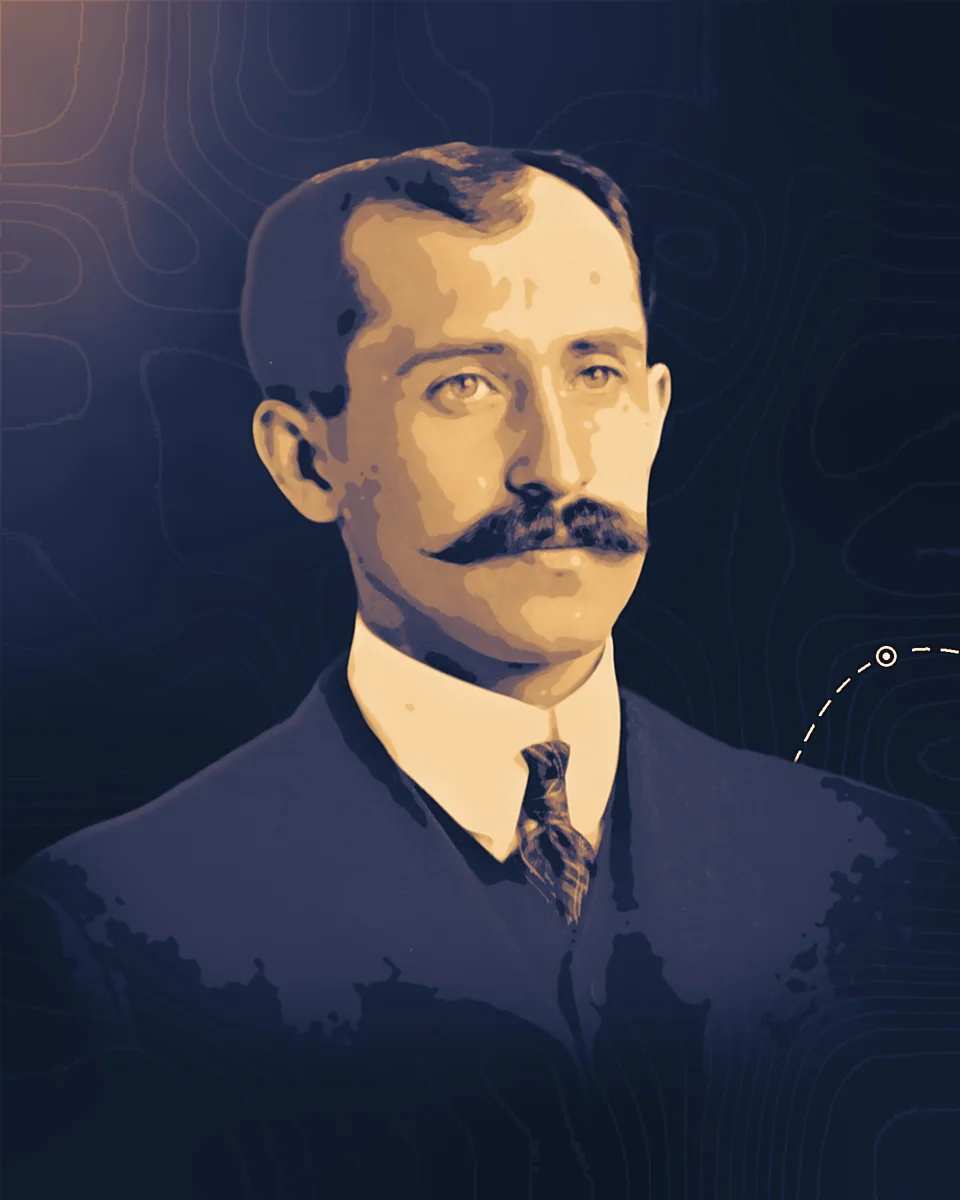
Orville Wright
He piloted the first powered flight in 1903 and, with his brother Wilbur, worked out the test methods and three-axis control that aircraft design still uses.
1871–1948
What they changed
1901
Measured data before building
When the 1901 glider gave about a third of the lift the brothers had calculated, they stopped trusting the published tables. From September to December 1901 they tested between one and two hundred model wings in a wind tunnel they built, about 30 of them in detail, changing one feature at a time. The Smithsonian counts the wind tunnel and flight testing, used as design tools, among the basic techniques of modern aeronautical engineering that began with the Wrights.
1903
The first powered flight
On 17 December 1903 at Kitty Hawk, North Carolina, Orville flew the Wright Flyer 36 m in 12 seconds. The Smithsonian calls it the first successful powered airplane with a pilot aboard. The brothers took turns for three more flights that morning.
1909
An airplane for the Army
Orville flew the US Army's trials at Fort Myer, Virginia, in 1908, where the contract asked for a one-hour flight at 40 miles an hour. A crash there killed his passenger, Lieutenant Thomas Selfridge, and broke Orville's thigh and pelvis. The brothers came back with a new airplane on 3 June 1909, and the Army bought it for 30,000 dollars.
1920
Twenty-eight years on the NACA
Orville was a member of the National Advisory Committee for Aeronautics, the US government's aeronautical research body and the forerunner of NASA, from 1920 until his death in 1948.
1928
A fight over the record
In 1914 the Smithsonian paid Glenn Curtiss to rebuild and fly Samuel Langley's failed 1903 machine, then labelled it the first airplane "capable of sustained flight". Orville sent the 1903 Flyer to the Science Museum in London in 1928 in protest. The Smithsonian published a correction in its 1942 annual report, and the Flyer was installed in Washington on 17 December 1948.
Life
Orville Wright was born in Dayton, Ohio, on 19 August 1871, the sixth of seven children of Milton and Susan Koerner Wright. He went to school in Iowa, Indiana and Dayton, and left Central High School without graduating because he lacked some credits.
He and his older brother Wilbur ran a print shop from 1889, where they printed a newspaper edited by Orville's classmate Paul Laurence Dunbar. In 1893 they opened a bicycle shop. From 1899 they worked on flight, with a kite, then three gliders tested at Kitty Hawk, then the powered Flyer of 1903.
The crash at Fort Myer in 1908 was the first test of the airplane in front of a paying customer, and it killed a man. The National Park Service says Orville's injuries gave him pain for the rest of his life.
When the Wright Company was formed in 1909 Orville was a vice-president. He became president after Wilbur died of typhoid fever in 1912, sold his interests in 1915 and stayed a year as consulting engineer. He then built a laboratory in west Dayton and lived at Hawthorn Hill in Oakwood, Ohio, with his sister Katharine and their father.
In 1927 the first head of US air regulation, William P. MacCracken Jr., offered him federal pilot licence No. 1. The Federal Aviation Administration's history says Orville declined because he no longer flew and did not think he needed a licence to show that he had been the first man to fly.
He died of a heart attack in Dayton on 30 January 1948, aged 76. He never married. The 1903 Flyer was still in London, and his executors brought it home that year.
Read more
5 accounts
1903 Wright Flyer, Smithsonian National Air and Space Museum, object record read in 2026.
The museum's account of the research program and the flights of 17 December 1903.
airandspace.si.edu
How the Wright Flyer Got to the Smithsonian, Smithsonian National Air and Space Museum, read in 2026.
The museum's own account of its quarrel with Orville and how it ended.
airandspace.si.edu
The Papers of Wilbur and Orville Wright, including the Chanute-Wright letters, Ayer reprint, 1998.
The brothers' letters, diaries and notebooks, including Orville's diary of the 1903 flights.
archive.org
Orville Wright's Life Story, US National Park Service, Dayton Aviation Heritage National Historical Park, read in 2026.
A short sourced life from the park that keeps the family's sites.
nps.gov
Wright 1901 Wind Tunnel Tests, NASA Glenn Research Center, web page read in 2026.
The tunnel, the balances and the model wings, explained for students.
grc.nasa.gov