Industries / Figureheads
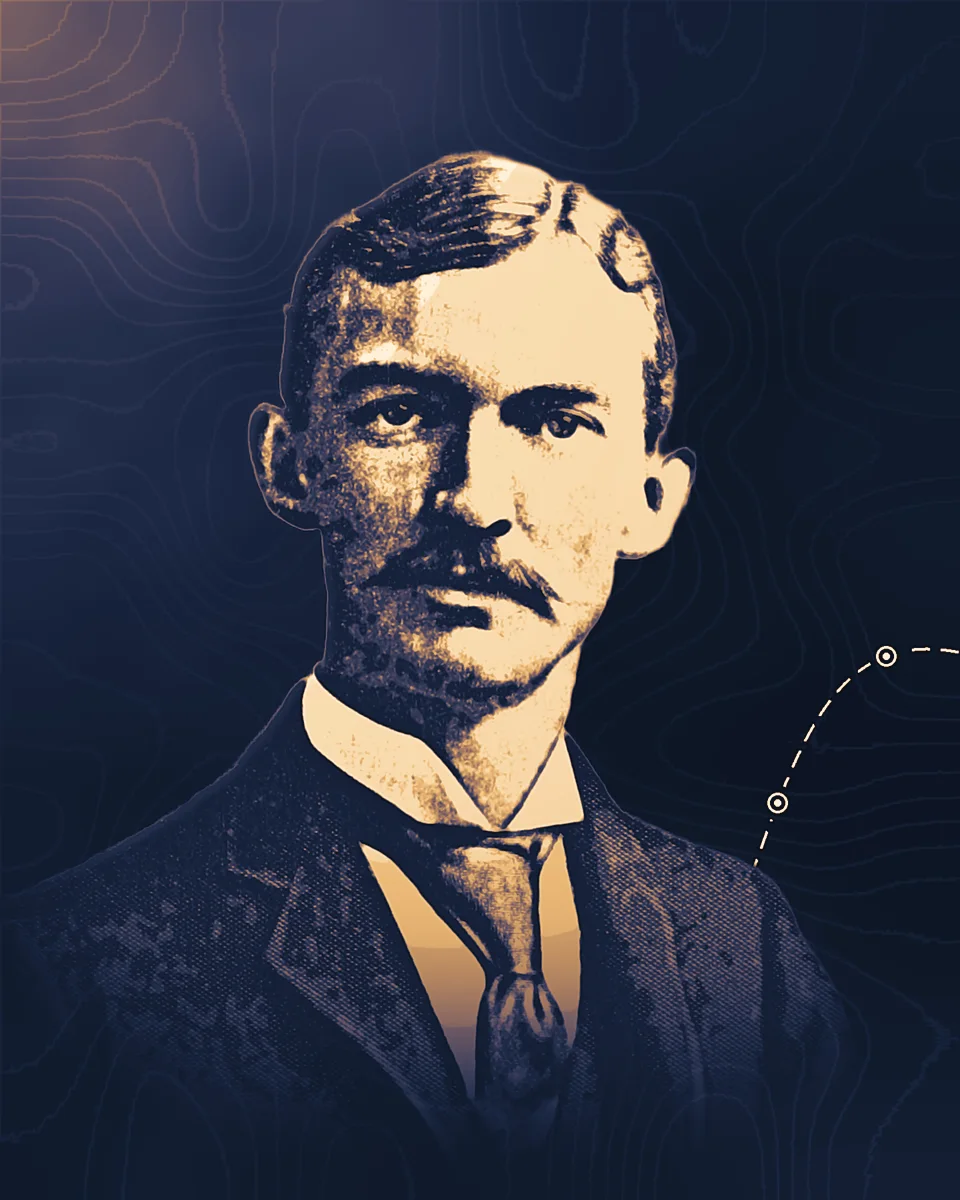
Oliver B. Shallenberger
He turned a chance observation in 1888 into a meter for alternating current, so AC supply could be sold by measured use.
1860–1898
What they changed
1885
Testing the imported system
At the Union Switch and Signal Company in Pittsburgh, Shallenberger was put in charge of setting up and running the alternating-current apparatus of Gaulard and Gibbs that George Westinghouse had imported, and his practical work with alternating current began there, by Electrical World's 1894 profile. After William Stanley's plant at Great Barrington, Shallenberger ran a second trial from Pittsburgh to East Liberty, about three miles, measured the voltage drop and the efficiency, then rewound the transformers for 1,000 volts and tested again.
1886
Transformers made to sell
As chief electrician of the new Westinghouse Electric Company, he was responsible for the electrical design of all its apparatus in the years after the system was adopted, Electrical World wrote in 1894. The company's chief engineer told Henry Prout that "it was due to Shallenberger that the early Westinghouse transformers were brought to a practical commercial condition."
1888
A spring that turned
Late in April 1888, while he examined a new alternating-current arc lamp, a small coil spring came loose and lodged near a coil and a projecting iron core, and he saw it slowly turn. He traced the motion to a shifting magnetic field and within weeks built a meter in which two fields, one lagging behind the other, turn a metal disc or ring at a rate that grows with the current used. He filed for US patents 388,003 and 388,004 on 6 June 1888, and both were issued on 14 August 1888. Electrical World counted more than 80,000 of the meters in use by 1894.
1880s
Alternators run in parallel
Coupling two alternating-current generators on one circuit was then thought hard, and Electrical World's 1894 profile says Shallenberger was "the first in America who succeeded in doing this." He built a phase detector to show when two machines were in step, so they could be joined safely. A memorial by Charles A. Terry for the American Institute of Electrical Engineers credited him with the same first, "in this country at least."
1890
Street lamps that stay lit
In his system for street lighting, each incandescent lamp in a series circuit is bridged by a coil with an iron core, so that when one lamp fails the current flows through its coil and the other lamps stay lit. He applied for the patent on 4 September 1890; it was issued as US 740,189 in 1903, after his death. Electrical World said in 1894 that the system was "extensively used for street lighting."
Life
Oliver Blackburn Shallenberger was born at Rochester, Pennsylvania, on 7 May 1860, the son of Aaron T. Shallenberger, a physician. He went to the town's public schools and to Beaver College, and in 1877, helped by his uncle, the congressman W. S. Shallenberger, he entered the Naval Academy at Annapolis as a cadet engineer, at the head of the 25 admitted that year. A dislocated arm, a broken wrist and poor eyesight slowed his later years there, and he graduated in 1881 third in his class. On a cruise in the Mediterranean aboard the flagship Lancaster he saw the bombardment of Alexandria. He came home in 1883 and resigned from the navy the next year to work in electricity.
In 1884 he joined the electric light department of the Union Switch and Signal Company in Pittsburgh, then run by George Westinghouse. There he worked with Stanley and Reginald Belfield on the alternating-current system, and when the Westinghouse Electric Company was formed he became its chief electrician. He was elected to the American Institute of Electrical Engineers in 1888, and in 1889 he toured central stations in Europe's larger cities.
He did not have the AC meter to himself. Prout records that Westinghouse applied for a patent on an alternating-current meter in June 1887 and filed another with the engineer Philip Lange in October; both were issued in May 1888. Lange and Lewis Stillwell were with Shallenberger when the spring turned, and Prout quotes him saying: "There's a meter in that and perhaps a motor." The meter ran on the same principle as Nikola Tesla's motor, whose patents were issued on 1 May 1888, and Galileo Ferraris in Turin published a lecture on a similar motor within days. Prout says Shallenberger did not know of Tesla's work until some days later. Tesla wrote after his death that Shallenberger, "although at a later date," had found the rotations on his own and quickly made them into instruments. Terry wrote in 1904 that for nearly ten years the Shallenberger meter was the main recording meter for alternating current, and that the only other commercial one was Elihu Thomson's.
He married Mary Woolslair on 27 November 1889, and they had two children. Failing health made him give up the post of chief electrician in 1891, but Westinghouse kept him as consulting electrician. He spent winters in Colorado and summers in a laboratory near his home in Rochester, and he served as an expert witness in many patent cases. In 1897 he organized the Colorado Electric Power Company and became its president, and that October he settled in Colorado Springs, where he died on 23 January 1898, aged 37. He was buried in Beaver County.
Read more
5 accounts
O. B. Shallenberger, The Electrical World, vol. 23, no. 25, 23 June 1894, pp.
827–828. A profile written in his lifetime, with the story of the spring and the meter.
archive.org
Shallenberger, Oliver B., Encyclopedia of Pennsylvania Biography, vol. 1, Lewis Historical Publishing Co., 1914.
A long sketch that reprints part of Charles A. Terry's memorial for the AIEE and Tesla's letter on his death.
archive.org
A Life of George Westinghouse, Henry G. Prout, American Society of Mechanical Engineers, 1921.
Chapter five tells how the meter came about and who else was working on one.
archive.org
The Development of Alternating-Current Work in America, Charles A. Terry, Electrical World and Engineer, 5 March 1904.
Recollections by the Westinghouse patent lawyer who wrote his memorial.
archive.org
Meter for Alternating Electric Currents, Oliver B. Shallenberger, US patent 388,003, 1888.
His own description of the meter, with drawings.
patents.google.com