Industries / Figureheads
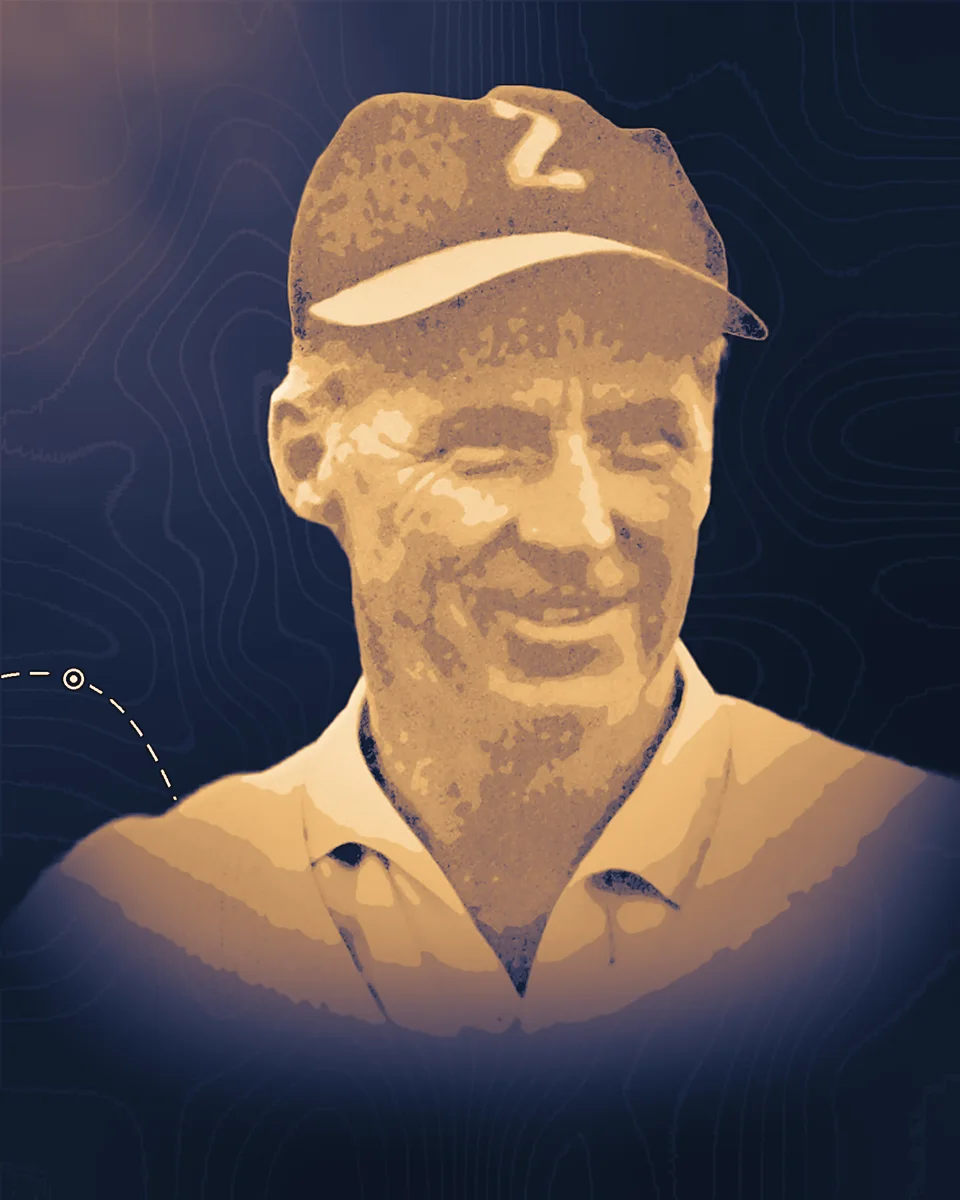
Norman Borlaug
He bred short, rust-resistant wheats in Mexico that raised harvests there and across India and Pakistan.
1914–2009
What they changed
1946
Two breeding seasons a year
Borlaug grew one generation of wheat in summer near Mexico City and a second in winter in the irrigated Yaqui Valley of Sonora, so a new variety took half as many years to breed. The program's adviser said seed needed a year of rest and its director said the plan cost too much, and Borlaug went north anyway.
1954
Dwarf genes from Japan
Tall wheat fell over when it was fertilized heavily. Borlaug crossed his Mexican wheats with lines that carried dwarfing genes from the Japanese variety Norin 10, sent to him by the US breeder Orville Vogel. He dated the first crosses to 1954, and CIMMYT, the international maize and wheat center in Mexico, dates them to 1953. The first two short varieties, Pitic 62 and Penjamo 62, were released in 1962.
1956
Mexico grows its own wheat
Mexico produced enough wheat to meet its own needs in 1956, by the University of Minnesota's account. The Guardian's obituary says his rust-resistant varieties had helped double the country's wheat production by then.
1961
Breeders trained in the field
On Borlaug's recommendation to the UN Food and Agriculture Organization, the first trainees from North Africa and the Middle East came to Sonora in 1961 and learned wheat breeding by doing it in the plots. The Guardian's obituary counts more than 2,000 young scientists from nearly 20 countries trained in his program.
1966
Seed by the shipload
After trials that began in 1963, India imported 18,000 tons of Mexican dwarf wheat seed in 1966 and Pakistan 42,000 tons a year later. By Borlaug's figures India's wheat harvest rose from 12.3 million tons in 1965 to 20.0 million in 1970, and Pakistan's from 4.6 million to 8.4 million.
Life
Norman Ernest Borlaug was born on 25 March 1914 on a farm near Cresco, Iowa. He studied forestry at the University of Minnesota and graduated in 1937. He stayed to study plant pathology, the science of plant disease, and took a master's degree in 1939 and a doctorate in 1942. He worked for the chemical company DuPont from 1942 to 1944, then joined a wheat program in Mexico run by the Mexican government and the Rockefeller Foundation.
The first problem was stem rust, a fungus that could destroy a wheat crop. Borlaug crossed Mexican wheats with resistant ones and bred two generations a year at two sites. The short stems came later and were not his discovery. They came from Norin 10, a variety the Japanese breeder Gonjiro Inazuka made in 1935. Samuel Salmon of the US Department of Agriculture brought it to the United States after the Second World War, and Orville Vogel in Washington State bred from it and sent seed to Borlaug. The Mexican scientist Ignacio Narváez worked beside him from the first years and later led the work in Pakistan with him.
borlaug.cfans.umn.eduborlaug.cfans.umn.educimmyt.orgborlaug.cfans.umn.edu
Trials of the short wheats began in India and Pakistan in 1963. Both countries then imported seed by the shipload, and their wheat harvests rose by more than half between 1965 and 1970. In his Nobel lecture Borlaug said the wheats did this only with fertilizer, irrigation, credit and a fair price for grain, and that Indian and Pakistani scientists had fitted the methods to their own fields. He received the Nobel Peace Prize in 1970 "for having given a well-founded hope - the green revolution". The University of Minnesota's history says he wrote to his teacher Elvin Stakman and to George Harrar, who had led the Mexican program, that either of them should have had the prize or shared it.
Critics said the gains came at a cost. The Guardian's obituary reports the case made by the Indian ecologist Vandana Shiva and others: the new seeds needed bought fertilizer and more water, and their spread brought poorer soil, fewer crop varieties, debt and inequality, and pushed many small farmers off the land. A 2012 review of the evidence by the economist Prabhu Pingali found that the Green Revolution cut hunger and poverty. It also found that some regions were left behind and that water, soil and rivers were damaged, mostly because subsidies for fertilizer, pesticide and irrigation water encouraged farmers to overuse them.
Borlaug rejected much of this. He said many Western environmental lobbyists were "elitists" who had "never experienced the physical sensation of hunger". In a lecture in Oslo in 2000 he argued that, at the cereal yields of 1950, the world harvest of 1999 would have needed nearly 1.8 billion hectares of land of the same quality, where 600 million were used. In the same lecture he said the environmental movement in rich countries was owed a debt for cleaner air and water. In his last decades he argued for genetically modified crops.
He retired from CIMMYT in 1979 and from 1984 taught at Texas A&M University. After the famine in Ethiopia he became president of the Sasakawa Africa Association, which worked on food production in African countries, and stayed with it for the rest of his life. He received the Presidential Medal of Freedom in 1977 and the Congressional Gold Medal in 2006. He died in Dallas, Texas, on 12 September 2009, aged 95.
Read more
6 accounts
The green revolution, peace, and humanity, Norman Borlaug, 1970.
His Nobel lecture, with his own figures for seed, fertilizer and harvests in Mexico, India and Pakistan.
nobelprize.org
The Green Revolution revisited and the road ahead, Norman Borlaug, 2000.
A lecture in Oslo thirty years after the prize, in which he answers his critics.
nobelprize.org
Norman Borlaug: in-depth history, University of Minnesota, undated. A year-by-year account in six parts, from his birth to his death, by the university that taught him.
borlaug.cfans.umn.edu
Reference books, University of Minnesota, undated. The university's list of the book-length lives, among them Lennard Bickel's Facing Starvation (1974), Leon Hesser's The Man Who Fed the World (2006) and Noel Vietmeyer's three-volume Borlaug (2008–2010).
borlaug.cfans.umn.edu
Norman Borlaug, Christopher Reed, The Guardian, 2009.
An obituary that sets the criticisms beside the harvest figures.
theguardian.com
Green Revolution: impacts, limits, and the path ahead, Prabhu Pingali, Proceedings of the National Academy of Sciences, 2012.
A review of what the evidence shows the new varieties did and did not do.
pmc.ncbi.nlm.nih.gov