Industries / Figureheads
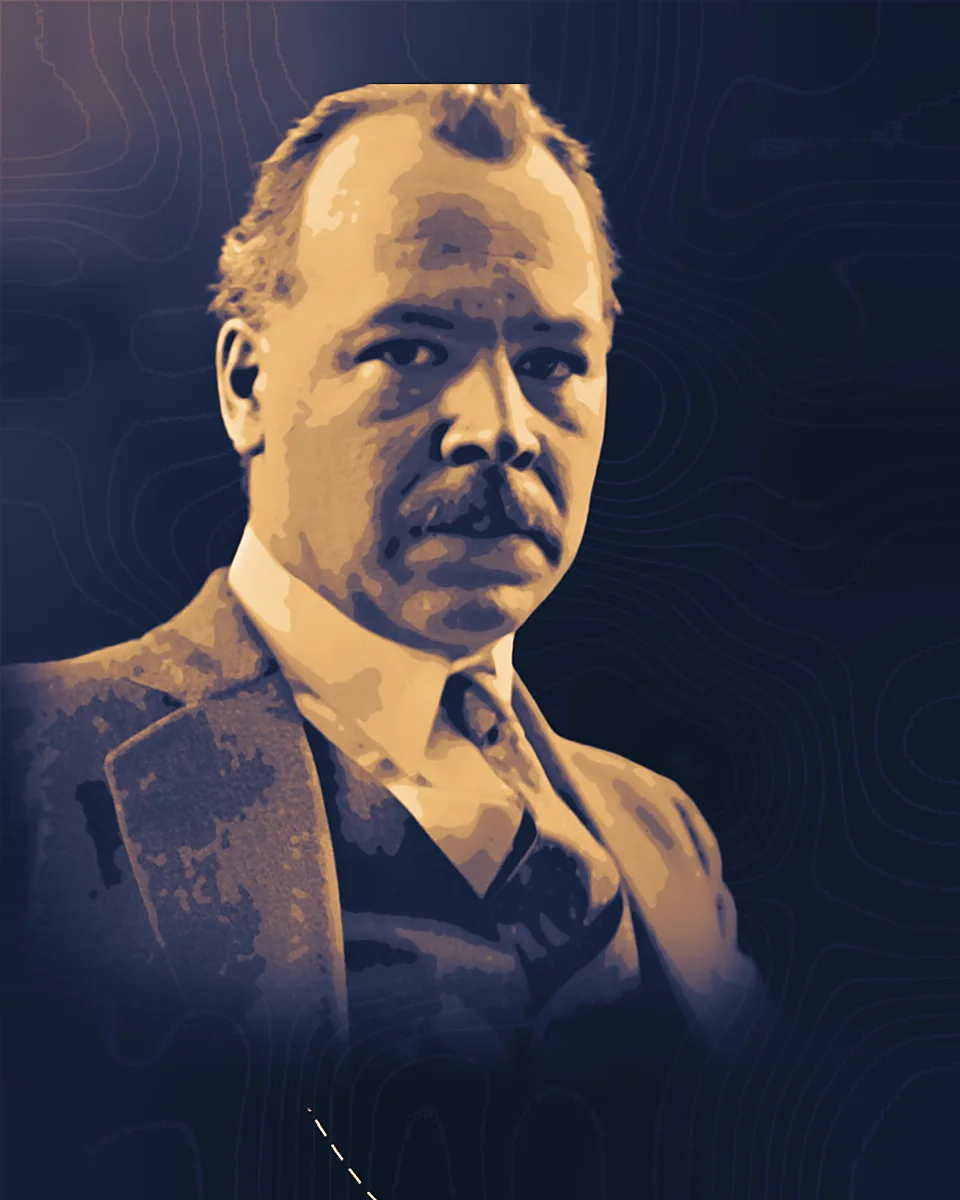
Nikolai Vavilov
He built a world collection of crop seed in Leningrad, the pattern for today's gene banks.
1887–1943
What they changed
1920
A rule for collectors
At Saratov, Vavilov set out his law of homologous series: related species vary in parallel, so a form found in one, such as wheat without awns (the bristles on the ear), can be expected in its relatives, such as barley and rye. It told a collector which forms were still missing. He published it in English in 1922.
1924
A bank for seed
That year he reorganized Russia's Bureau of Applied Botany into a national institute in Leningrad, now St. Petersburg, with a seed collection meant to be used as well as kept. There was no cold storage, so the samples were sown each year at stations across the country and fresh seed was sent back. He headed it from 1920 to 1940 and built what was then the world's largest collection of cultivated plants, more than 200,000 samples by the count of Solberg and colleagues.
1926
Where crops began
From his own collecting he argued that crops arose in a few regions of the world, mostly mountainous, where their wild relatives and oldest varieties are still most varied. He used the map to aim expeditions. Those regions remain important collecting grounds.
1970s
Gene banks multiply
Many countries set up national gene banks from 1970 onward. Solberg and colleagues, a team with authors in Norway, Canada and Russia, trace those banks, the Nordic Gene Bank of 1979 and the Svalbard Global Seed Vault of 2008 back to Vavilov's work, and say gene banks "in the modern sense" begin with him.
2022
Breeders still draw on it
Over three seasons a University of Queensland team grew 292 wheat samples from the Vavilov collection and found new sources of resistance to stripe rust, a fungal disease of wheat, including seven regions of the genome not linked to it before.
Life
Nikolai Vavilov was born in Russia in 1887 and grew up in years when drought, pests and cold wrecked harvests; one famine of his childhood killed 400,000 people, by the Science History Institute's account. He graduated from the Moscow Agricultural Institute in 1910. In a 1912 paper he argued that Mendel's genetics should be the scientific basis of plant breeding, and in 1913 and 1914 he worked in England with the geneticist William Bateson.
He collected in person. He went to Iran and Central Asia in 1916, Afghanistan in 1924 and Ethiopia in 1927, and visited 40 countries on five continents. With his colleagues' trips the institute ran 140 expeditions inside the Soviet Union and 40 abroad, covering 64 countries. He meant the seed to be bred from, and set up breeding programs and more than 100 experiment stations to test it.
He rose high in Soviet science. He was elected a full member of the Academy of Sciences in 1929, was the first president of the Lenin Academy of Agricultural Sciences, and was a Foreign Member of Britain's Royal Society.
From the mid-1930s the agronomist Trofim Lysenko, who denied that genes exist and promised quick gains from chilling seed before sowing, had the backing of Stalin's government and made political accusations against geneticists. Vavilov argued against him at public meetings in 1936 and 1939. In August 1940, while he was collecting in Ukraine, security agents arrested him. He was sentenced to death, the sentence was changed to 20 years, and he died of hunger in Saratov prison in January 1943, aged 55.
His staff kept the collection through the siege of Leningrad, which lasted from September 1941 to January 1944. They did not eat it. Nine of them starved to death, the Science History Institute records, one at his desk with a packet of peanuts in his hand.
Parts of the record are unsettled. Vavilov redrew his own map, from three centers of origin in 1924 to eight in 1934 and seven in 1940, and Cohen and Loskutov note that the centers do not always match the places where crops are most varied today. Counts of the collection in his time run from 187,000 to 380,000 samples, depending on the source. The Science History Institute calls it the world's first seed bank; the geneticist Ilya Zakharov says "among the first ones in the world and the most extensive at that time."
Read more
6 accounts
The Law of Homologous Series in Variation, N. I. Vavilov, Journal of Genetics, 1922.
His own paper, in English.
link.springer.com
Origin and Geography of Cultivated Plants, N. I. Vavilov, Cambridge University Press, 1992.
His papers on where crops came from, in English translation.
archive.org
The Murder of Nikolai Vavilov, Peter Pringle, 2008.
A full biography in English, from his expeditions to his death in prison.
openlibrary.org
The Tragedy of the World's First Seed Bank, Sam Kean, Science History Institute, 2022.
The collection, the arrest and the siege, told for general readers.
sciencehistory.org
Exploring the Nature of Science Through Courage and Purpose: A Case Study of Nikolai Vavilov and Plant Biodiversity, J. I. Cohen and I. G. Loskutov, SpringerPlus, 2016.
His ideas, his gene bank and his expeditions, with sources.
pmc.ncbi.nlm.nih.gov
The Impact of N. I. Vavilov on the Conservation and Use of Plant Genetic Resources in Scandinavia, S. Ø. Solberg and colleagues, Plants, 2022.
How his work led to today's gene banks, including Svalbard.
pmc.ncbi.nlm.nih.gov