Industries / Figureheads
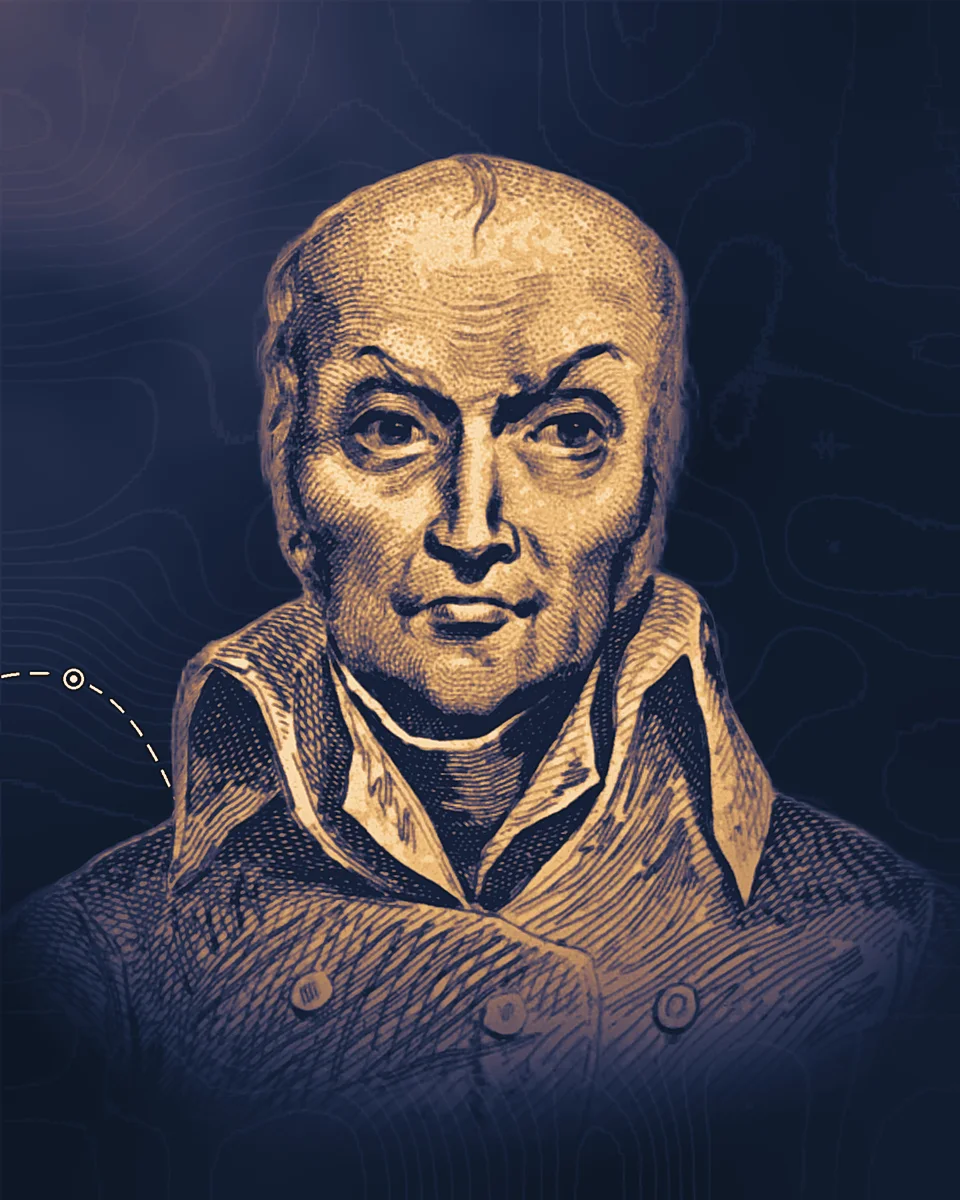
Nicolas Appert
He showed that food heated in a sealed container keeps for years, and published the method for anyone to use.
1749–1841
What they changed
c. 1802
A factory for bottled food
Appert moved his work from a Paris shop to Massy, south of the city, where he grew produce and preserved it in glass bottles. The town of his birth dates the works to 1802 and says it employed about fifty people. The Encyclopedia of World Biography dates it to 1804 and calls it the world's first canning factory.
1803
The navy tests it
The Minister of Marine sent Appert's bottled food to the port of Brest. After three months lying at anchor, the port's Council of Health reported that the broth was good and that the beans and green peas had the freshness and flavour of newly gathered vegetables. Appert printed the report in his book.
1810
The method made public
On 30 January 1810 the Minister of the Interior, Montalivet, wrote to Appert granting him 12,000 francs. The only condition was that he print an exact description of the process at his own cost and send in 200 copies. The book came out that year as L'Art de conserver, pendant plusieurs années, toutes les substances animales et végétales, and an English translation was printed in London in 1811.
1810
Two rules for preserving
In the book Appert stated what he had found by trial: fire delays the natural tendency of food to decay, and food keeps when heat is applied after it has been cut off from the air as completely as possible. He packed food in bottles, corked them tightly and heated them in boiling water. Every later form of canning uses the same two steps.
1813
Others put it in tin
Appert took no patent. In England Peter Durand patented preserving food in tinplate and other containers, saying the idea came from "a person residing abroad", and sold the patent. By 1813 the firm of Donkin, Hall and Gamble was producing canned food. Appert himself moved to cylindrical tinplate cans about twelve years after Durand's patent.
Life
Nicolas Appert was born on 17 November 1749 at Châlons-sur-Marne, now Châlons-en-Champagne, the ninth child of innkeepers. He learned cooking and preserving in the trade, worked for twelve years at the castle of Deux-Ponts in Germany, and in 1784 opened a confectioner's shop in Paris. He took part in the Revolution and spent three months in prison. In his book he wrote that he had spent 45 years in pantries, breweries, cellars and the shops of confectioners, distillers and grocers.
He began his trials in the 1790s. By the early 1800s he was preserving meat, soup, vegetables, fruit and milk at Massy, and he asked the navy to test them at sea. In 1810 a board that included the chemist Gay-Lussac examined the process for the Minister of the Interior and certified that Appert's description matched the experiments he had made in front of them. The minister's letter said the discovery would be of use on sea voyages, in hospitals and in homes.
Appert knew that the method worked and not why. Nobody yet knew that microbes spoil food. More than fifty years later Louis Pasteur patented a way of keeping wine by heating it, defended his priority for some years, and in the end admitted, in the words of the Dictionary of Scientific Biography entry carried by Encyclopedia.com, "that he had been anticipated by Nicolas Appert".
The prize did not make him rich. The Massy works were destroyed when Prussian and Austrian armies invaded France in 1814, and he started again in Paris at the age of 64, in premises the government helped pay for. He went on to use an autoclave, a kind of pressure cooker, to make gelatin, dried bouillon and concentrated milk. The Society for the Encouragement of National Industry gave him a gold medal in 1820 and a prize of 2,000 francs in 1824.
He sold the business in 1840. He died at Massy in June 1841, aged 91, a widower without the money for a funeral, and was buried in the common grave.
Read more
4 accounts
The Art of Preserving All Kinds of Animal and Vegetable Substances for Several Years, Nicolas Appert, London, 1811.
The first English translation of his own book, with the minister's letter, the board's certificate and the navy's report printed at the front.
archive.org
The Book for All Households, Nicolas Appert, translated by K. G. Bitting, Chicago, 1920.
A later English translation of the book, made for the American canning trade.
archive.org
Nicolas Appert, Châlons-en-Champagne tourist office, undated. The account kept by his birthplace, with the dates of the shop, the factory and the sale of the business.
en.chalons-tourisme.com
Nicolas Appert, Grace's Guide to British Industrial History, 2017.
A short account of how the method crossed to England, condensed from Maureen Greenfield and Russ Day's 2016 life of Bryan Donkin.
gracesguide.co.uk