Industries / Figureheads
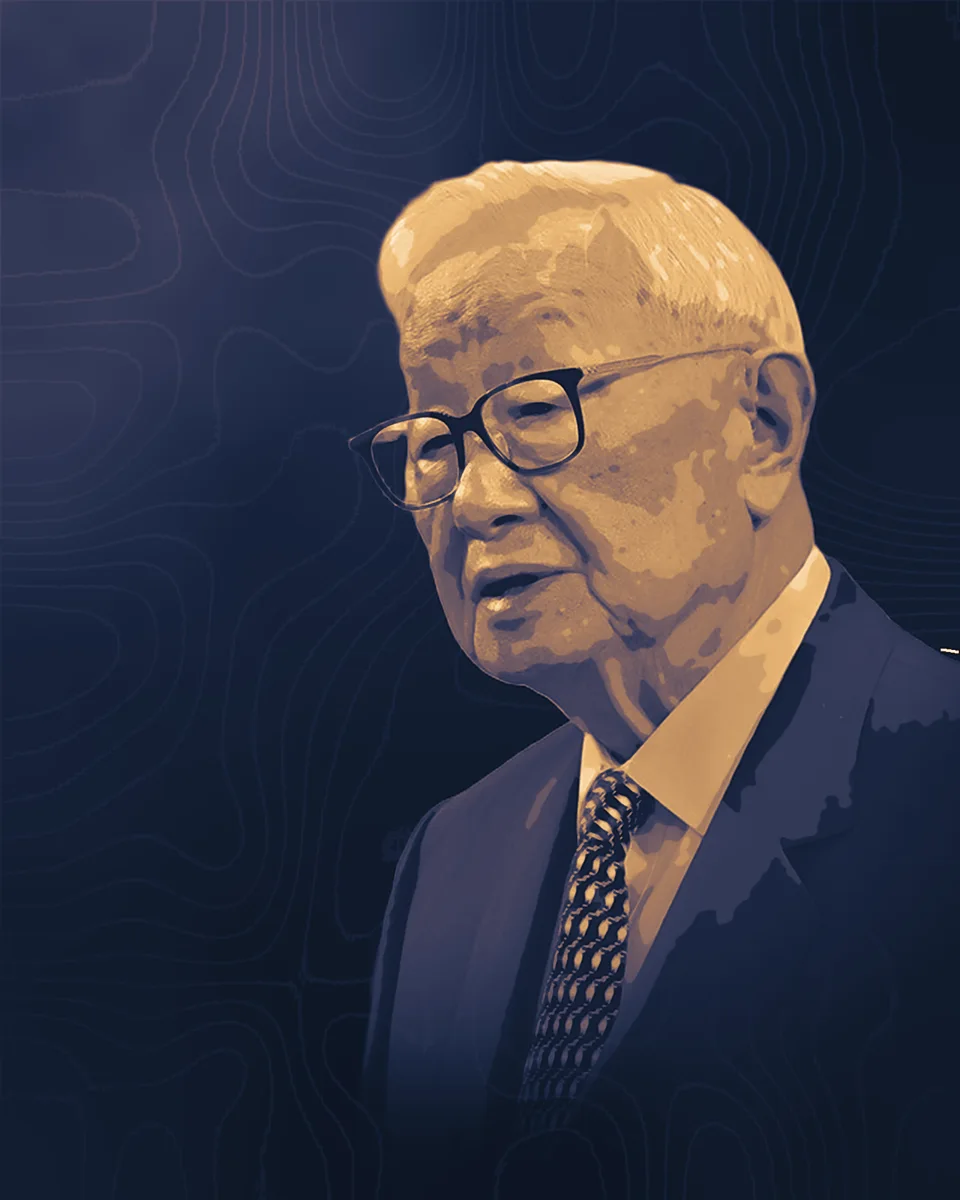
Morris Chang
He founded TSMC as a factory that makes other companies' chips and designs none of its own, which let chip companies exist without a factory.
born 1931
What they changed
1964–1983
Prices set ahead of costs
As a manager at Texas Instruments, where he ran the whole semiconductor business by 1972, Chang set chip prices below early costs in order to win orders, so that volume would raise the share of good chips on each wafer and bring costs down. IEEE Spectrum says he "pioneered the then controversial idea".
1985
A plan in four days
K. T. Li, a minister in Taiwan's government, asked Chang for a business plan for a new chip company. Chang judged that Taiwan was weak in chip design, marketing and patents and had one possible strength, manufacturing. He proposed a company that would only manufacture, which he called a pure-play foundry.
1987
A factory for hire
Taiwan Semiconductor Manufacturing Company (TSMC) opened in February 1987 with $220 million in capital, half from Taiwan's government and half from outside investors, of which the Dutch firm Philips was the main one. The IEEE calls it "the world's first dedicated IC foundry company". Because it sold no chips of its own, it did not compete with the firms whose designs it made.
1991
Chip firms without factories
TSMC's first customers were large chipmakers handing over older products. By Chang's account the company began to grow fast in 1991 and 1992, when companies that design chips and own no factory, called fabless, multiplied. He counted fewer than a hundred of them before 1991 and close to a thousand in 2007. Broadcom, Marvell, Nvidia and Qualcomm were customers from their early years.
2011
IEEE Medal of Honor
The Institute of Electrical and Electronics Engineers gave Chang its Medal of Honor "for outstanding leadership in the semiconductor industry".
Life
Morris Chang was born in 1931 in Ningbo, China. His family moved several times during the wars of his childhood, to Nanjing, Guangzhou, Hong Kong and Chongqing. In 1949 he went to the United States to study at Harvard University, and after a year he transferred to the Massachusetts Institute of Technology, where he took a bachelor's degree in 1952 and a master's in 1953, both in mechanical engineering. He failed the qualifying examination for a doctorate there and in 1955 took a job in the small semiconductor division of Sylvania Electric Products.
In 1958 he joined Texas Instruments in Dallas. His first job was a production line making a transistor for IBM to IBM's own design, where almost none of the devices worked. After four months of changes to the process the share of good devices passed 20 percent, and he was made a manager. The company paid for him to take a doctorate in electrical engineering at Stanford University, which he finished in 1964. By 1972 he ran the company's whole semiconductor business. In 1978 he was moved to its consumer products, which he later called a mistake, and in 1983 he left. He was president of General Instrument in New York for about a year.
Taiwan's government had been building a chip industry for a decade before Chang came. In 1975 its Industrial Technology Research Institute (ITRI) licensed a manufacturing process from the American firm RCA, and in 1980 the institute spun off a chip company. Chang said the political leaders "deserved all the credit" for the RCA licence. In 1985 K. T. Li, a minister without portfolio who had met Chang when Texas Instruments was negotiating to build a plant in Taiwan, recruited him as president of ITRI. Within weeks Li asked him to start a semiconductor company.
Chang did not claim the idea as wholly his own. He said he had read Carver Mead, who had shown that the design of a chip could be separated from its manufacture, though Mead had not proposed a company that did only manufacturing. He called the foundry "the least evil choice" for a place with little strength in design or marketing. Of the fabless industry that later grew on it he said: "I can't tell you that I saw the rise of the fabless industry, I only hoped for it." The plan was poorly received. Philips was, in his words, "the only willing significant investor", and the government put up half the capital. The institute's process was by then about two and a half generations behind the leading chipmakers.
The companies that came to depend on TSMC give the outside view. Jensen Huang, a founder of Nvidia, told IEEE Spectrum that with TSMC "the barriers to getting your chips built, to realizing your imagination, disappeared". James Plummer, then dean of engineering at Stanford, said Chang "enabled start-ups to start with a few million dollars rather than a few hundred million". By the magazine's figures TSMC took almost half of all foundry revenue in 2010.
Chang retired from TSMC after its shareholders' meeting on 5 June 2018. On 14 September 2018 President Tsai Ing-wen awarded him the Order of Propitious Clouds, first class. He represented Taiwan at the leaders' meeting of APEC, the Asia-Pacific Economic Cooperation forum, in 2023, and in April 2024 he received the Order of Dr. Sun Yat-sen for representing Taiwan there.
investor.tsmc.compr.tsmc.comfocustaiwan.twfocustaiwan.twflickr.com
Read more
3 accounts
Oral history of Morris Chang, interviewed by Alan Patterson, Computer History Museum, 2007.
Chang's own account of Texas Instruments, ITRI and how the foundry plan was made, in 18 pages.
archive.computerhistory.org
Morris Chang: Foundry Father, Tekla S. Perry, IEEE Spectrum, 2011.
A long profile written for his Medal of Honor, with the views of customers and colleagues.
spectrum.ieee.org
TSMC Dr. Morris Chang Announces Retirement in June 2018, TSMC, 2017.
The company's announcement, with his own statement on handing over.
pr.tsmc.com