Industries / Figureheads
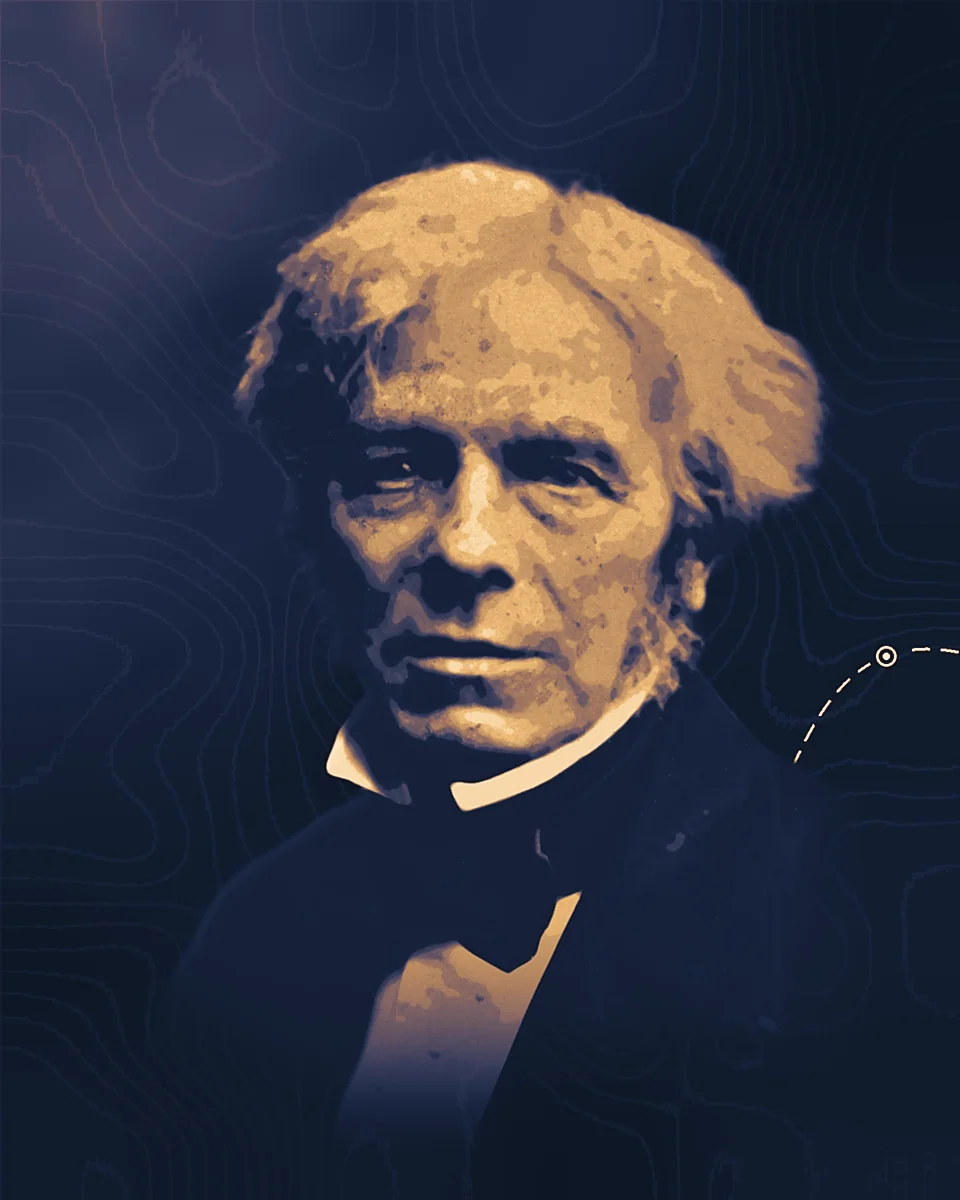
Michael Faraday
He found that a moving magnet makes an electric current in a wire, the principle every generator in every power plant works by.
1791–1867
What they changed
1821
Electricity makes motion
Soon after Hans Christian Ørsted found that an electric current moves a compass needle, Faraday built two devices in which a wire carrying current turned steadily around a magnet, and a magnet around a wire.
1831
The induction ring
On 29 August 1831 he wound two coils of wire on an iron ring and found that switching the current in one produced a brief current in the other. The Institution of Engineering and Technology says "the induction ring was the first electric transformer."
1831
A magnet makes a current
Within weeks he showed that moving a magnet in and out of a coil of wire, or turning a copper disc between the poles of a magnet, produced a current for as long as the motion lasted. The Institution says of the disc, "This was the first generator."
1832
One electricity
He showed that the electricity from his induction experiments, from batteries and from static machines was the same thing.
Life
Michael Faraday was born on 22 September 1791 at Newington Butts, Southwark, now part of London. His father was a blacksmith who had come from the north-west of England, and the family belonged to the Sandemanians, a small Christian church. From 1805 to 1812 he was apprenticed to the bookbinder George Riebau.
On 1 March 1813 he was taken on as laboratory assistant at the Royal Institution in London. He toured the Continent with the chemist Humphry Davy and returned to the laboratory in 1815. He stayed for the rest of his working life. He became Director of the Laboratory in 1825 and Fullerian Professor of Chemistry in 1833. He liquefied chlorine in 1823 and discovered benzene in 1825.
His experiments on induction began in 1831, and he reported them to the Royal Society on 24 November 1831 and 12 January 1832. He did not build machines to sell. The apparatus he made that autumn, a coil on a tube and a bar magnet, is on show at the Royal Institution, which says that nearly all electric power is still generated on his principle, whether the plant runs on coal, gas, nuclear fuel, water or wind.
He founded the Royal Institution's Christmas Lectures in the mid-1820s and gave many of them. He advised the Admiralty from 1829 and Trinity House, the lighthouse authority, from 1836 to 1865, and taught chemistry at the Royal Military Academy, Woolwich, from 1830 to 1851. He twice declined the presidency of the Royal Society and said several times that he would not accept a knighthood.
He ended his connection with the Royal Institution in 1865, after more than fifty years, and died on 25 August 1867 at his house at Hampton Court.
Read more
4 accounts
The Life and Letters of Faraday, Henry Bence Jones, 1870.
Two volumes of his letters and laboratory notes, put together by the Royal Institution's secretary three years after his death.
archive.org
Michael Faraday, Institution of Engineering and Technology Archives, undated. A dated account of the experiments, from the body that holds many of his papers.
theiet.org
Michael Faraday's generator, Royal Institution, undated. The record of the 1831 coil and magnet, with what it showed.
rigb.org
Michael Faraday (1791–1867), Royal Institution, undated.
The Institution's own account of his posts and his life there.
rigb.org