Industries / Figureheads
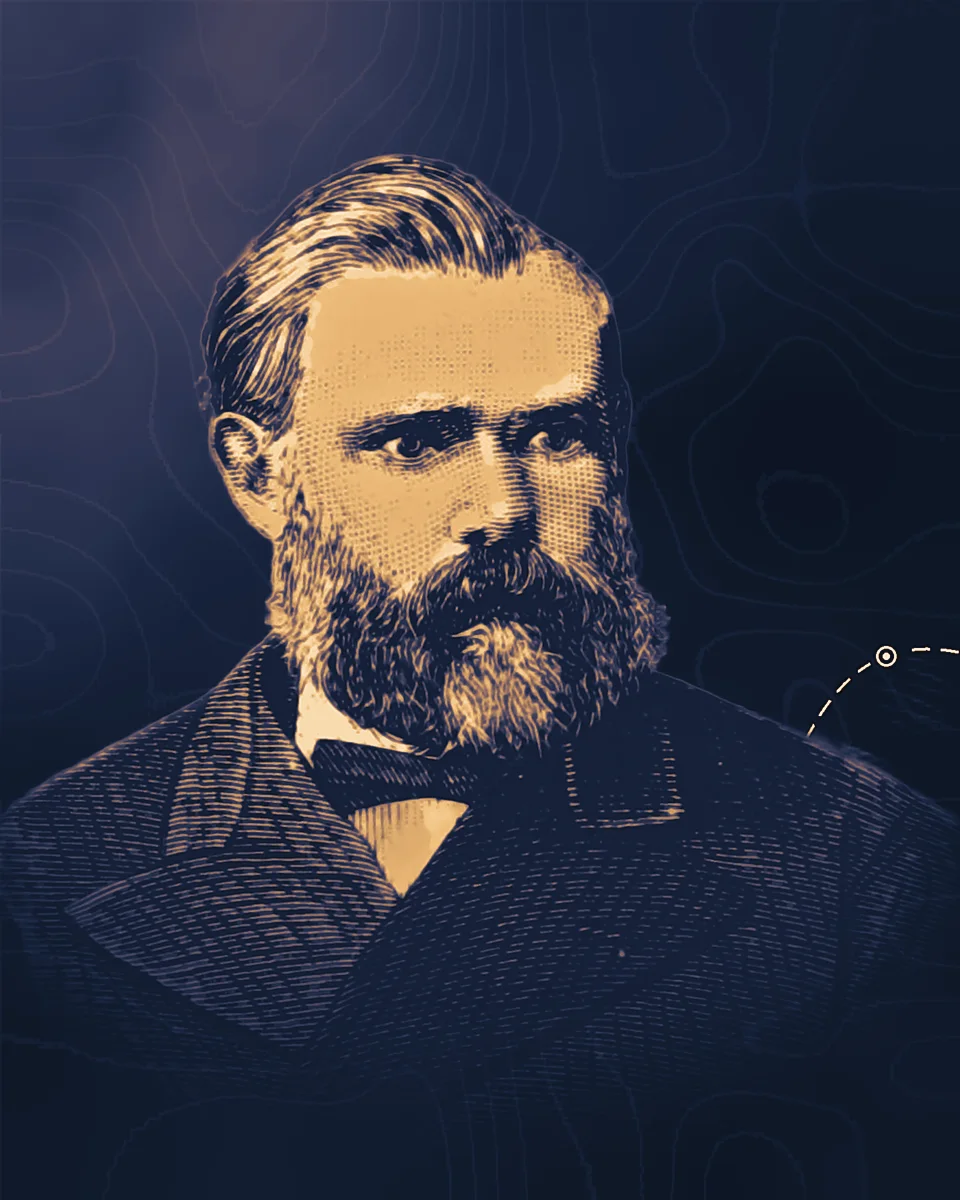
Ludvig Nobel
He paid for the first oil pipeline at Baku and then moved Russia's oil in bulk by tank ship, tank car and a chain of storage depots, so kerosene no longer travelled in barrels.
1831–1888
What they changed
1878
Pipe to the refinery
At Baku crude oil went from the Balakhany wells to the refineries in barrels on carts. Charles Marvin, writing in 1884, says Robert Nobel could not persuade the other firms to share a pipeline, so his brother Ludvig paid about £10,000 for an eight-mile line to the Black Town that paid for itself in its first season. Marvin calls it "the first in the country." The carriers lost their trade, and watch-houses had to be built along the line to protect it.
1878
Oil carried loose at sea
The Nobels had the Zoroaster built in Sweden, which the Branobel History timeline calls the world's first tanker, commissioned in 1878. Marvin says Ludvig Nobel designed the Caspian cistern steamers himself, with watertight compartments to hold the shifting cargo, after the Caucasus and Mercury steamship company refused to fit tanks. When Marvin wrote, the firm had twelve; the Spinoza carried 750 tons of kerosene a trip.
1880s
Tank cars for the railways
When the railway from the Volga refused to add tank cars, the Nobels built their own, about 1,500 when Marvin wrote, run as sixty trains of 25 cars of about ten tons each, by Marvin's figures. They replaced barrels on the line from Tsaritsyn into Russia.
1880s
Depots for the winter
River boats could carry oil only in summer, when little lamp oil was burned. So the firm built storage depots to fill in summer and empty in winter: a central depot at Orel with tanks for 18 million gallons, four others at Moscow, St Petersburg, Warsaw and Saratov, and more than twenty smaller ones, 35.8 million gallons in all with Tsaritsyn, Marvin reports.
Life
Ludvig Nobel was born in Stockholm in 1831, a brother of Alfred Nobel, who invented dynamite. In 1842 the family joined his father Immanuel in St Petersburg, where Immanuel had set up an engineering works that made naval mines and, during the Crimean War, engines for gunboats. When the works failed in 1859 and Immanuel went home, Ludvig, then 28, stayed, wound up the business for the creditors and bought a smaller factory of his own.
His money came from arms. His works made cannons, gun carriages, mines and shells and converted 100,000 muzzle-loading rifles to breech-loaders, and with Major General Peter Bilderling he built a rifle factory at Izhevsk in the Urals in 1872. In 1873 his brother Robert went to the Caucasus to look for walnut for rifle stocks, and in 1874 bought a refinery at Baku. Ludvig and his son Emanuel visited Baku in 1876 and drew up a plan for the whole trade, from the wells to tankers and depots across Russia.
The engineering was not his alone. In 1876 he sent his works manager, Alexander Bari, to study the American oil trade, and Russian accounts credit the design of the 1878 pipeline and of the firm's riveted steel tanks to Bari's young chief engineer, Vladimir Shukhov. Marvin names neither man. He writes that the Russian public ascribed "every movement or innovation to Ludwig Nobel", and his own chapter on Nobel, titled "The Oil King of Baku", is openly admiring. The Branobel History project credits Ludvig with the cylindrical tanks as well as the pipeline.
branobelhistory.comweb.archive.orgarchive.orgbranobelhistory.com
In 1879 the brothers formed Branobel, the Nobel Brothers Petroleum Production Company, with Ludvig as chairman, Alfred and Bilderling among the shareholders. Robert opposed the company and left Baku about a year later. By the account of Jabi Bahramov and Haji Hasanov on the Branobel History site, the pipelines and tankers gave Branobel a monopoly of oil transport by land and sea in Russia, and the carters who lost their work attacked the first line until Cossack patrols guarded it. Branobel fought Standard Oil for the Russian and European markets for thirty years, and in 1881 its tanker Nordenskiöld burned while loading at Baku.
In 1882 he began Villa Petrolea, a residential suburb with a park at Baku for the firm's engineers and skilled workers, opened in 1884. He died at Cannes in 1888. His son Emanuel took over Branobel, and by 1916 the company produced a third of Russia's crude oil, according to the AAPG Explorer.
Read more
5 accounts
The Region of the Eternal Fire, Charles Marvin, 1884.
An account of the Baku oil field written from a visit at the time; chapter 17, "The Oil King of Baku", is a long portrait of Ludvig Nobel and his transport system.
archive.org
Ludvig Nobel enters the fight for oil, Brita Åsbrink, Branobel History, 2011.
His life from the St Petersburg works to Baku.
branobelhistory.com
Nobel's inventions led to oil business boom, Jabi Bahramov and Haji Hasanov, Branobel History, 2011.
The pipeline, the tanks, the tankers and the opposition they met.
branobelhistory.com
Timeline, Branobel History, undated. The company's dates year by year, from 1837 to its end.
branobelhistory.com
Baku Had Its Origins as a Nobel Venture, Sigrunn Johnsen, AAPG Explorer, 2012.
A short history of the brothers in Baku for petroleum geologists.
aapg.org