Industries / Figureheads
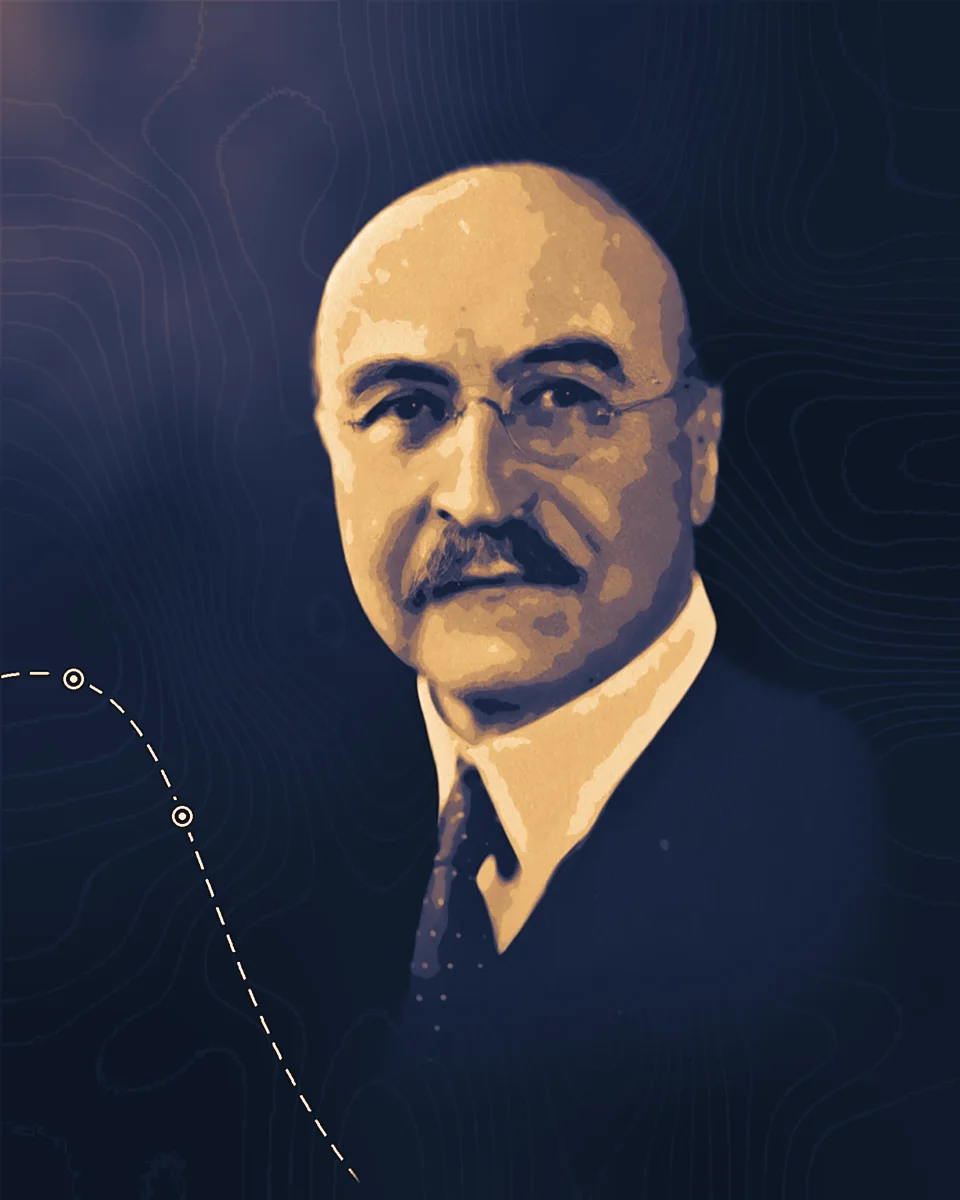
Leo Baekeland
He made Bakelite from phenol and formaldehyde, the first plastic built wholly from chemicals and the first that sets hard for good when molded under heat and pressure.
1863–1944
What they changed
1893
Velox printing paper
With Leonard Jacobi he founded the Nepera Chemical Company at Yonkers, New York, and made Velox, a photographic paper that could be printed by artificial light. Eastman Kodak bought the business in 1899, for a reputed 750,000 dollars, and the money paid for the laboratory where Bakelite was made.
1907
Hardening under heat and pressure
Chemists before him had mixed phenol, a coal-tar chemical, with formaldehyde and got either a meltable resin no better than shellac or a porous lump no solvent would touch. Baekeland split the reaction into steps. He first made a resin that could still be melted and shaped, then heated it under strong pressure so that it set into a hard solid without foaming. His US patent 942,699, filed in July 1907 and granted on 7 December 1909, claims the hardening "by the combined action of heat and pressure".
1909
Bakelite announced
He made his process public in 1909 and named the material Bakelite. The Science History Institute calls it "the first fully synthetic plastic": celluloid, before it, started from cotton. Once set, Bakelite does not melt again or dissolve, which made it the first of the plastics now called thermosets.
1910
A company to make it
He founded the General Bakelite Company in 1910. The material went into electrical insulators, radio and telephone parts, pot handles and stove knobs, and the Science History Institute says the car and radio industries were its chief early users.
collection.sciencemuseumgroup.org.uksciencehistory.orglindahall.org
Life
Leo Hendrik Baekeland was born on 14 November 1863 in Ghent, Belgium. He entered the University of Ghent at seventeen, supported himself by tutoring, and took his doctorate of science at twenty-one. He taught at the state normal school in Bruges from 1887 and became an associate professor at Ghent in 1889. A prize for young Belgian chemists paid for a tour of foreign universities, and it brought him to the United States in 1889. He stayed.
The sale of Velox in 1899 left him free, in the words of Charles Chandler of Columbia University, "to devote his time and energy to study and research". He set up a laboratory at his home in Yonkers. He also worked for Elon Hooker on the Townsend cell, which makes caustic soda and chlorine from salt water with electricity, at the plant that became the Hooker Electrochemical Company at Niagara Falls.
He did not discover the reaction between phenol and formaldehyde. Chandler's account of 1916 lists those who came before: Adolf von Baeyer in 1872, Kleeberg in 1891, then Smith, Luft, Story, Blumer and De Laire, whose aim was a cheap substitute for shellac. Baekeland began with the same aim, and his assistant Nathaniel Thurlow doubted that the hard, insoluble product others had thrown away could be put to use. Baekeland's step was to control the reaction so that the hard material formed in the mold, in the shape wanted.
He received the Perkin Medal on 21 January 1916 and was president of the American Chemical Society in 1924. That year Time magazine put him on its cover with the line "It will not burn. It will not melt."
archive.orgcollection.sciencemuseumgroup.org.uklindahall.org
He retired in 1939 and sold the company to the Union Carbide and Carbon Corporation. He died on 23 February 1944. The National Inventors Hall of Fame inducted him in 1978.
Read more
5 accounts
Presentation of Perkin Medal to L. H. Baekeland, Metallurgical and Chemical Engineering, 1 February 1916.
Chandler's account of his life and of the chemistry before him, and Baekeland's own speech on Velox and Bakelite.
archive.org
Leo Hendrik Baekeland, 1863–1944, Charles F.
Kettering, National Academy of Sciences Biographical Memoirs. The academy's memoir, with a list of his papers and patents.
nasonline.org
Method of Making Insoluble Products of Phenol and Formaldehyde, L. H. Baekeland, US patent 942,699, 1909.
The "heat and pressure" patent.
patents.google.com
Leo Hendrik Baekeland, Science History Institute, undated. A short life with the Velox sale and the uses of Bakelite.
sciencehistory.org
Leo Baekeland, William B. Ashworth Jr., Linda Hall Library, 2016.
A short illustrated life by a historian of science.
lindahall.org