Industries / Figureheads
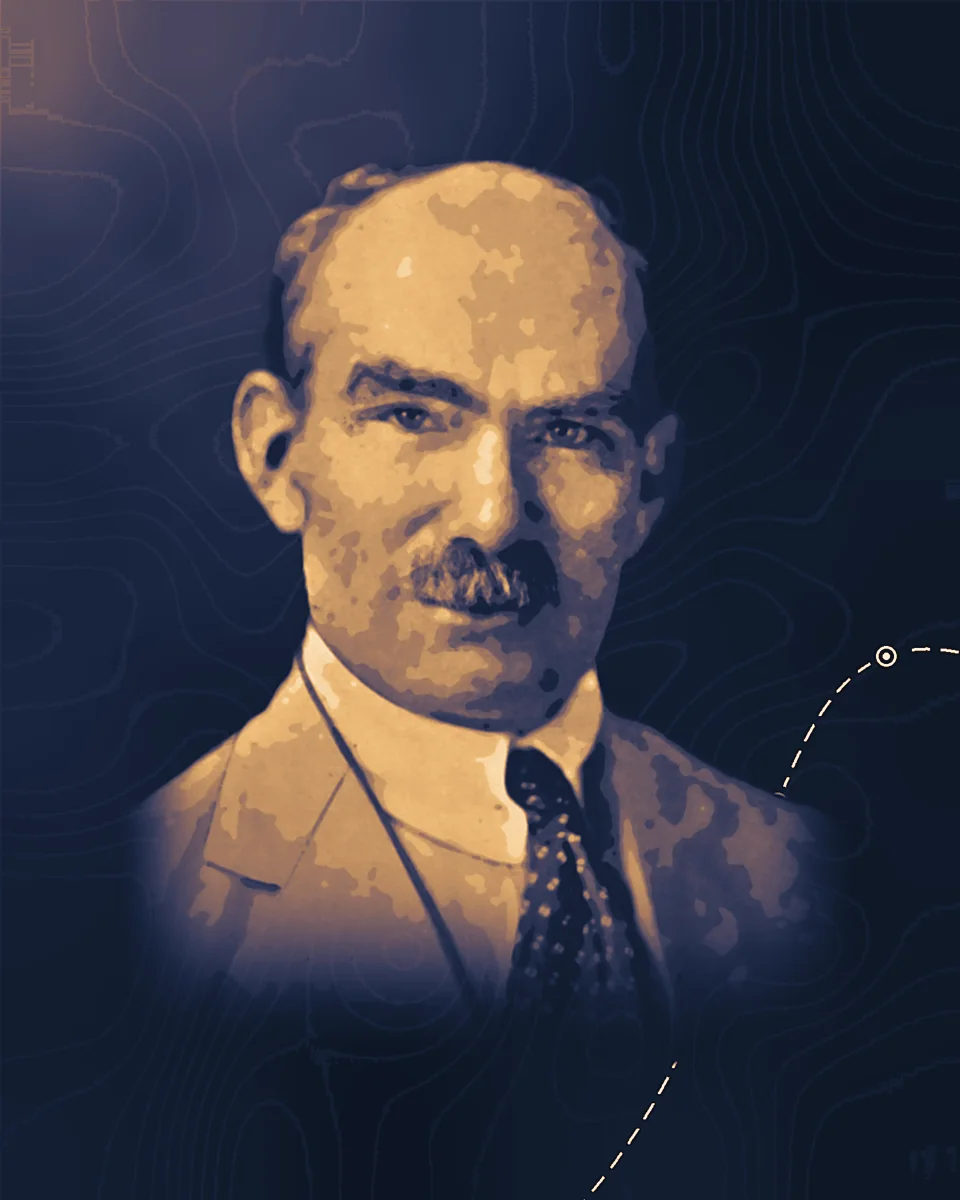
Lee de Forest
He put a third electrode, the grid, into the vacuum tube in 1906 and so made the Audion, the first widely used device that could amplify an electrical signal.
1873–1961
What they changed
1906
The Audion
John Ambrose Fleming's valve of 1904 was a light bulb with a metal plate in it that passed current one way. De Forest first patented a two-electrode tube of his own, then put a third electrode between the filament and the plate: a small wire grid. A weak signal on the grid controls a much larger current through the tube. He named the tube the Audion, and the patent on the three-electrode version was granted in 1908.
1912
The Audion amplifies
At first the Audion was used to detect radio signals. In the summer of 1912, at the Federal Telegraph Company in Palo Alto, California, de Forest and his assistant Van Etten worked on using it to strengthen weak telephone currents. He sold rights in the tube to the American Telephone and Telegraph Company, whose engineer Harold Arnold found that it worked properly only with the gas pumped out. Tubes made that way served as the repeaters, or boosters, on the telephone line across the United States, which opened on 25 January 1915.
1916
Broadcasts from a tube
A tube that feeds part of its output back to its grid produces a steady radio wave, which can carry speech and music. By 1916 de Forest was using Audions as a transmitter in New York, and in November 1916 he broadcast the returns of the presidential election, with music as well.
1920s
Sound printed on film
De Forest built Phonofilm, a system that recorded sound as an optical track on the cinema film itself, in step with the picture. The Engineering and Technology History Wiki says its quality was poor and the film industry did not take it up, but that the process the industry later adopted was very like it. The film academy gave him an honorary Oscar in 1959.
Life
Lee de Forest was born in Council Bluffs, Iowa, on 26 August 1873 and grew up in Talladega, Alabama, where his father was president of Talladega College, a historically Black school. He studied at Yale's Sheffield Scientific School and took a doctorate in 1899 with a thesis on radio waves along wires. He worked for Western Electric in Chicago, then moved to New York and started the De Forest Wireless Telegraph Company in 1902.
The Audion was built on Fleming's valve, and de Forest did not understand why it worked. He held that it depended on charged gas left in the bulb. Arnold's team showed that the gas was the fault and a high vacuum the cure. The Museum of Broadcast Communications' radio encyclopedia says "the inventor did not fully understand his own creation", and the United States Supreme Court wrote in 1934 that the tube's powers "were not fully appreciated by electrical experts, not even by its inventor". Ellison Hawks wrote in 1927 that American courts had treated the grid as an improvement on Fleming's patent, to be made only under licence from its owner.
His companies sold stock to the public, and that brought a criminal charge. A federal indictment of 15 March 1912 accused de Forest and four others of using the mails to defraud buyers of stock in the Radio Telephone Company and its sister firms, by claiming the companies paid dividends out of profits and by overstating what the radio telephone was worth. He was arrested at Palo Alto on 27 March 1912. The trial ended in December 1913. The jury convicted his business partners James Dunlop Smith and Elmer Burlingame and found de Forest not guilty.
The longest fight was with Edwin Howard Armstrong over the feedback circuit, also called regeneration. Armstrong, then a student at Columbia University, conceived it about January 1913 and was granted a patent in October 1914. De Forest claimed he had found it in August 1912. Federal courts in New York ruled for Armstrong, and in 1923 so did the Commissioner of Patents. An appeals court in Washington reversed that in 1924 and gave priority to de Forest, and the Supreme Court upheld him twice, the second time on 21 May 1934. The radio encyclopedia says that "although the courts would finally side with de Forest, the technical community did not".
De Forest received the Medal of Honor of the Institute of Radio Engineers in 1922 and the Edison Medal of the American Institute of Electrical Engineers in 1946, the latter for "the invention of the grid-controlled vacuum tube with its profound technical and social consequences". He held more than 300 patents. His autobiography of 1950 was titled Father of Radio, a name the Engineering and Technology History Wiki says he sought for himself and never won. He died in Los Angeles on 30 June 1961.
Read more
5 accounts
Father of Radio: The Autobiography of Lee de Forest, Lee de Forest, 1950.
His own account, written to make his case.
archive.org
Empire of the Air: The Men Who Made Radio, Tom Lewis, Edward Burlingame Books, 1991.
A history of de Forest, Armstrong and David Sarnoff and the lawsuits among them.
archive.org
Radio Corporation of America v. Radio Engineering Laboratories, United States Supreme Court, 293 U.S. 1, 1934.
Justice Cardozo's opinion in the last round of the feedback case, with the whole history of the dispute.
law.cornell.edu
The Radio Telephone Company prosecution, Thomas H. White, United States Early Radio History, undated. Trade-paper and newspaper reports of the arrests and the stock-fraud case, reprinted with notes.
earlyradiohistory.us
Pioneers of Wireless, Ellison Hawks, Methuen, 1927.
A history written at the time, with de Forest's own account of his first experiments in chapter 18.
archive.org