Industries / Figureheads
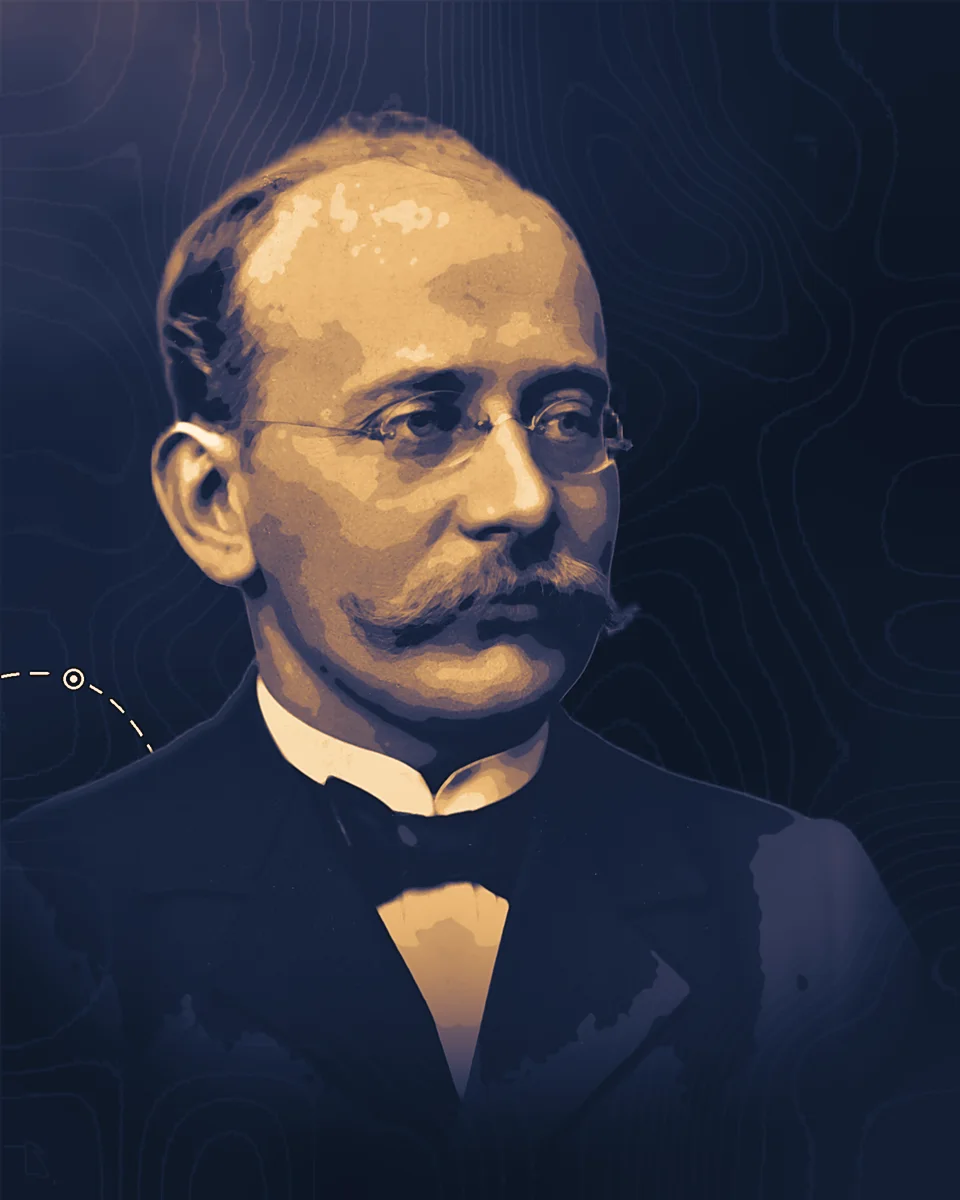
Kristian Birkeland
He invented the electric-arc method that first fixed nitrogen from the air for fertilizer on a factory scale, the method Norsk Hydro was founded to run.
1867–1917
What they changed
1903
Nitrogen from an arc
Birkeland was building an electromagnetic cannon, and its short circuits threw arcs of flame. He noticed a smell of nitrogen oxide with them, by Norsk Hydro's history. On 20 February 1903 he applied for a patent on ways of using electricity to make nitrogen compounds from the air, which Hydro counts as its patent number one.
1903
An inventor meets a builder
At a dinner on 13 February 1903 the engineer Sam Eyde said he wanted "the most powerful electrical discharge on earth", and Birkeland answered "That I can get for you." Within days they had an agreement to patent his method, with the patents in Birkeland's name. The method draws the arc out in a magnetic field. Norway's national biography calls Birkeland the inventor and Eyde the entrepreneur who made it pay.
1905
A factory at Notodden
The method was developed further at a power station near Arendal from 1904, with Birkeland in charge of the technical work and the experiments. Production began at Notodden on 2 May 1905 with about 100 workers. Output rose to well over 500 kilos of nitric acid per kilowatt-year, the level that chemists on a commission sent by the French bank Paribas had set as the point of profit.
1905
A company to run it
Norsk Hydro was founded on 2 December 1905, and the same meeting hired Birkeland as technical consultant for life at 5,000 kroner a year, the pay of his professorship. Its plants at Notodden made nitric acid, calcium nitrate and nitrite, and the calcium nitrate was tested as a fertilizer in place of Chilean saltpeter. UNESCO, which listed the Rjukan and Notodden works as a World Heritage Site in 2015, says they were built "to manufacture artificial fertilizer from nitrogen in the air".
Life
Kristian Birkeland was born in Christiania, now Oslo, on 13 December 1867. He took his degree in 1890, taught at a school for a couple of years, and was let back into the university's laboratory by its only physics professor. He became a university fellow in 1893 and professor of physics in 1898, at the age of 30.
His own field was the aurora. He argued that it came from rays from the sun drawn toward the poles, and tested the idea on a magnetized sphere in a vacuum chamber. He built observatories in the far north and led the Norwegian Aurora Polaris Expedition of 1902 and 1903. He needed money for this work, and in 1901 he set up a company to build a cannon that fired its shell with electromagnets. A public trial before representatives of Armstrong and Krupp went badly. Norway's national biography dates it 6 February 1903, as Eyde did in his memoirs; Hydro's history says it was held on 6 March.
The credit for the arc process has long been argued over. Norway's national encyclopedia says how the honour should be shared between Birkeland and Eyde "has been a disputed question". Hydro's history says Eyde thought his own part was underrated and helped feed the quarrel, and quotes him in 1916: "Much bound Birkeland and I together in the first years and much divided us in later years". Birkeland gave up his share in the company in 1907 for a large payment. Hydro says he was nominated for the Nobel Prize seven times, three of them together with Eyde, and never won it.
The arc did not last. It bound nitrogen as nitric acid, while the German Haber-Bosch process bound it as ammonia. Hydro's researchers tried to build a better arc furnace, and their work went better at small scale than at large. In spring 1927 Hydro agreed a partnership with IG Farben to expand by the ammonia method instead.
From about 1913 he lived at Helwan, near Cairo, where he built a house with an observatory to study the zodiacal light. His hearing was badly damaged, he may have been poisoned by mercury from his vacuum pumps, and Hydro's history says he suffered from delusions. The war cut him off from Norway. In 1917 he set out for home by way of East Asia and stayed in Tokyo to work with colleagues there. He was found dead in his hotel on 15 June 1917. His face has been on Norway's 200-kroner note since 1994.
Read more
5 accounts
Kristian Birkeland: The First Space Scientist, Alv Egeland and William J. Burke, Springer, 2005.
A full-length scientific biography, including the nitrogen work and Norsk Hydro.
archive.org
The Northern Lights, Lucy Jago, Knopf, 2001.
A life written for general readers, from the aurora expeditions to his death in Tokyo.
archive.org
Kristian Birkeland, Trygve Holtebekk, Norsk biografisk leksikon, about 2000.
Norway's national biography, with the dates of the cannon, the patent and the founding of Hydro. In Norwegian.
nbl.snl.no
On the oxidation of atmospheric nitrogen in electric arcs, Kristian Birkeland, Transactions of the Faraday Society, volume 2, 1906.
His own account of the arc process for a scientific society.
doi.org
1903: Explosive winter days, Norsk Hydro, 2020.
The company's account of the cannon, the dinner with Eyde and the first patent.
hydro.com