Industries / Figureheads
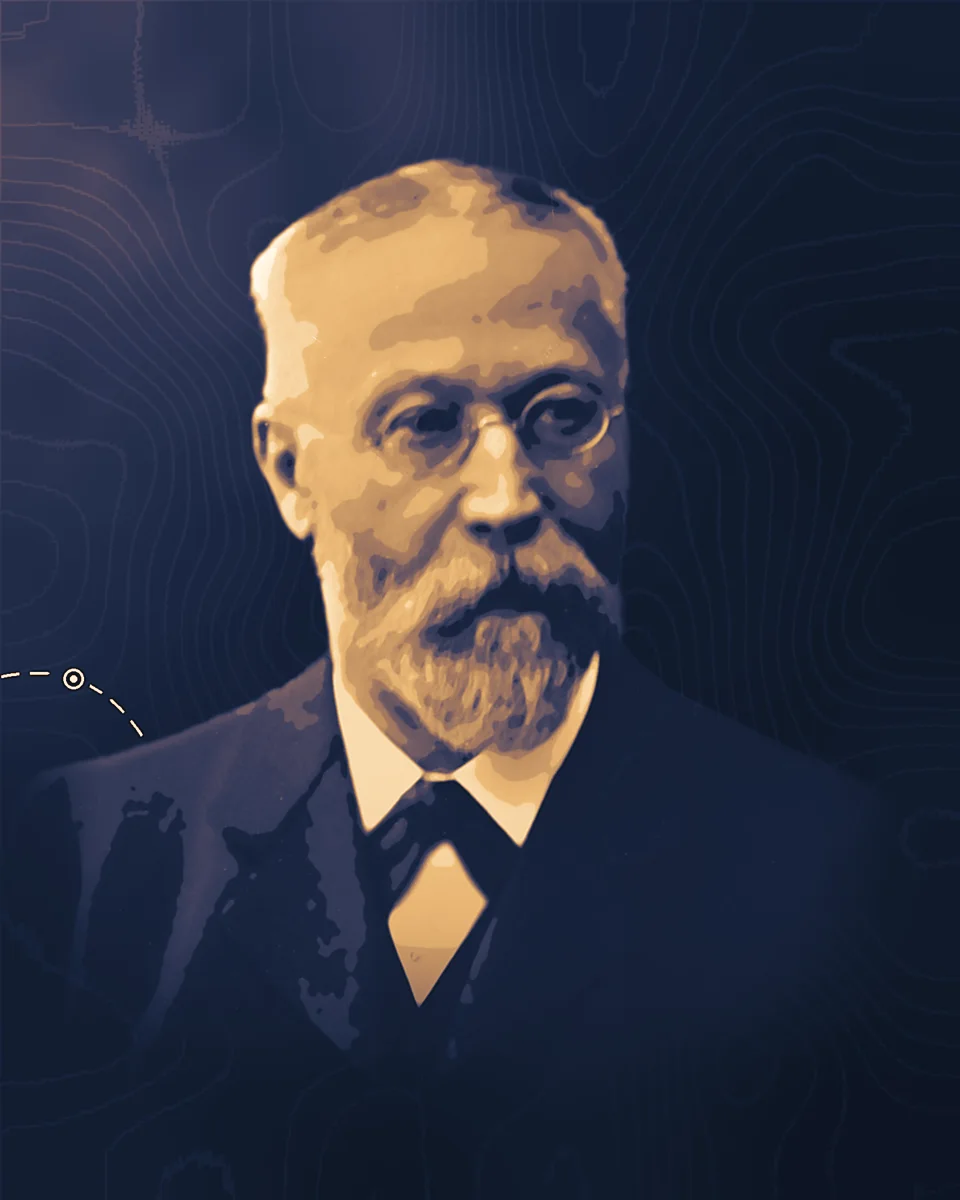
Karl Ferdinand Braun
He found in 1874 that a metal point on a crystal lets current through one way only, the effect behind the semiconductor diode, and in 1897 he built the cathode-ray tube.
1850–1918
What they changed
1874
One-way current in crystals
Braun touched a crystal of galena (lead sulfide) with the point of a thin metal wire and found that current passed freely in one direction only. A device that does this is called a rectifier, or diode. The Computer History Museum calls his paper the first written description of a semiconductor diode. He said in 1909 that he never found an explanation for the effect.
1897
The cathode-ray tube
To study fast alternating currents, Braun focused a beam of cathode rays (now known to be electrons) onto a glowing screen at the end of a glass tube and steered the beam with a coil, so the spot drew the shape of the current. The Linda Hall Library calls it the first modern cathode-ray tube and the first oscilloscope, the instrument engineers use to see a signal. Television picture tubes were later built on it.
1898
A transmitter with more reach
Marconi's first transmitters put the spark in the antenna itself and reached about 15 km. Braun moved the spark into a separate closed circuit and linked that circuit to the antenna through coils, which let a transmitter send more power. The German national biography says a side-by-side trial showed his transmitter worked better than Marconi's of the time.
1901
Crystals as radio detectors
When he took up radio in 1898 Braun tried his crystals as detectors of radio waves and found they gave no gain over the coherer, the detector then in use. He wrote that he recognized their use for listening by ear in 1901, and that the Telefunken company began work on them in 1905 on his advice. The crystal detector is the "cat's whisker" of the early crystal radio set.
1909
A Nobel Prize with Marconi
Braun and Guglielmo Marconi shared the Nobel Prize in Physics "in recognition of their contributions to the development of wireless telegraphy".
Life
Karl Ferdinand Braun was born in Fulda, Germany, on 6 June 1850, the son of a court official. He studied mathematics and physics at Marburg and Berlin and took his doctorate in Berlin in 1872 with a paper on vibrating strings. He then went to Würzburg as assistant to the physicist Georg Hermann Quincke, and in 1874 became a teacher at the St. Thomas school in Leipzig.
The crystal work dates from those years. In his Nobel lecture he said he found in 1874 that galena, pyrite and similar minerals did not obey Ohm's law, the rule that current rises in step with voltage, above all where an electrode touched the crystal over a small area. He showed the effect to an audience in Leipzig on 14 November 1876. It had no use for a quarter of a century. The first patents on crystal detectors for radio went to others: Jagadish Chandra Bose filed one in 1901, and the Americans Greenleaf Pickard and Henry Dunwoody received theirs in 1906.
He held chairs at Marburg from 1876, Strasbourg from 1880, Karlsruhe from 1883 and Tübingen from 1885, where he built a new physics institute. In 1895 he returned to Strasbourg, then a German city, as head of its physics institute, and stayed. The cathode-ray tube of 1897 came from his work there on alternating currents. Jonathan Zenneck wrote in the German national biography that the tube was probably his most important invention and had become the basis of television.
Braun turned to radio in 1898. A company was formed to use his transmitter. It was later enlarged with the Siemens firm, and in 1903 it merged with a rival German group into the company known as Telefunken. He also worked on sending and receiving radio waves in a chosen direction. In his Nobel lecture he credited a co-worker, Dr. Mandelstam, with one of the models he used to explain coupled circuits.
After the First World War began, Braun went to New York as a witness in a patent lawsuit over the German-built radio station at Sayville, on Long Island. He did not return. The Nobel Foundation's biography says absence from his laboratory and illness ended his scientific work. Britannica says he was detained as a German citizen once the United States entered the war in 1917. He died in Brooklyn on 20 April 1918.
Read more
5 accounts
Electrical oscillations and wireless telegraphy, Karl Ferdinand Braun, Nobel lecture, 11 December 1909.
His own account of the coupled transmitter, the tube and the crystal work of his youth.
nobelprize.org
Ferdinand Braun: A Life of the Nobel Prizewinner and Inventor of the Cathode-Ray Oscilloscope, Friedrich Kurylo and Charles Susskind, MIT Press, 1981.
The full biography in English, translated and adapted from Kurylo's German life.
archive.org
Braun, Karl Ferdinand, Jonathan Zenneck, Neue Deutsche Biographie, volume 2, 1955.
The German national biography's entry, in German, with a list of his papers.
deutsche-biographie.de
Karl Ferdinand Braun, Benjamin Gross, Linda Hall Library, 2019.
A short illustrated essay with pages from his 1897 paper and his 1901 book on wireless telegraphy.
lindahall.org
1874: Semiconductor point-contact rectifier effect is discovered, Computer History Museum, The Silicon Engine, undated. The museum's entry on the crystal discovery, with the reference to his 1874 paper.
computerhistory.org