Industries / Figureheads
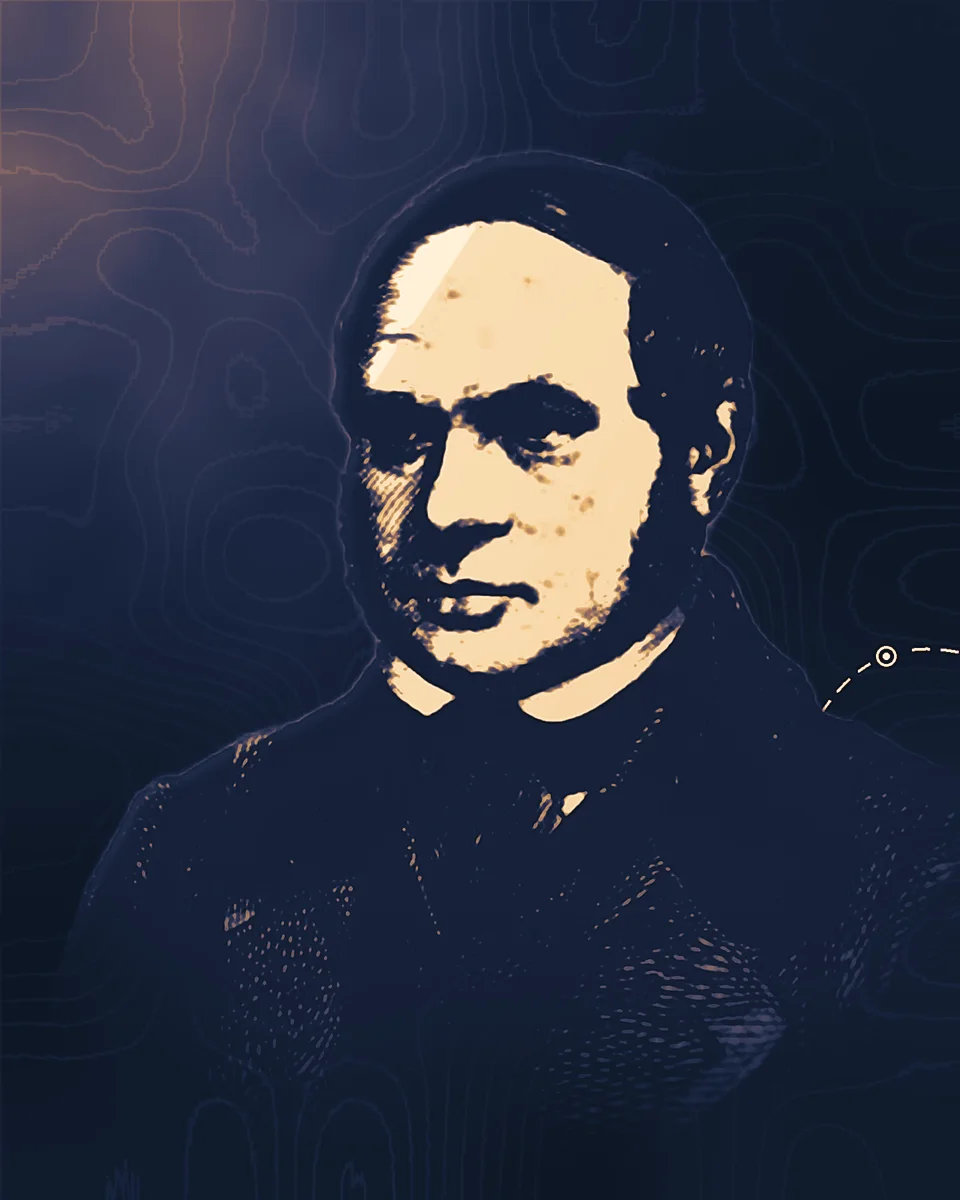
Karl Baedeker
He made the travel guide a book checked on the spot every year, which led the traveller to the sights and rated the inns without fear or favour.
1801–1859
What they changed
1828
Straight to the sights
In 1828 Baedeker bought the rights to J. A. Klein's Rhine guide, Rheinreise von Mainz bis Köln, and after Klein's death rewrote it himself; the new editions appeared in 1835 and 1839. The national biography of Germany says he led the stranger straight to the sights from his own travels and spared him the costly guidance of hired guides, and that this created a new type of guidebook.
1839
Murray's plan in German
Baedeker's guide to Holland and Belgium of 1839 thanked "Murray's Handbook for Travellers" in its preface as the foundation of his own little book, as John Murray III quoted it in 1887. The weekly Die Gartenlaube wrote in 1861 that the idea came to him when he saw the red Murray handbook in the hands of the English travellers on the Rhine.
1844
Stars for sights and inns
By 1844 Baedeker had taken up Murray's star system, by The National Archives' account, and he added information on art and architecture and detailed maps and city plans. Die Gartenlaube tells of him taking the star away from a hotel at Vevey whose staff had treated him badly.
1850s
Rechecked every summer
He walked his routes again every summer to correct the next edition, and spent the winters sorting his notes and the hundreds of letters of corrections that readers sent him. He sent back the cigar boxes and baskets of champagne that innkeepers offered him, saying that his recommendation was not for sale.
Life
Karl Baedeker was born in Essen on 3 November 1801, the son of the bookseller Gottschalk Diederich Baedeker. He went to Heidelberg in 1817 to learn the book trade, worked for the booksellers Mohr and Winter there and for Georg Reimer in Berlin, and in 1827 opened his own bookshop and publishing house in Koblenz. Die Gartenlaube adds that he heard lectures in history and philosophy at Heidelberg for a year and served his year in the army at Wetzlar in 1822.
Koblenz sat in the middle of a growing traffic of travellers on the Rhine, where passenger steamers had run since 1827, and the Rhine guide he bought in 1828 gave his business its direction. By his death the firm had volumes on the Rhineland, Belgium, Holland, Paris, Germany and the Austrian empire, the main ones in many editions. The historian Theodor Mommsen supplied notes on the Roman towns of Switzerland in 1852.
The form was not his alone. John Murray III, whose Handbooks for Travellers began in 1836, wrote in 1887 that Baedeker had at first copied, extracted and even translated from Murray's books, and pointed to a mistranslation in which Swiss slate "full of red garnets" became rocks overgrown with red pomegranates. He also printed Baedeker's own dedication of 1841 thanking Murray for his help. Die Gartenlaube agreed that Baedeker began from Murray's book, and said he soon found his first edition so full of mistakes that he pulped more than half the copies and brought out a corrected one. The historian Pieter François argues that guidebooks of the period borrowed heavily from one another and grew out of earlier travel accounts.
Innkeepers feared him. He travelled plainly dressed and often unrecognized, and Die Gartenlaube printed its portrait of him only after his death, saying it had not been proper to do so while he still needed to go unnoticed. It reported that a cab driver in Basel wanted to give up his trade because travellers now came with "the cursed red books".
He died in Koblenz on 4 October 1859. He had ten children. His son Fritz Baedeker carried on the work with his brothers, brought out English and French editions beside the German ones, and in 1872 moved the firm to Leipzig.
Read more
5 accounts
Baedeker, Karl, Hans Lülfing, Neue Deutsche Biographie, 1953.
The national biography's entry on his training, his Rhine guide and his method.
deutsche-biographie.de
Der getreue Eckardt der Reisenden, Die Gartenlaube, 1861.
A long notice in the popular weekly two years after his death, with his portrait and stories from his travels.
de.wikisource.org
The Origin and History of Murray's Handbooks for Travellers, John Murray III, 1887.
Murray's own reply to a claim that Baedeker invented the guidebook, reprinted in John Murray IV's memoir of his father in 1919.
archive.org
'If It's 1815, This Must Be Belgium': The Origins of the Modern Travel Guide, Pieter François, Book History, 2012.
A study of British guides to Belgium before Murray and Baedeker.
uhra.herts.ac.uk
The birth of the travel guide, The National Archives, undated. A short history of Starke, Murray, Baedeker, Bradshaw and Cook, drawn from the guidebooks it holds.
nationalarchives.gov.uk