Industries / Figureheads
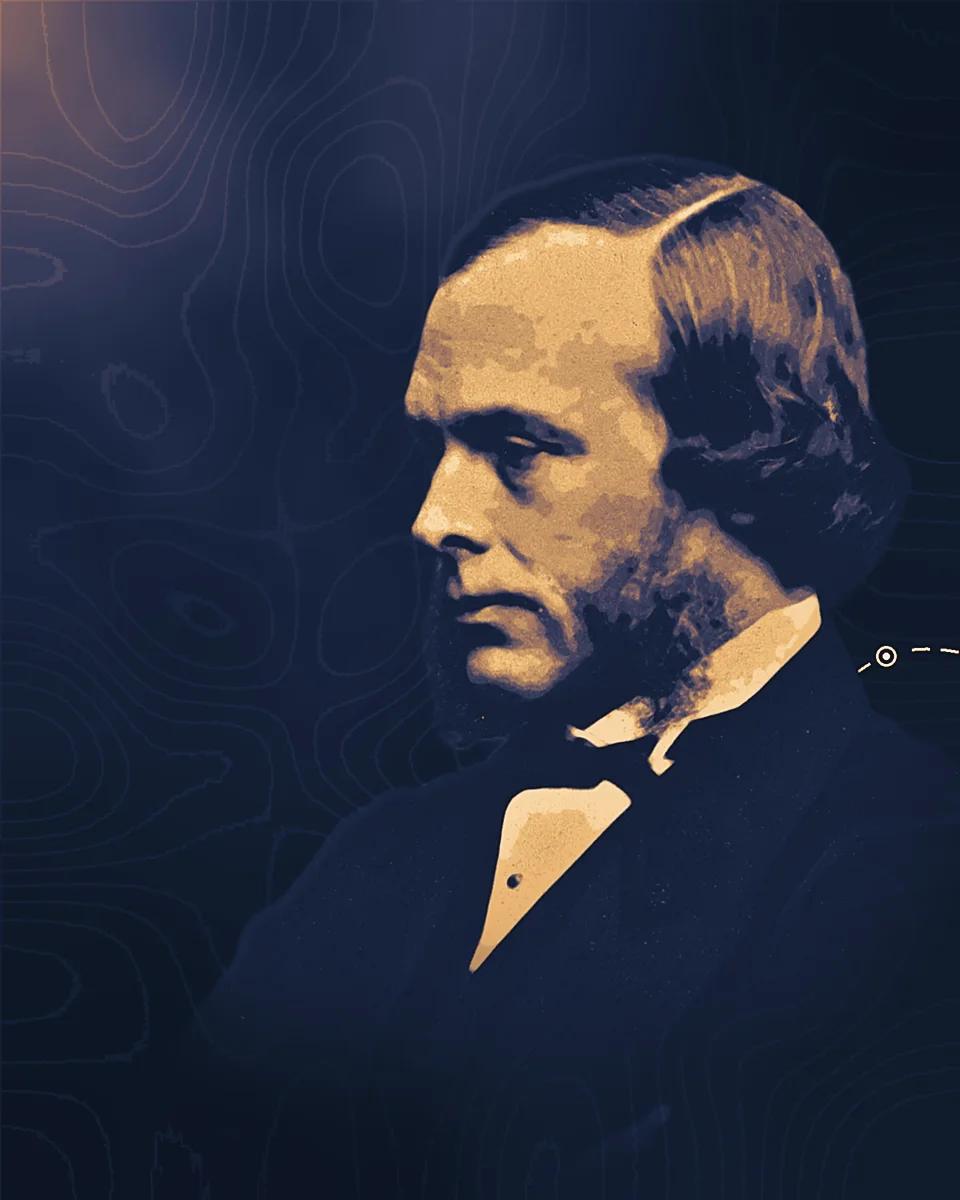
Joseph Lister
He treated wounds and dressings with carbolic acid to kill the germs that Pasteur had found in the air, and made surgeons treat wound infection as something they could prevent.
1827–1912
What they changed
1865
Carbolic acid on open fractures
A compound fracture is a broken bone that pierces the skin, and in Lister's time it often festered and ended in amputation. He first used carbolic acid (phenol) on one in March 1865. In August 1865 his house surgeon, Dr Macfee, laid lint soaked in carbolic acid on the leg wound of an 11-year-old boy, James Greenlees, and four days later there was no sign of infection. Of 11 such patients Lister treated from 1865 to 1867, 9 stayed free of infection, by the count of a 2022 review, and he published the series in The Lancet from March 1867.
1867
The antiseptic principle
On 9 August 1867 Lister read "On the Antiseptic Principle in the Practice of Surgery" to the British Medical Association in Dublin. He said he had conceived the method once "the researches of Pasteur" showed that putrefaction came from minute organisms in the air, not from the air itself. He claimed that his two wards at the Glasgow Royal Infirmary, once among its unhealthiest, had seen no case of pyaemia, a form of blood poisoning, or of hospital gangrene or erysipelas in nine months.
1870
Deaths after amputation counted
Two and a half years after his first case series, Lister used numbers. In his Glasgow wards, 16 of 35 patients had died after amputation before he used antisepsis and 6 of 40 after, a fall from about 45% to about 15%. He called the numbers "too small for a satisfactory statistical comparison". The historian Ulrich Tröhler, writing in 2014, shows that death rates in the rest of the infirmary rose over the same years and swung widely from year to year before 1865, and questions how Lister chose his years and cases.
1881
Ligatures the body absorbs
Silk threads tied round arteries were left trailing out of the wound, and germs followed them in. Lister treated catgut, gut string made for musical instruments, with carbolic acid so that it could be tied off and left inside to be absorbed. To make it last longer before it dissolved he soaked it in chromic acid, and he published chromic catgut in 1881.
Life
Joseph Lister was born on 5 April 1827 at Upton House in West Ham, then in Essex, the son of Joseph Jackson Lister, a Quaker wine shipper whose improvements to the microscope lens made him a Fellow of the Royal Society. He went to Quaker schools and entered University College London in 1844. He was in the audience in 1846 when Robert Liston operated under ether, the first public use of an ether anaesthetic in England, and he became a Fellow of the Royal College of Surgeons in 1852.
worldchanging.glasgow.ac.ukarchiveandlibrary.rcsed.ac.ukcollection.sciencemuseumgroup.org.uk
In 1853 he went to Edinburgh to see the surgeon James Syme at work, meaning to stay a month, and stayed seven years. He married Syme's eldest daughter, Agnes, left the Society of Friends, and worked with her on his experiments until her death in 1893. In 1860 he became professor of surgery at the University of Glasgow. The Glasgow Royal Infirmary's board did not want a teaching surgeon trying new ideas, and gave him wards only in 1861, after a petition from his students. In 1865 the professor of chemistry, Thomas Anderson, told him of Louis Pasteur's work on putrefaction.
archiveandlibrary.rcsed.ac.ukcollection.sciencemuseumgroup.org.ukheritage.rcpsg.ac.uk
The method was fought over for more than a decade in Britain. Surgeons of the "cleanliness" school, among them Lawson Tait, said strict cleanliness and cold water did as well with less harm, and in 1879 William Savory, later president of the Royal College of Surgeons, said Lister had still not produced comparative figures. Carbolic acid had already been used on wounds by Jules Lemaire in France and by Bottini in Italy, and the germ theory behind Lister's method was taken up sooner on the Continent. Carbolic acid also burned living tissue, and many of his patients probably suffered carbolic poisoning. Lister held that bad results came from surgeons who gave the method "a loose and trifling" trial. Others had shown before him that clean hands saved lives, among them Ignaz Semmelweis in Vienna; Lister wrote in 1906 that in 1865 he had not heard of Semmelweis.
He moved to the chair of clinical surgery at Edinburgh in 1869 and to King's College London in 1877. His return to London was not a success at first: students stayed away from his lectures and nurses opposed his methods. From 1871 he sprayed a mist of carbolic acid over the operating field, and gave it up in 1887. At the International Medical Congress in Berlin in 1890 he said, "I feel ashamed that I should ever have recommended it for the purpose of destroying the microbes in the air."
collection.sciencemuseumgroup.org.ukarchiveandlibrary.rcsed.ac.ukpmc.ncbi.nlm.nih.govarchive.org
Surgery moved on from his chemicals. In 1881 Robert Koch found that carbolic acid killed germs far less well than had been thought, and that as a spray it had no effect in his tests. German-speaking surgeons trained in Koch's laboratory methods turned to asepsis, keeping germs out of the wound by boiling instruments and steaming dressings. At the same Berlin congress of 1890 Ernst von Bergmann said he had replaced antisepsis with asepsis in his hospital, and his assistant Kurt Schimmelbusch's guide of 1892 spread the method. The historian Thomas Schlich concludes that it was aseptic practice, more than antisepsis, that made modern surgery look as it does.
He was made a baronet in 1883 and president of the Royal Society in 1895, the first surgeon to hold that office. In 1897 he became Baron Lister, the first doctor in Britain made a peer, and at the coronation of Edward VII one of the 12 original members of the Order of Merit. In 1908 he went to Walmer in Kent for the sea air and stayed. His sight and hearing failed, and he died there on 10 February 1912.
collection.sciencemuseumgroup.org.ukarchiveandlibrary.rcsed.ac.ukarchive.org
Read more
5 accounts
Lord Lister, Rickman John Godlee, Macmillan, 1917.
The full life by his nephew, who assisted him at operations in London, with his letters and case notes.
archive.org
On the Antiseptic Principle in the Practice of Surgery, Joseph Lister, British Medical Journal, 1867.
The paper read at Dublin, in the journal's scan.
pmc.ncbi.nlm.nih.gov
Effects of the antiseptic system of treatment upon the salubrity of a surgical hospital, Joseph Lister, The Lancet, 1870.
His amputation figures, with the journal pages, in the James Lind Library.
jameslindlibrary.org
Statistics and the British controversy about the effects of Joseph Lister's system of antisepsis for surgery, 1867-1890, Ulrich Tröhler, James Lind Library, 2014.
How his evidence was argued over, and what the whole infirmary's figures show.
jameslindlibrary.org
Asepsis and bacteriology: a realignment of surgery and laboratory science, Thomas Schlich, Medical History, 2012.
How German-speaking surgeons replaced antisepsis with asepsis.
pmc.ncbi.nlm.nih.gov