Industries / Figureheads
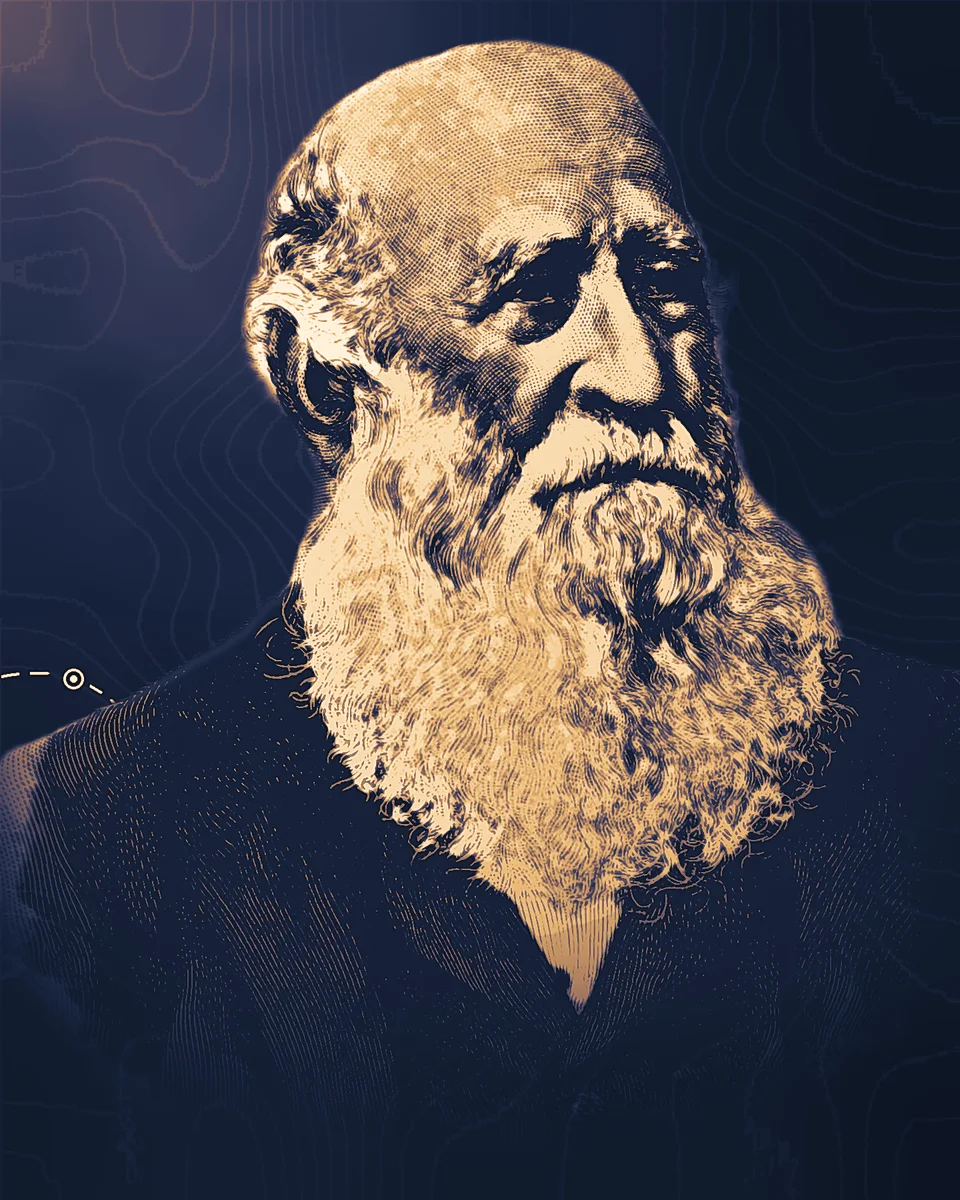
Joseph Henry Gilbert
He ran the Rothamsted laboratory for 58 years and showed that grain crops need nitrogen in the soil.
1817–1901
What they changed
1843
A laboratory beside the fields
Gilbert took charge of the laboratory at Rothamsted on 1 June 1843. Lawes directed the farming of the experimental plots, and the rest of the work, by the account of a colleague, Robert Warington, was in Gilbert's hands. As a rule each plot got the same manure every year. Samples of its grain and straw were kept from each harvest, and later samples of its soil. Warington put the store at more than 50,000 samples when Gilbert died. Rothamsted puts it at over 300,000 today and still draws on it for new studies.
1851
Grain needs nitrogen supplied
Justus von Liebig, the German chemist who had taught Gilbert, held that crops get enough nitrogen from the air and that manure needs to supply only minerals. On Broadbalk field, minerals alone added little to the wheat crop, nitrogen alone added much more, and the two together added most. Lawes and Gilbert set out the case against Liebig's "mineral theory" in the Royal Agricultural Society's journal in 1851. The Dictionary of Scientific Biography says they had shown by then that Liebig was in error about nitrogen.
1856
Park Grass begins
Lawes and Gilbert gave plots on about 2.8 hectares of old pasture different fertilizers and manures and cut them for hay each year. Within two to three years the treatments had changed which plants grew on each plot, so the hay was sorted by species as well as weighed. The experiment still runs. The Ecological Continuity Trust, a registered charity, calls it the longest-running grassland experiment in the world and counts nearly 200 scientific papers drawn from it.
1888
Nitrogen fixation confirmed
In 1861 Lawes, Gilbert and Evan Pugh, who by Gilbert's account took a prominent part in the work, reported pot experiments that found no sign of plants taking nitrogen from the air. They noted that their legumes, the family of peas, beans and clover, had grown poorly and needed more trials. In 1886 Hermann Hellriegel announced in Berlin, at a session Gilbert chaired, that legumes do take nitrogen from the air, through bacteria in small swellings on their roots. Gilbert began repeating the work at Rothamsted in 1888 and reported to the Royal Society that Hellriegel was right. The earlier pots had held soil sterilized by fire, which killed the bacteria.
Life
Gilbert was born at Hull on 1 August 1817, a son of Joseph Gilbert, a Congregational minister, and Ann Taylor, who wrote poems for children. The family moved to Nottingham in 1825. In 1832 a gunshot accident at Scarborough cost him the sight of one eye and damaged the other, and it was some years before he could study again. He entered the University of Glasgow in 1838 to learn analytical chemistry, moved to University College London the next year, and spent the summer of 1840 in Liebig's laboratory at Giessen, where he took his doctorate. In 1842 he went to work as a chemist for a cloth printer near Manchester.
At University College he had worked in the same laboratory as John Bennet Lawes. Lawes owned the Rothamsted estate in Hertfordshire, held the patent on superphosphate, a phosphate fertilizer made with acid, and paid for field experiments out of his factory's profits. He wanted a trained chemist and hired Gilbert, who began in a laboratory fitted into a barn. The two met most days. J. A. Voelcker, a pupil and friend of Gilbert, wrote that Lawes was the readier to change a plan and joked that, left alone, he would have plowed up many plots before they gave their full results. Lawes said of Gilbert in 1855: "It is not every gentleman of his attainments who would subject himself to the caprice of an individual."
encyclopedia.comarchive.orgen.wikisource.orgen.wikisource.org
The quarrel with Liebig began with the first Rothamsted reports. A. D. Hall, who became director of the station in 1902, wrote that it went on for more than a generation. A memoir of Gilbert by the botanist W. B. Bottomley says it "was not always free from bitterness", and Warington called Gilbert "an antagonist who never tired". Liebig died in 1873. Nitrogen is now known to be the main nutrient limiting crop growth, and Liebig's phosphate and potash are the other two main ingredients of modern fertilizer. In September 1893 the Liebig Foundation of the Royal Bavarian Academy of Sciences gave Lawes and Gilbert its silver medal.
On legumes the answer went against Gilbert. Bottomley writes that while trials in Germany, France, England and the United States pointed to legumes taking nitrogen from the air, Gilbert "would not listen to any such heresy" until he heard Hellriegel in 1886. He then repeated the experiments at seventy and published the confirmation himself. Hall wrote that the discovery came as "somewhat of a disappointment" at Rothamsted. Gilbert was also hostile at first to the finding that bacteria turn ammonia in the soil into nitrate, a process called nitrification. That work was done at Rothamsted by Warington, and Bottomley says the credit for it "belongs entirely to Warington".
Edwin Grey, who joined the laboratory as a boy in 1872, remembered Gilbert as its "ruling spirit". The Dictionary of Scientific Biography says his conservatism "hardened into intolerance of younger chemists and new ideas", and that he staffed the laboratory with village boys, each trained in one kind of analysis. E. J. Russell of Rothamsted, introducing Grey's memoirs, called Gilbert "something of a martinet". Gilbert and Warington were estranged from the 1860s, when Gilbert objected to a book Warington planned on the Rothamsted experiments and it stayed unpublished. Lawes brought Warington back in 1876 as his own assistant. In June 1890 the committee then running the station, unable to end the tension between the two men, decided to end Warington's work there.
From 1884 to 1890 Gilbert also held Oxford's Sibthorpian chair of rural economy and gave more than seventy lectures there on the Rothamsted results. Rothamsted's own timeline says he was "not a charismatic lecturer", and Grey recalled that he "cared little for charts, but delighted in columns and columns of figures". His sight stayed poor, so his second wife, Maria, read papers to him and he dictated his own. The Royal Society elected him a fellow in 1860 and gave him its Royal Medal, with Lawes, in 1867. On 29 July 1893 the fiftieth year of the experiments was marked at Rothamsted, and on 11 August he was knighted. That autumn, at 76, he lectured on the work in Chicago and at Amherst, Massachusetts. He died at Harpenden on 23 December 1901 and was buried near Lawes.
en.wikisource.orgarchive.orgrothamsted.ac.ukarchive.orgarchive.orgen.wikisource.org
Read more
6 accounts
Gilbert, Sir Joseph Henry, Ernest Clarke, Dictionary of National Biography, 1912 supplement.
A short life by the secretary of the Royal Agricultural Society, written partly from personal knowledge.
en.wikisource.org
Sir Joseph Henry Gilbert, William Beecroft Bottomley, 1913.
A botanist's chapter from Makers of British Botany on his science, with the nitrogen argument and his mistakes set out plainly.
en.wikisource.org
The Book of the Rothamsted Experiments, A. D. Hall, 1905.
The station's account of each experiment, opening with Robert Warington's Royal Society obituary of Gilbert.
archive.org
Agricultural investigations at Rothamsted, England, during a period of fifty years, Joseph Henry Gilbert, 1895.
His own summary of the work, given as lectures in the United States in 1893 and printed by the Department of Agriculture.
archive.org
On the sources of the nitrogen of vegetation, J. B. Lawes, J. H. Gilbert and Evan Pugh, 1861.
The Royal Society paper that found no plant taking nitrogen from the air and asked for more trials on legumes.
archive.org
Rothamsted Experimental Station: reminiscences, tales and anecdotes, Edwin Grey, 1922.
The laboratory under Gilbert, as remembered by a man who started there as a boy in 1872.
archive.org