Industries / Figureheads
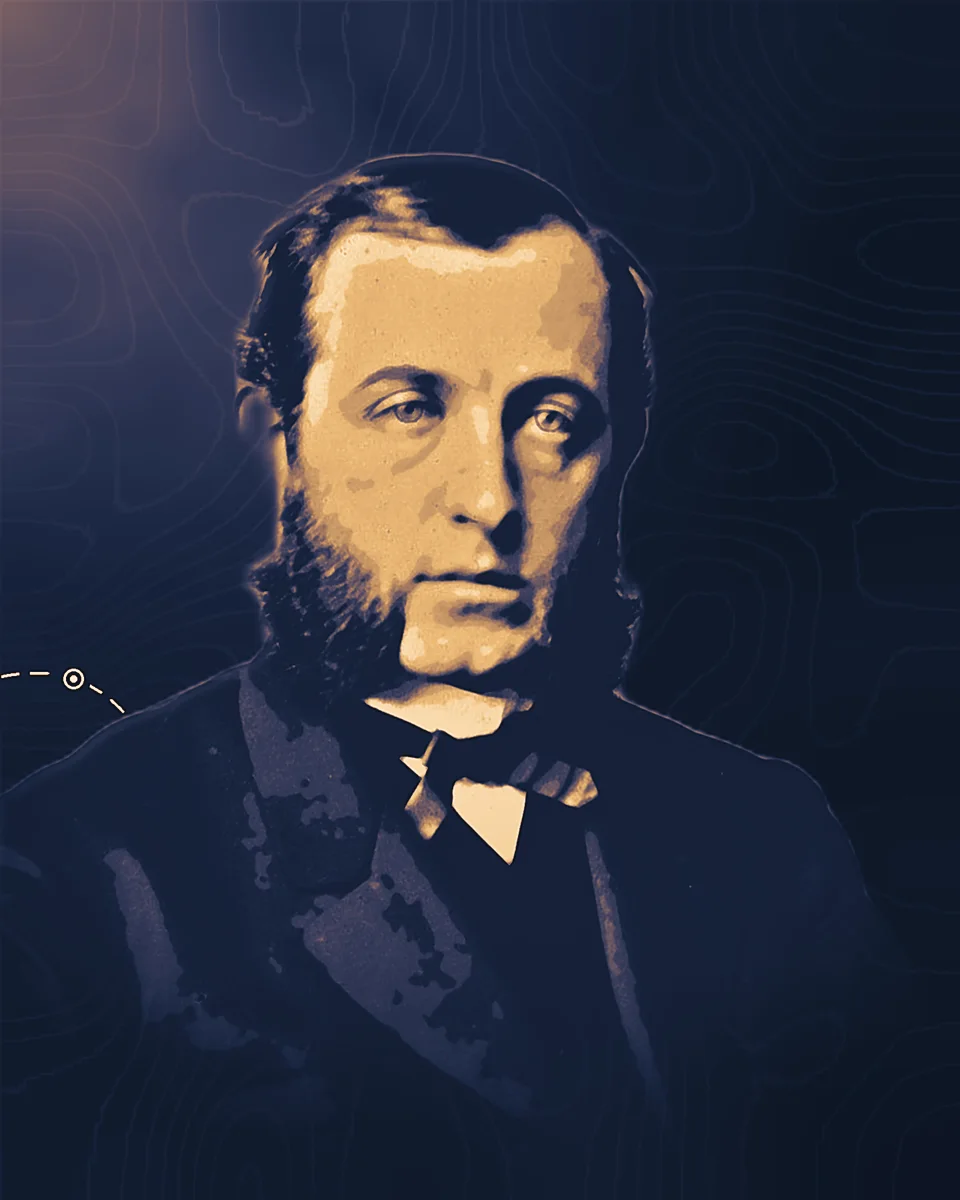
Joseph Glidden
He patented the barbed wire that won the market, with its barbs locked between two twisted strands, and cheap wire fences closed the open range.
1813–1906
What they changed
1874
Barbs locked by a twist
On 24 November 1874 the US Patent Office issued Glidden patent No. 157,124. A short wire barb is coiled around one strand and held in place by twisting that strand together with a second one, so the barbs cannot slide along the wire or turn. The National Archives calls it the recognized winner among the improvements patented since Michael Kelly's of 1868, and says it "remains the most familiar style of barbed wire."
1874
Wire made by machine
In July 1874 the DeKalb hardware merchant Isaac Ellwood bought a half share in the patent for $265, and the two began making wire as the Barb Fence Company. By the figures of the Ellwood House museum, they made 10,000 pounds in 1874, largely by hand, and more than 600,000 pounds in 1875 in a factory with a steam engine. The National Archives credits Glidden with the machinery to make the wire in quantity as well as the design.
1876
Sold to Washburn & Moen
Glidden sold his share to Washburn & Moen of Worcester, Massachusetts, the largest wire maker in the United States, for $60,000 and a royalty of 25 cents on every 100 pounds made. By the end of 1876 that company held every major barbed wire patent except Jacob Haish's. Output, by the DeKalb County Manufacturer's figures, rose from 2.84 million pounds in 1876 to 50.3 million in 1879.
1881
A ranch fenced with wire
To advertise the wire, Glidden and his salesman Henry Sanborn bought 95 sections of land in the Texas Panhandle in 1881, about 61,000 acres. They enclosed it with a four-wire fence 120 miles (about 190 km) long that cost $39,000, and stocked it with 15,000 cattle. It was called the Frying Pan Ranch, after its brand.
1892
The last step that wins
Rival makers argued that earlier patents had covered barbed wire before Glidden. On 29 February 1892 the US Supreme Court upheld his patent, finding that the coiled barb held by a twisted strand was what made the earlier ideas work: "In the law of patents, it is the last step that wins." The patent ran out the same year.
Life
Joseph Farwell Glidden was born on 18 January 1813 in New Hampshire. A county history printed in his lifetime gives the town as Charlestown, in Sullivan County. His parents, David and Polly Glidden, moved the family to a farm in Orleans County, New York, about 1814. He went to the Middlebury Academy and a seminary at Lima, taught school for a few months, and then rented farms. In 1837 he married Clarissa Foster.
In the autumn of 1842 he went west with two threshing machines, threshed wheat on farms in Michigan, and came on to DeKalb County, Illinois. That winter he bought 600 acres a mile west of the village of DeKalb from his cousin Russell Huntley. Clarissa followed him west and died in childbirth, and none of their three children lived. He married Lucinda Warne in 1850 or 1851, and their daughter Elva was born in 1851. He was elected sheriff of the county in 1852.
The prairie had little timber or stone for fences. By Lucinda's later account, in the winter of 1872–73 her hairpins began to go missing, and she found them in his shirt pocket: he was working on a fence. With his friend the blacksmith Phineas Vaughan he turned an old coffee mill into a tool that coiled barbs of even size. He twisted the barbed strand to a plain one with a grindstone and fenced his farmyard with it. He applied for the patent on 27 October 1873, when he was 60.
The idea of a barbed fence was not his. The National Archives counts nine patents for barbed fencing from Michael Kelly's of November 1868 to Glidden's, and two other men in DeKalb were working on it at the same time: Ellwood, who gave up his own design for Glidden's, and the lumber dealer Jacob Haish, who had applied for his "S barb" earlier in 1874. Years of lawsuits followed between the holders of Glidden's patent and Haish and other makers, until the Supreme Court decided for Glidden in 1892.
archives.govellwoodhouse.orgtshaonline.orgsupreme.justia.com
The wire changed who held the land. Ranchers and farmers fenced off land and water that had been open to all. In Texas, fencing the open range led to the fence-cutting conflicts of the early 1880s, and elsewhere cattlemen who were shut out fought range wars with farmers who owned the land. The National Archives records that Native Americans, pushed further off land they had always used, called it "the Devil's rope". Fenced herds could also be bred with more control, which all but ended the demand for the Texas Longhorn of the open range, and the wire helped end the long cattle drives.
After 1876 Glidden went back to farming, and by 1885 he held about 1,500 acres in DeKalb County. He became owner of the DeKalb Chronicle newspaper in 1879 and started the DeKalb National Bank in 1883. In the 1890s he gave land and money toward a state teachers' school at DeKalb, now Northern Illinois University. He passed the Texas ranch to his son-in-law William Bush in 1898, and died in DeKalb on 9 October 1906, aged 93.
Read more
5 accounts
The Wire That Fenced the West, Henry D. and Frances T. McCallum, University of Oklahoma Press, 1965.
The standard history of barbed wire and the men who made, sold and fought over it.
archive.org
The Impact of Barbed Wire on Texas Agriculture and Ranching, Frances T. McCallum and James Mulkey Owens, Handbook of Texas Online, Texas State Historical Association. What the wire did to the range, the cattle and the long drives.
tshaonline.org
Glidden's Patent Application for Barbed Wire, Emily Ray and Wynell Schamel, National Archives, 1997.
The patent drawing and text, with an account of what the wire did to the West.
archives.gov
The Barbed Wire Patent, 143 U.S. 275, Supreme Court of the United States, 1892.
The opinion that settled who invented the wire, with the earlier patents drawn and described.
supreme.justia.com
Portrait and Biographical Album of DeKalb County, Illinois, Chapman Brothers, 1885.
A life written while he was alive, with the terms of the 1876 sale and engraved portraits of him and Lucinda.
archive.org