Industries / Figureheads
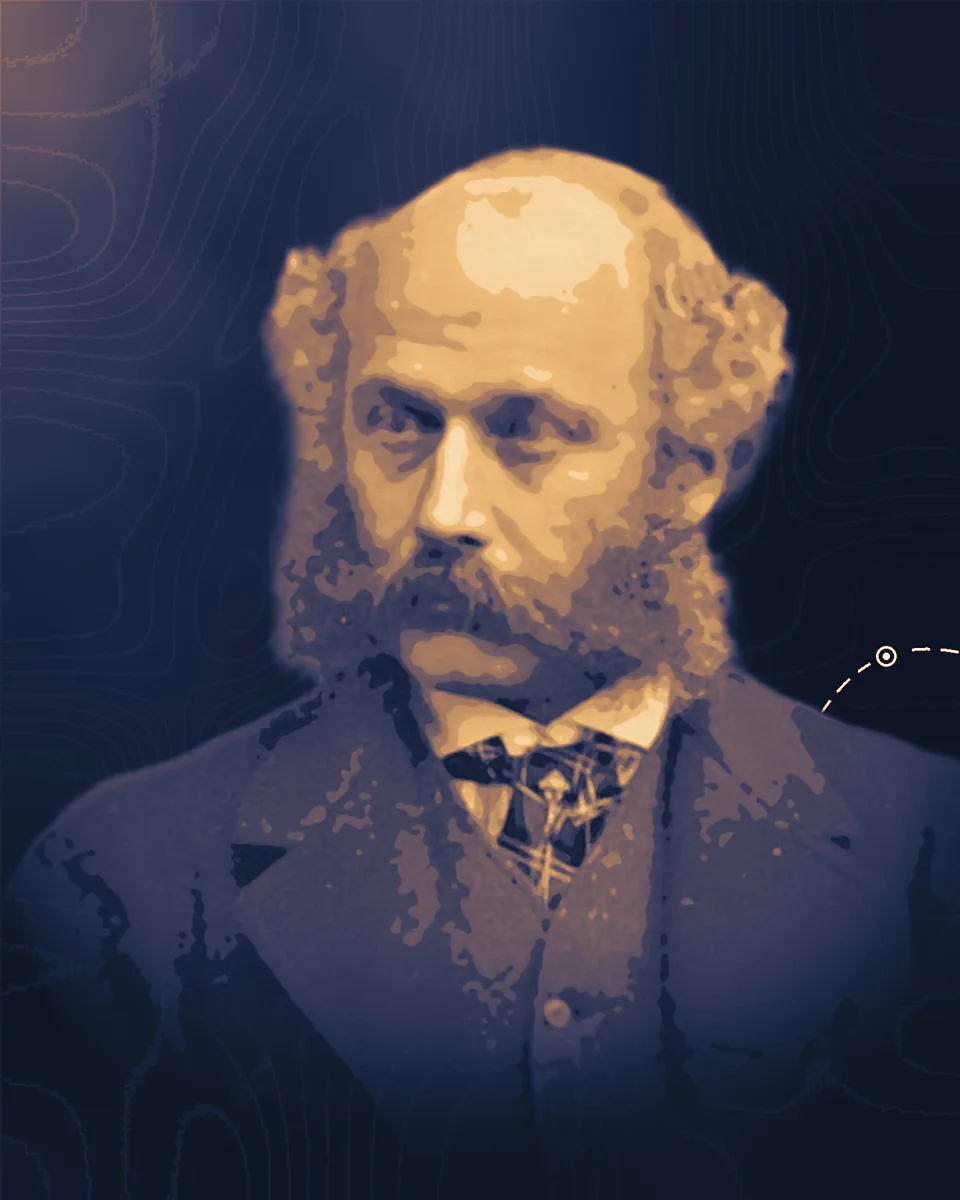
Joseph Bazalgette
He designed and built London's main drainage, intercepting sewers that caught the city's sewage before it reached the Thames and carried it east to pumping stations and outfalls.
1819–1891
What they changed
1856
One plan for London
When the Metropolitan Board of Works was created by an act of 16 August 1855, it made Bazalgette its chief engineer and told him to devise a drainage scheme for the whole city. His plans, worked up with William Haywood from earlier schemes, were held up by government objections until an act of August 1858, passed after the "Great Stink" of that summer, gave the board full control.
1865
Sewers that intercept
The main drainage opened in 1865 and was finished in 1875. By the London Museum's account, about 1,100 miles of street drains fed 82 miles of new brick-lined sewers and six intercepting sewers, which caught the flow before it reached the river. Pumping stations at Deptford, Crossness and Abbey Mills lifted it to outfalls in the lower Thames, east of London. The Dictionary of National Biography gives a capacity of 420 million gallons of sewage and rain a day and a cost of £4.6 million. Bazalgette insisted on Portland cement, strong and water-resistant, which the London Museum counts among the reasons much of the system still works.
1870
A sewer under the embankment
The Victoria Embankment, built out into the Thames, carried the low-level intercepting sewer and the Metropolitan District Railway inside it. Its first section, from Westminster to Blackfriars, opened on 13 July 1870, and the Albert and Chelsea embankments followed.
1880s
Settling tanks at the outfalls
In his last years at the board he enlarged the sewage reservoirs at Crossness and Barking and added precipitating tanks, in which solids settled out of the sewage before it went into the river. The sludge was pumped into steamers and dumped at sea, and the liquid was dosed with chemical deodorants.
Life
Joseph William Bazalgette was born at Enfield, north of London, on 28 March 1819, the son of a Royal Navy commander of the same name; the family were of French descent. In 1836 he became a pupil of the engineer John MacNeill and worked for a time on drainage and land reclamation in the north of Ireland. He set up as a consulting engineer in Westminster in 1842, mostly on railway schemes, until his health broke down in the railway boom and he had to rest for more than a year.
In 1849 he joined the Metropolitan Commission of Sewers, created the year before to replace eight separate drainage bodies. Six commissions came and went between 1848 and 1855. The engineers G. B. Forster and William Haywood drew up drainage schemes for one of them in 1850 and 1851, but nothing was built, and when Forster resigned Bazalgette succeeded him as engineer-in-chief.
The idea was not new. The London Museum notes that the painter John Martin had proposed something similar in 1834, though he wanted to keep the sewage for farming. Bazalgette's plans of 1856 went to a commission of three engineers, including Douglas Galton, which reported in July 1857 for a costlier scheme with outfalls much further down the river. The board had Bazalgette answer it with the engineers George Parker Bidder and Thomas Hawksley in April 1858. After the act of August 1858 his designs were put in hand at once.
The new sewers moved London's sewage, untreated, to the river below the city. In 1878 the pleasure steamer Princess Alice sank at Gallions Reach near Woolwich, and around 640 people drowned in water that, an hour before, had been filled with sewage from the outfalls. The London Museum says the disaster drove the building of sewage treatment, which led to the settling tanks of the 1880s. A royal commission on the sewage discharge, in its first report of 31 January 1884, praised the original scheme and Bazalgette's skill in building it.
He was made a Companion of the Bath in 1871 and knighted in 1874, and was president of the Institution of Civil Engineers in 1884. Foreign governments consulted him on the drainage of continental cities. He stayed chief engineer until the board was abolished in 1889 and replaced by the London County Council, and wrote 33 annual reports on its works. He died at his home in Wimbledon Park on 15 March 1891.
Read more
5 accounts
Bazalgette, Joseph William, Thomas Hudson Beare, Dictionary of National Biography, 1901 supplement.
The national biography's account, with the history of the commissions and a list of his reports.
en.wikisource.org
Sir Joseph William Bazalgette, Institution of Civil Engineers, Minutes of Proceedings, 1891.
The obituary by his own institution, as transcribed by Grace's Guide, with the later works at the outfalls.
gracesguide.co.uk
Sir Joseph Bazalgette, C.B., Thompson Cooper, Men of Mark, volume 2, 1876.
A short contemporary notice beside Lock and Whitfield's portrait of him.
archive.org
Construction of London's Victorian sewers: the vital role of Joseph Bazalgette, G. C. Cook, Postgraduate Medical Journal, 2001.
A medical historian's account of the work and its effect on health.
pmc.ncbi.nlm.nih.gov
How Bazalgette built London's first super sewer, London Museum. The museum's illustrated account, including the Princess Alice.
londonmuseum.org.uk