Industries / Figureheads
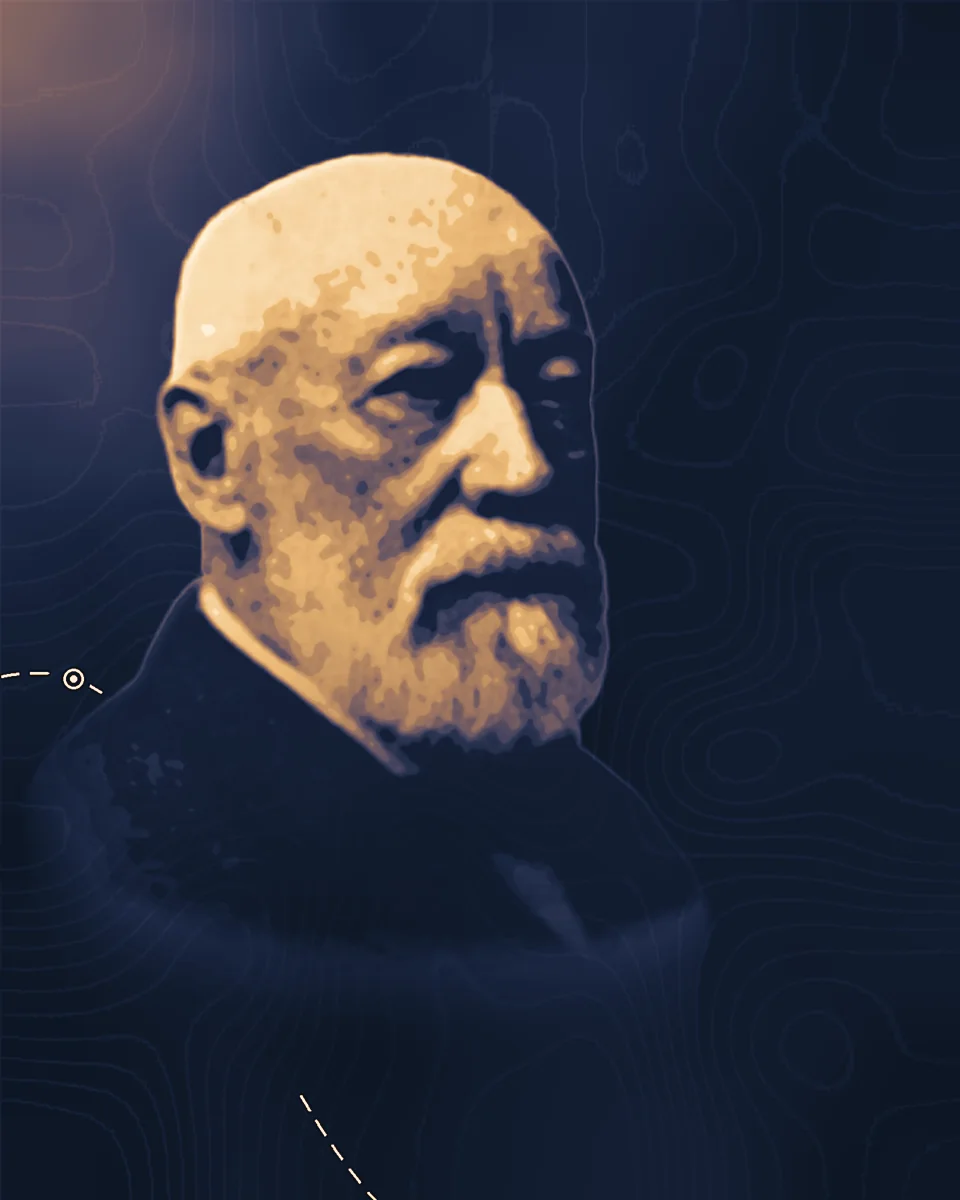
John Wesley Hyatt
He made celluloid a material that could be manufactured and built the machines to shape it, among them the first injection molding machine.
1837–1920
What they changed
1870
Celluloid
With his brother Isaiah he patented a way to make a solid, moldable material from cellulose nitrate (cotton treated with nitric acid): grind it to a pulp, mix it with powdered camphor, and apply heat and pressure. US patent 105,338 of 12 July 1870 fixes about one part of camphor to two of cellulose nitrate. The National Inventors Hall of Fame calls celluloid "the first artificial plastic".
1872
The injection molding machine
The brothers' US patent 133,229 of 19 November 1872 describes a heated cylinder in which a plunger pushes the softened material out through a nozzle into a closed mold. Tadmor and Gogos's textbook says Hyatt "invented the thermoplastics injection-molding machine in 1872", taking the idea from the die-casting of metal.
1870s
Machines for a new material
A trade history of 1926 calls it "an undisputed fact" that the stuffing machines that pressed celluloid into rods and tubes, the presses that formed it into blocks and the machines that sliced thin sheets from those blocks were his. It says the principles had not changed in fifty years.
1873
A factory at Newark
His Albany Dental Plate Company of 1870, which made celluloid plates for false teeth, became the Celluloid Manufacturing Company in 1872 and moved to Newark, New Jersey, in 1873. Celluloid went into combs, collars, knife handles and toys, and from the late 1880s into photographic film.
Life
John Wesley Hyatt was born on 28 November 1837 at Starkey, New York, the son of a blacksmith. At sixteen he went to Illinois and learned printing, and worked at it for about ten years before he moved to Albany, New York, as a journeyman printer. He had no training in chemistry. When he received the Perkin Medal in 1914 he thanked the chemists for overlooking his "lack of early training in the sciences".
In Albany he saw an offer of 10,000 dollars from Phelan and Collender, a New York maker of billiard tables, for a substitute for ivory in billiard balls. He experimented at night and on Sundays. His first compositions were not good enough for billiard balls, and he and two brothers made checkers and dominoes from them. He said the work on cellulose nitrate began when he found a dried piece of collodion, a liquid dressing for cuts, "the size and thickness of my thumb nail". The Plastics Hall of Fame says there is no evidence that the prize was ever paid.
He was not the first to make a plastic from cellulose nitrate. Alexander Parkes in England had shown Parkesine in 1862, and Parkes and Daniel Spill had used camphor with solvents. Charles Chandler of Columbia University, presenting the Perkin Medal, said that Hyatt had known nothing of their work, that the federal courts had gone through the question by 1886 and sustained the Hyatt patents, and that "celluloid was invented by the brothers Hyatt". The 1926 trade history grants that Parkes "undoubtedly made material" from cellulose nitrate and gives Hyatt the credit for using camphor alone, with heat and pressure, and for making the manufacture practical. It says the dispute over who invented these plastics "has raged intermittently for well over fifty years".
Isaiah Hyatt, who had been a newspaper editor in Illinois, gave celluloid its name and worked with his brother until he died in March 1885. Together they also started the Hyatt Pure Water Company in the early 1880s. Its filter added a coagulant, a chemical that clumps fine dirt together, to water on its way to a sand bed, so that no settling tanks were needed. Chandler said more than 100 cities and towns used it by 1914. In 1891 and 1892 John Hyatt took up roller bearings, and he also designed a mill for crushing sugar cane.
Celluloid had a serious fault: it burns fiercely. The 1926 history records that the Newark works was once completely destroyed by fire. Hyatt received the Perkin Medal, the American chemical industry's chief award, on 23 January 1914. He died at Short Hills, New Jersey, on 10 May 1920. The National Inventors Hall of Fame inducted him in 2006.
Read more
5 accounts
Presentation of the Perkin Medal to John W. Hyatt, Metallurgical and Chemical Engineering, February 1914.
Chandler's account of the patents and Hyatt's own speech on how he came to celluloid.
archive.org
John Wesley Hyatt Created Celluloid, Carl Marx, Plastics, April 1926.
A short life in the plastics trade's first magazine, six years after his death.
archive.org
Improvement in Processes and Apparatus for Manufacturing Pyroxyline, I. S. Hyatt and J. W. Hyatt, US patent 133,229, 1872.
The patent with the plunger machine that injection molding grew from.
patents.google.com
Celluloid: The Eternal Substitute, Science History Institute, Distillations magazine. A history of the material and what it replaced.
sciencehistory.org
Hyatt, John Wesley, Plastics Hall of Fame, undated. The trade's own record of his patents and companies.
plasticshof.org