Industries / Figureheads
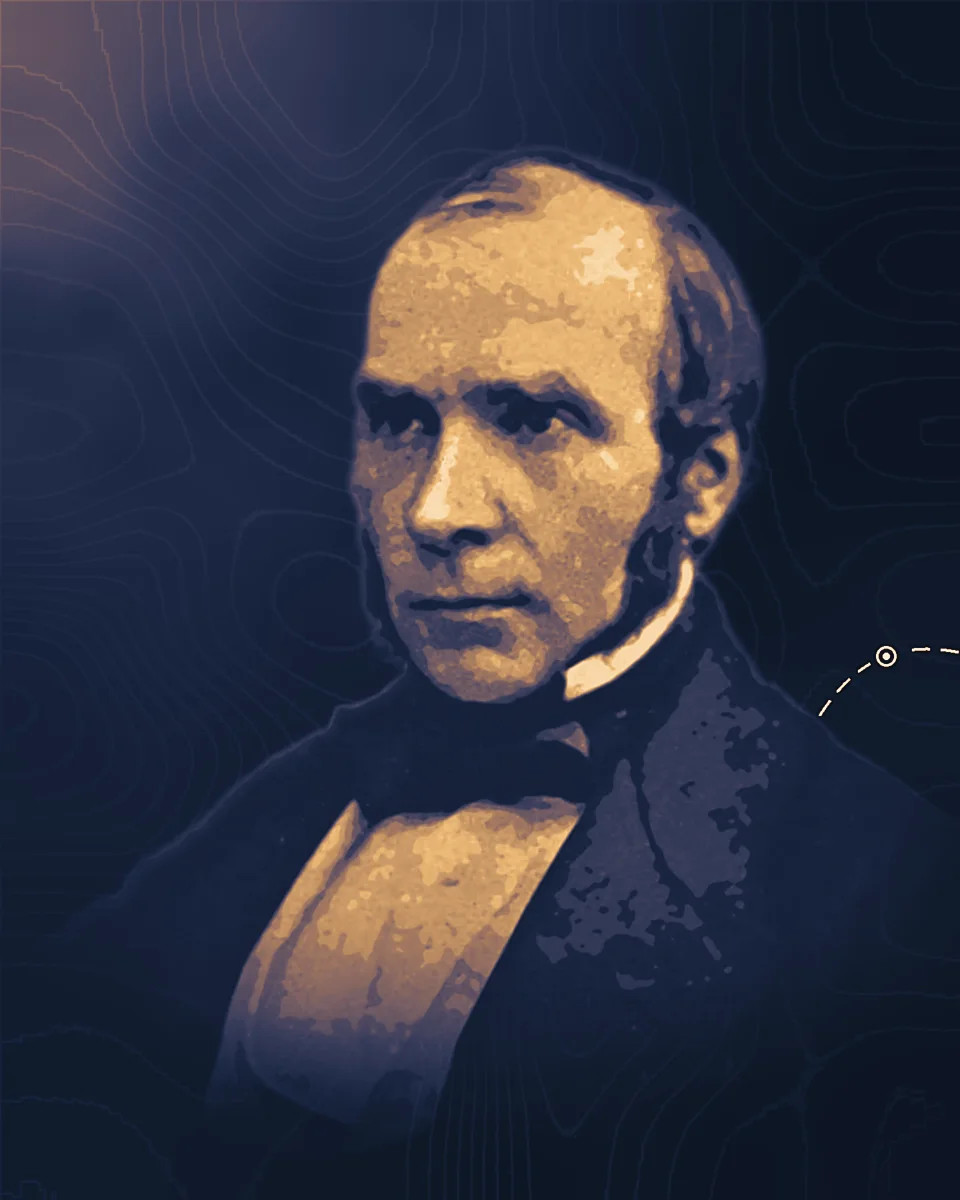
John Snow
He showed, by tracing cholera deaths to a street pump and to one water company's supply, that the disease spreads through drinking water fouled by sewage.
1813–1858
What they changed
1849
Cholera tied to water
After the London epidemic of 1849, Snow published On the Mode of Communication of Cholera, a 31-page pamphlet arguing that cholera was carried in water contaminated by sewage. Most doctors then held the miasma theory, that the disease came from bad air given off by rotting matter.
epi-snow.ph.ucla.eduepi-snow.ph.ucla.eduepi-snow.ph.ucla.edu
1854
The Broad Street pump
In a cholera outbreak around Broad Street in Soho, Snow mapped the deaths, found them clustered around one public pump, and on 7 September 1854 put his case to the parish Board of Guardians. The pump handle was taken off the next day. The Science Museum Group notes that the epidemic had mostly passed by then.
1854
Two companies, one experiment
South London was served by two water companies whose pipes ran down the same streets. The Lambeth Company had moved its intake up the Thames, above the city's sewage, in 1852, and the Southwark and Vauxhall Company still drew from the river at Battersea. Snow called the 300,000 people they supplied a "grand experiment" and checked house by house which company served each death. In the second seven weeks of the 1854 epidemic he counted 573 deaths for every 10,000 houses on the Southwark and Vauxhall supply and 115 on Lambeth's.
1855
The evidence in one book
He set out both studies, with their maps, in a much enlarged second edition of On the Mode of Communication of Cholera, published by John Churchill in 1855. It is the work he is best known for.
Life
John Snow was born on 15 March 1813 on North Street in York, the first of nine children. His father worked as a laborer in a coal yard and later as a carter. At 14 he was apprenticed to William Hardcastle, a surgeon-apothecary (what would now be called a general practitioner) in Newcastle upon Tyne. When cholera reached the area in 1831 and 1832, Hardcastle sent him on his own to treat the miners at the Killingworth colliery. He gave up meat at 17 and alcohol soon after, and argued for temperance for many years.
He moved to London in 1836 to finish his training, at the Hunterian School of Medicine and then on the wards of Westminster Hospital in 1837 and 1838. He set up as a general practitioner at 54 Frith Street in Soho in 1838, and took his bachelor's and doctor's degrees in medicine at the new University of London in 1843 and 1844.
He made his name first in anaesthesia. He published on breathing ether in 1847, turned to chloroform, and designed devices to give both safely. He gave Queen Victoria chloroform at the births of Prince Leopold on 7 April 1853 and Princess Beatrice on 14 April 1857, which the Science Museum Group credits with making pain relief in childbirth more widely accepted.
His case on cholera was disputed in his lifetime. William Farr of the General Register Office, whose death tables Snow used, held for a time that cholera rose in a poisonous air near the river. The Broad Street work was not Snow's alone. Henry Whitehead, a young curate in the parish, set out in 1855 to disprove Snow, and instead found the probable first case: a five-month-old girl at 40 Broad Street whose mother had emptied the water from her soiled napkins into a cesspool that a surveyor found leaking into the pump's well, 2 feet 8 inches away. Snow's assistant, a Mr. Whiting, carried out part of the house-to-house inquiry in South London. Neither man knew that Filippo Pacini in Italy had seen the cholera germ under a microscope in 1854; Robert Koch identified it in 1884.
epi-snow.ph.ucla.eduepi-snow.ph.ucla.eduepi-snow.ph.ucla.eduepi-snow.ph.ucla.edu
He had a stroke at his home at 18 Sackville Street and died there on 16 June 1858, aged 45. He was buried in Brompton Cemetery on 21 June. The Lancet gave his death a four-line notice that mentioned only his work on anaesthetics; it published a fuller obituary in April 2013, by the account of the UCLA historians. His book On Chloroform and Other Anaesthetics, finished by his friend Benjamin Ward Richardson, came out after his death.
epi-snow.ph.ucla.eduepi-snow.ph.ucla.eduepi-snow.ph.ucla.edu
Read more
5 accounts
On the Mode of Communication of Cholera, John Snow, John Churchill, 1855.
The second edition, with the Broad Street map and the account of the two water companies.
archive.org
On the Mode of Communication of Cholera, John Snow, John Churchill, 1849.
The first statement of his case, before the 1854 outbreak.
archive.org
John Snow, M.D., a representative of medical science and art of the Victorian era, Benjamin Ward Richardson, The Asclepiad, 1887.
A memoir by the friend who finished his last book, with the photograph used here.
archive.org
Cholera, Chloroform, and the Science of Medicine: A Life of John Snow, Peter Vinten-Johansen and others, Oxford University Press, 2003.
The full-length life, written by a team of historians and epidemiologists.
archive.org
John Snow: Historical Giant in Epidemiology, Ralph R. Frerichs, UCLA Department of Epidemiology. A large illustrated site with his texts, maps and records of his life.
epi-snow.ph.ucla.edu