Industries / Figureheads
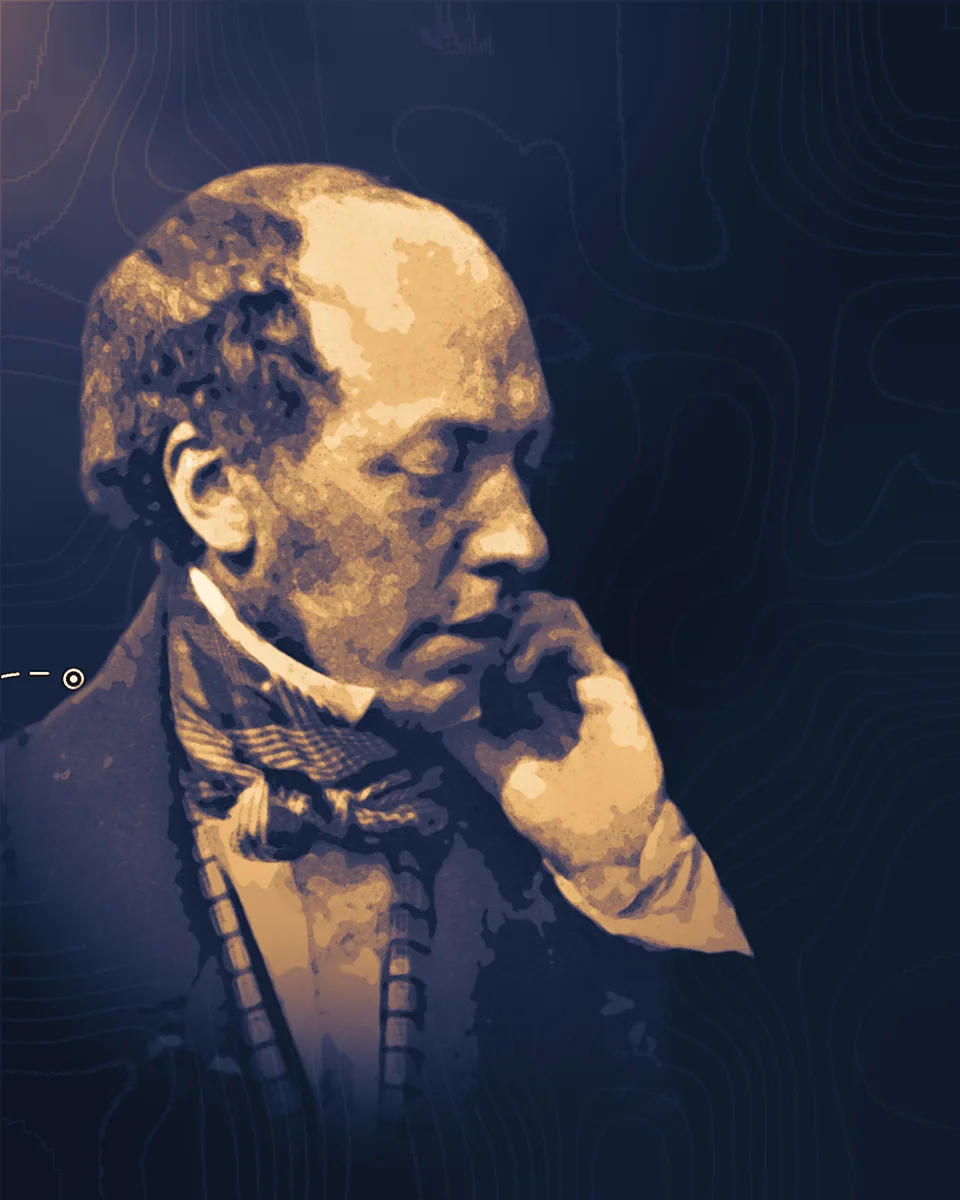
John Murray III
He wrote and published the Handbooks for Travellers, guides laid out by route from facts gathered on the spot, which picked out what was worth seeing and ranked it.
1808–1892
What they changed
1829
Notes taken on the road
On his first journey abroad, in 1829, Murray found no guidebook for Germany, France or Spain; he counted only Ebel's for Switzerland, Boyce's for Belgium and Mariana Starke's for Italy. He travelled "note-book in hand", arranged what he gathered into routes, and lent the proofs to friends going abroad so they could check them on the spot before he published.
1836
The first Handbook for Travellers
His Handbook for Travellers on the Continent, covering Holland, Belgium and North Germany, appeared in 1836. He wrote the volumes on South Germany, Switzerland and France that followed himself, then brought in specialists, among them Richard Ford for Spain and Sir Gardner Wilkinson for Egypt. He said his father chose the name "Handbook", a title used "for the first time to an English book".
1836
Sights ranked by importance
The National Archives credits the Handbooks with turning Starke's exclamation marks into star ratings and with "the concept of rated sights", which told travellers "not just where to go, but what they should see and how important each attraction was". Baedeker took up the stars by 1844.
1830s
Inns judged in print
The Handbooks reported on the sanitary arrangements of hotels and towns. Hotel keepers and town officials sent him accusations and threats, and he answered that he would change what he had written once they showed proof that things were better. The National Archives says such ratings pushed hotels to improve or "risk shame in print".
Life
John Murray was born on 16 April 1808, the son of the London publisher John Murray II and the grandson of the John Murray who founded the firm in 1768. He was sent to Charterhouse school. An inflammation of the eyes left him very short-sighted for life, and glasses did not help. In January 1827 he went to the University of Edinburgh, where he studied geology and mineralogy under Professor Jameson and chemistry under Dr Hope; geology stayed his favourite pursuit.
From 1829 to 1843 he spent his holidays travelling and writing the Handbooks: Holland, Belgium and North Germany in 1829, when he met Goethe at Weimar, then France in 1830 and northern Italy and Bavaria in 1831, and in 1836 a journey down the Danube to the borders of Turkey and Wallachia. He wrote to his father that he had not borrowed "one sentence from any English author".
He took over the firm when his father died in 1843 and ran it for close to fifty years. He became Charles Darwin's publisher in 1845 and published On the Origin of Species on 22 November 1859; his stock sold out on the first day it was offered to booksellers. He did not accept evolution himself, and in 1877 he published Scepticism in Geology under the pen name "Verifier".
He owed more to others than his claim to be "the author, inventor, and originator" of the form allows. Mariana Starke's guides, which his father published from 1820, had already joined practical advice to sightseeing and rated what they described; the historian Benjamin Colbert calls her books the prototypes for Murray's handbooks. In 1887, answering a newspaper that gave the invention to Baedeker, Murray wrote that Baedeker had copied and translated from his Handbooks, while granting that Baedeker was legally entitled to do so.
He kept working until a few days before his death in 1892. His son John Murray IV followed him as head of the firm, which stayed in the family until the seventh John Murray sold it in 2002. Its archive is now in the National Library of Scotland.
Read more
4 accounts
The Origin and History of Murray's Handbooks for Travellers, John Murray III, Murray's Magazine, 1887.
His own account of how the Handbooks began, and his case against the claim made for Baedeker.
archive.org
John Murray III, 1808-1892: A Brief Memoir, John Murray IV, John Murray, 1919.
A short life by his son, with letters from his travels.
archive.org
Charles Darwin and his publisher, Darwin Correspondence Project, Cambridge University Library, undated. His dealings with Darwin, with the terms and print runs from their letters.
darwinproject.ac.uk
The birth of the travel guide, The National Archives, undated. A short history of Starke, Murray and Baedeker drawn from the guidebooks it holds.
nationalarchives.gov.uk