Industries / Figureheads
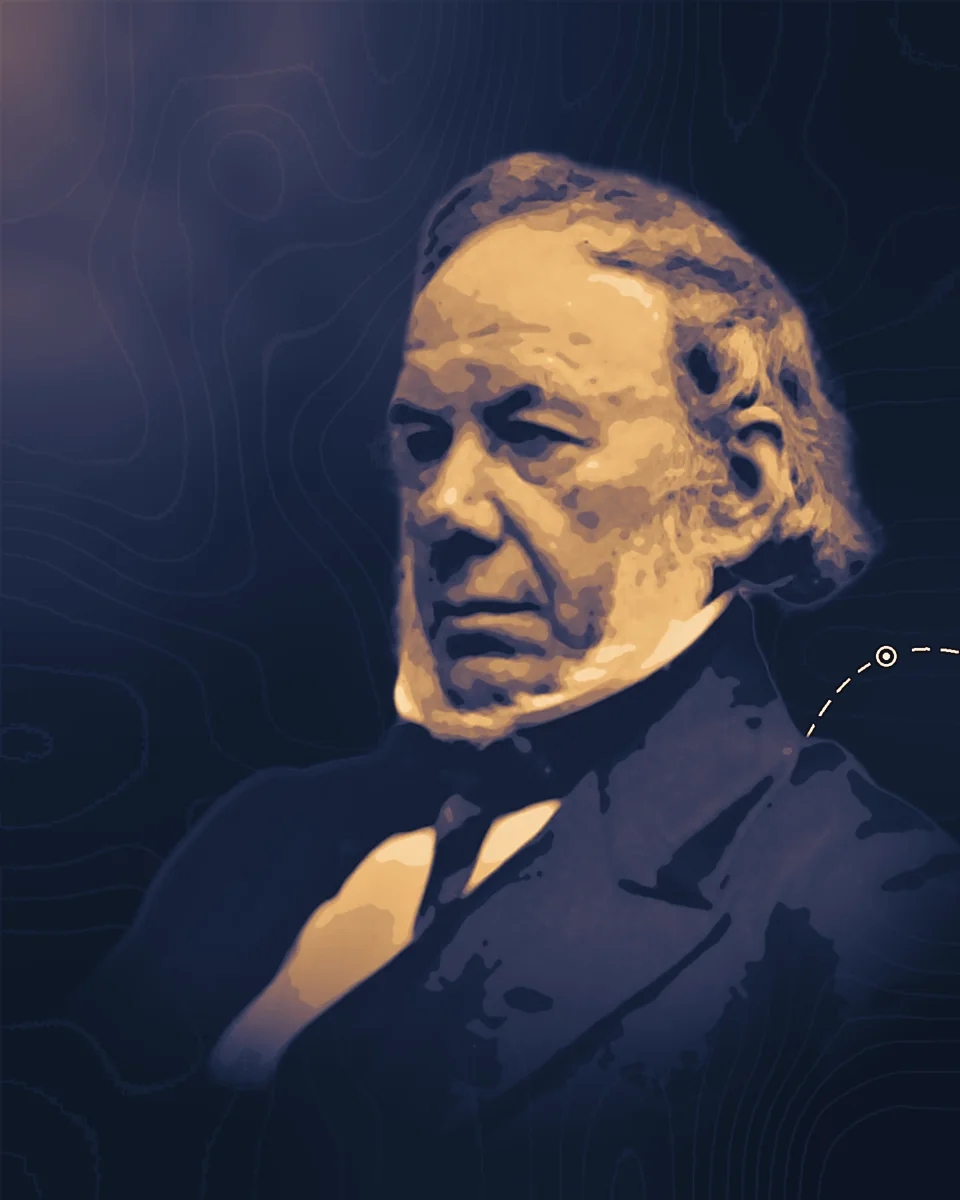
John Mercer
He found that a bath of strong caustic soda makes cotton shrink, grow stronger and take dye more readily, the treatment still called mercerizing.
1791–1866
What they changed
1817
An orange for calico
Mercer, then a hand-loom weaver teaching himself chemistry, worked out how to print a bright orange on cotton with a compound of antimony. His biographer Edward Parnell says no good orange for calico printers existed before it. The print works at Oakenshaw, Lancashire, hired him as its chemist on the strength of it in 1818.
1844
Caustic soda changes cotton
Mercer poured strong caustic soda (sodium hydroxide) through a cotton cloth filter and saw that the cloth had shrunk in length and width, thickened and turned half transparent. He showed the cloth to his partners as a curiosity and put it aside, because the print works left him no time for it.
1850
The process is patented
After the print works closed, Mercer went back to the cloth. He found that treated cotton took up dyes far more readily and was no weaker, and seemed stronger. He was granted British patent 13,296 on 24 October 1850 and a United States patent on 19 August 1851. The US patent says each fiber then needs "greater force to break it".
1851
A medal, but few buyers
At the Great Exhibition in London the jury recommended the process for a Council Medal. It still did not pay. The 1911 Encyclopaedia Britannica blames the cost of the caustic soda and, above all, the shrinkage of 20 to 25 percent, which meant less cloth to sell.
1890
Lowe adds the shine
Horace Arthur Lowe took out British patents in 1889 and 1890 for treating cotton with caustic soda while it is held stretched. Stretching stops the shrinkage and brings out a silk-like luster. A US court said in 1906 that "Lowe first discovered and suggested mercerization under tension". Ian Holme and Richard Blackburn wrote in 2019 that what is now called mercerizing is Lowe's method, and that it is still in use.
Life
John Mercer was born on 21 February 1791 at Dean, in the parish of Great Harwood near Blackburn, Lancashire. His father, Robert Mercer, was a hand-loom weaver who later took a farm, and died in 1800. John went to work at about nine as a bobbin-winder and then as a hand-loom weaver. He was ten before anyone taught him to read, write and reckon. His teacher was a pattern designer from the Oakenshaw print works named Blenkinsop, who gave him lessons in the evenings.
He taught himself dyeing by experiment and chemistry from a pocket textbook. In September 1809 he was taken on as an apprentice in the colour shop at Oakenshaw, and left the next year. His antimony orange brought him back in February 1818 as the works' experimental chemist, at thirty shillings a week. He became a partner in the firm, Fort Brothers, in 1825 and stayed until the partnership was dissolved in 1848.
Not everything he brought to the works was his own. The Dictionary of National Biography notes that the yellow he printed from 1823, lead chromate, had first been found by Daniel Koechlin in France. His own additions included bronze shades from manganese, better ways of printing with indigo, and a dry method of making the tin compounds that printers used to prepare cloth. In 1842 he put a theory of catalysis, the speeding of a reaction by a substance that is not used up, to the British Association at Manchester.
The cotton treatment that carries his name never made him money. Robert Hargreaves of the Broad Oak print works at Accrington gave him room and machinery for the experiments in return for a share of the patent. Parnell says a French company offered 40,000 pounds for the patents; Mercer, who had no works of his own, wished to accept, but Hargreaves refused and the sale fell through. Writing in 1886, Parnell said the invention had "not yet been extensively applied" for the purpose Mercer had in mind.
Mercer served as a juror at the Great Exhibition of 1851 and was elected a Fellow of the Royal Society in 1852. He died at Oakenshaw on 30 November 1866, in his seventy-sixth year, after an illness that followed a fall into a reservoir in 1864. The process became a trade only in the 1890s, on Lowe's method of stretching the cotton: Holme and Blackburn date a syndicate of twelve English firms that mercerized yarn for luster to about 1896.
Read more
5 accounts
The Life and Labours of John Mercer, Edward A. Parnell, Longmans, Green, 1886.
The only full biography, written at his daughters' request from his notes and letters, with his recipes and patent specifications.
archive.org
Mercer, John, P. J. Hartog, Dictionary of National Biography, volume 37, 1894.
A chemist's short account of the life and of each discovery.
en.wikisource.org
John Mercer FRS, FCS, MPhS, JP: the Father of Textile Chemistry, Ian Holme and Richard S. Blackburn, Coloration Technology, 2019.
A modern, referenced account of the life and the chemistry by two textile chemists; the link is the University of Leeds repository copy.
eprints.whiterose.ac.uk
Mercerizing, Edmund Knecht, Encyclopaedia Britannica, 11th edition, 1911.
A dye chemist's account of the process, of why Mercer's version failed and of Lowe's patents.
en.wikisource.org
Improvement in chemical processes for fulling vegetable and other textures, John Mercer, US patent 8,303, 1851.
His own description of the treatment and what it does to cloth.
patents.google.com