Industries / Figureheads
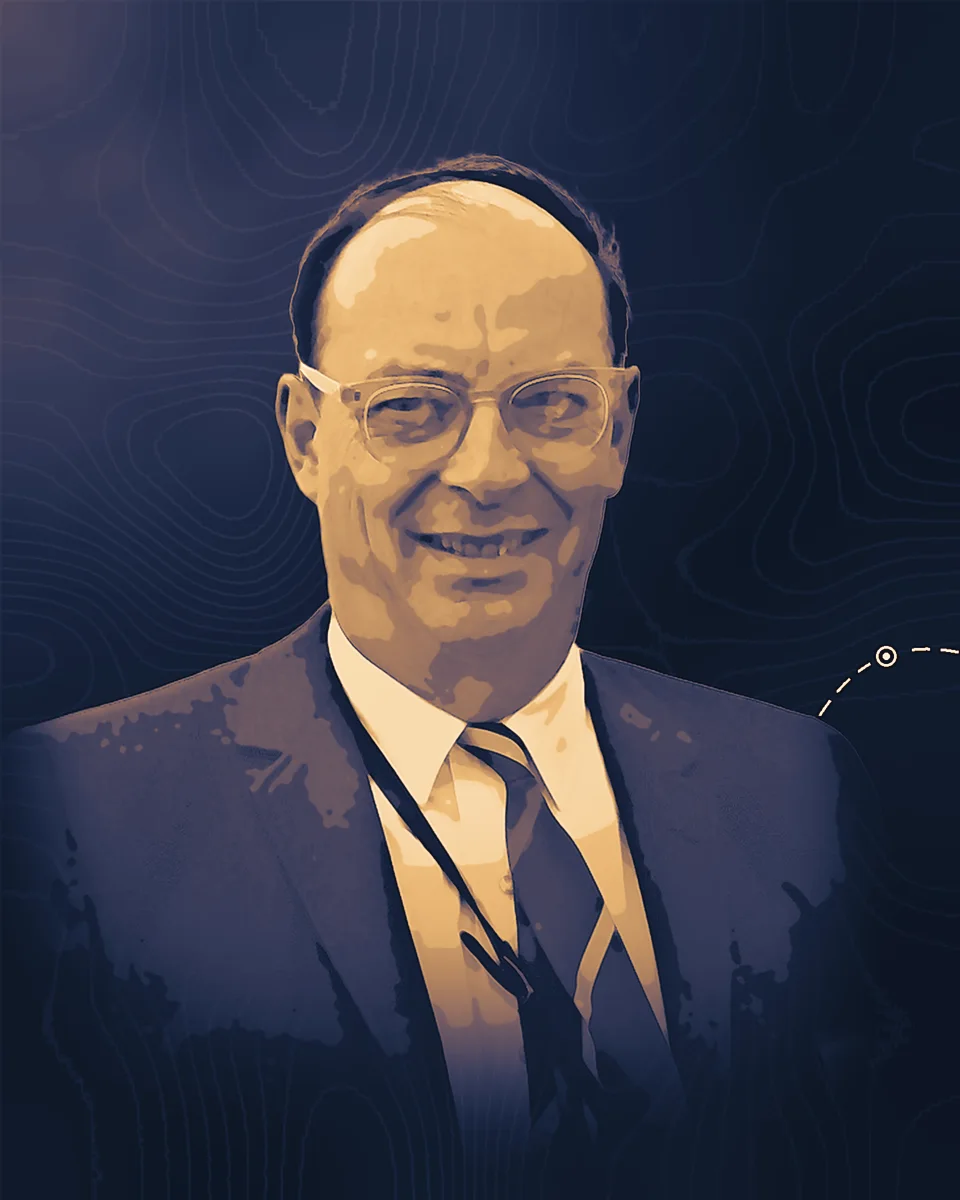
John Bardeen
He worked out why earlier solid amplifiers had failed, and with Walter Brattain made the first transistor at Bell Labs in December 1947.
1908–1991
What they changed
1946
Surface states explained
William Shockley's 1945 design for a solid amplifier, in which an electric field was meant to control the current in a semiconductor, did not work. Bardeen proposed that electrons held at the surface of the crystal were shielding its inside from the field. He and Walter Brattain then set out to study these "surface states", and that work led to the transistor.
1947
The first transistor
On 16 December 1947 Bardeen and Brattain pressed two gold contacts, set very close together, onto a small slab of germanium. A signal on one contact controlled a larger current through the other, and the Computer History Museum says the device amplified a signal up to 100 times. It is called the point-contact transistor. They showed it to Bell Labs managers on 23 December.
1948
Patent and announcement
Bell Labs announced the transistor in New York on 30 June 1948. The patent, filed that month and granted on 3 October 1950, names Bardeen and Brattain as its inventors. The museum says many thousands were made as the Bell Labs "Type A" transistor.
1951
A semiconductor laboratory at Illinois
Bardeen left Bell Labs for the University of Illinois and set up a semiconductor research group in its electrical engineering department. His first doctoral student there, Nick Holonyak, went on to develop the light-emitting diode, and in 1953 Bardeen ran what his memoirist calls the first international summer school in semiconductor electronics.
1957
A theory of superconductivity
With Leon Cooper and Robert Schrieffer he explained why some metals lose all electrical resistance when very cold. The three shared the 1972 Nobel Prize in Physics "for their jointly developed theory of superconductivity, usually called the BCS-theory".
Life
John Bardeen was born in Madison, Wisconsin, on 23 May 1908. His father was dean of the medical school at the University of Wisconsin. He took a degree in electrical engineering there in 1928 and worked from 1930 to 1933 at Gulf Research Laboratories in Pittsburgh on ways of reading magnetic and gravity surveys for oil. He then studied mathematical physics at Princeton under Eugene Wigner, where he took up the physics of solids, and received his doctorate in 1936. After three years at Harvard and three teaching at the University of Minnesota, he spent the Second World War at the Naval Ordnance Laboratory in Washington, working on the magnetic fields of ships.
In the fall of 1945 he joined a new solid-state group at Bell Telephone Laboratories, headed by William Shockley and Stanley Morgan, whose task was to find solid replacements for vacuum tubes and mechanical switches. Space was short, so he shared an office with two experimenters, Walter Brattain and Gerald Pearson. Brattain recalled of the group that "there was never any question as to who was the appropriate man in the group to do it." Bardeen supplied the theory and Brattain built the experiments.
The transistor came from an experiment that went the wrong way. A test meant to lower the current near the surface of a piece of germanium raised it instead, and Bardeen and Brattain concluded that a metal contact was pushing positive charge carriers, called holes, into the crystal. They put two contacts very close together to use the effect, and had an amplifier. The design did not last. Shockley, who had not taken part in the December experiments, worked out the sturdier junction transistor within weeks, and the industry built on that. Two German physicists working near Paris, Herbert Mataré and Heinrich Welker, made a point-contact transistor on their own in June 1948.
The invention ended the group. IEEE Spectrum reports that Shockley was angry at being left off the first patent. In a memo to the president of Bell Labs dated 24 May 1951, Bardeen wrote, "My difficulties stem from the invention of the transistor." He said that Shockley had at first kept the rest of the group off the problem and then "used the group largely to exploit his own ideas", so that Bardeen, a theorist, could only work on semiconductors by competing with his own supervisor. He moved to the University of Illinois that fall, with posts in both electrical engineering and physics.
At Illinois he divided his time between semiconductors and superconductivity. He shared the 1956 Nobel Prize in Physics with Shockley and Brattain "for their researches on semiconductors and their discovery of the transistor effect", and the 1972 prize with Cooper and Schrieffer. He also advised industry. His memoir for the National Academy of Sciences calls him the main scientific adviser for about thirty years to Xerox and its predecessor, the Haloid Company, and describes a long friendship with Sony that began with a visit to Japan in 1953. In 1989 Sony gave the university 3 million dollars for a professorship in his name.
Bardeen married Jane Maxwell in 1938, and they had three children. He died in Boston on 30 January 1991, aged 82.
Read more
5 accounts
Semiconductor research leading to the point contact transistor, John Bardeen, Nobel lecture, 1956.
His own account of the surface-state work and the December experiments.
nobelprize.org
John Bardeen 1908–1991, David Pines, National Academy of Sciences Biographical Memoirs, 2013.
A full memoir by his first postdoctoral associate, with the text of his 1951 memo on leaving Bell Labs.
nasonline.org
True Genius: The Life and Science of John Bardeen, Lillian Hoddeson and Vicki Daitch, Joseph Henry Press, 2002.
The book-length life, free to read on the National Academies' site.
nationalacademies.org
How the First Transistor Worked, Glenn Zorpette, IEEE Spectrum, 2022.
A clear account of the device itself, with drawings.
spectrum.ieee.org
1947: Invention of the Point-Contact Transistor, Computer History Museum, undated. The museum's short history, with the notebook pages and papers listed.
computerhistory.org