Industries / Figureheads
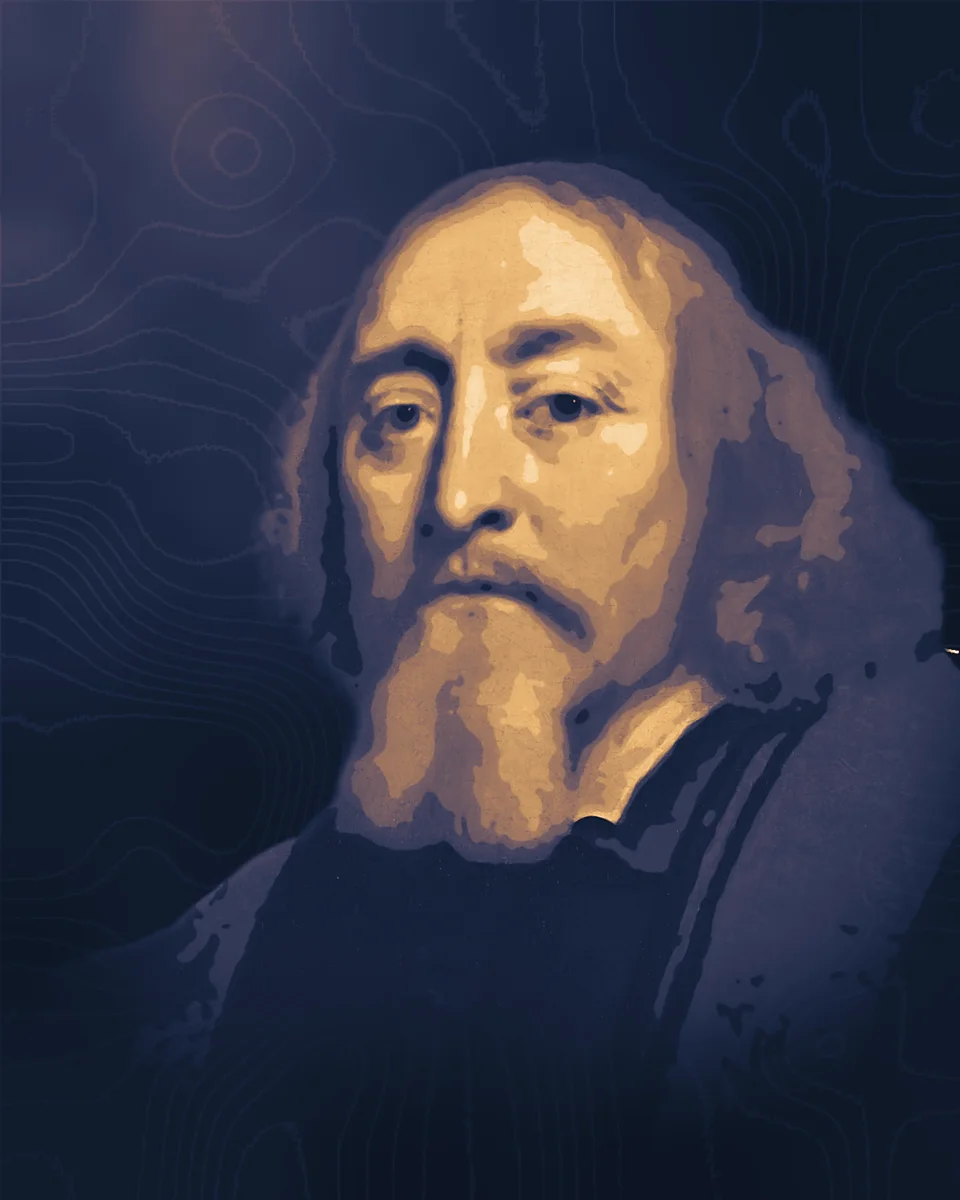
John Amos Comenius
He laid out one ladder of schools for every child, taught by classes and graded steps, and made the first schoolbook built on pictures.
1592–1670
What they changed
1631
Latin taught through things
Comenius's Janua linguarum reserata, printed at Leszno in Poland in 1631, taught Latin through sentences about everyday things instead of rules and words alone. His translator M. W. Keatinge says the plan was borrowed from Elias Bodinus, and that a Jesuit book of the same name already existed in Spain. Keatinge quotes the 17th-century scholar Pierre Bayle that it was translated into twelve European languages.
1657
One school ladder for all
In The Great Didactic, written in Czech and printed in Latin in his collected works at Amsterdam in 1657, Comenius divided the 24 years from birth to manhood into four schools of six years each: the mother's knee, a vernacular school in every village, a Latin school in every city and a university in every kingdom. All children, of both sexes and every rank, were to go through the same schools.
1657
A class taught as one
The same book argued that one teacher should take a whole class at once, with one book for each subject, the same exercise for every pupil and each day's work built on the last. Comenius held that a teacher could teach "several hundred scholars at once" this way.
1658
A schoolbook of pictures
Orbis Sensualium Pictus, printed in Latin and German in 1658 and in English in 1659, set woodcut pictures beside the names of the things shown, in two languages side by side. The Library of Congress says it is "considered the first children's picture book" and was used for more than 200 years. Jean Piaget called it "the first illustrated textbook".
Life
Jan Amos Komenský, known by the Latin name Comenius, was born on 28 March 1592 in south-eastern Moravia, now in the Czech Republic, at Nivnice or Uherský Brod. His parents died when he was twelve. He was 16 before he began Latin, at the school in Přerov, and Jean Piaget thought this late start made him think hard about how school should work. He studied theology at Herborn and Heidelberg for the ministry of the Unity of Brethren, a Protestant church.
He taught and preached at Fulnek until the Bohemian revolt that began the Thirty Years War. Imperial troops sacked the town and his library was burned in public. He lost his wife and young children, and an imperial edict of 1627 drove Protestant ministers out of the country. From February 1628 he lived in exile at Leszno in Poland, taught at its school and wrote the books that made his name.
His fame brought invitations. Friends in England published his plan for a universal body of knowledge, which he called pansophy, without his knowledge, and in 1641 Parliament invited him to London. Cardinal Richelieu asked him to reform schools in France. He chose Sweden, where the merchant Louis de Geer offered him work on school reform, discussed it with the chancellor Axel Oxenstierna in 1642, and wrote his new language method at Elbing in Swedish-held Prussia. From 1650 to 1654 he ran a school at Sárospatak, at the invitation of the Rákóczi princes of Transylvania, and wrote Orbis Pictus there. He became a bishop of the Unity of Brethren.
His textbooks had critics. Keatinge records that John Milton dismissed the Janua, and that later scholars called its Latin poor. Piaget wrote that his larger aim, one system of all knowledge, had already been overtaken by the separate sciences of his day, and that this is why his last great work was never finished.
In April 1656 Leszno was burned during the Swedish invasion of Poland, and he lost his library and most of his manuscripts, among them a Latin-Czech glossary he had worked on for forty years. He moved to Amsterdam to live with Laurens de Geer, his old patron's son, and there his collected educational works, Opera didactica omnia, were published in 1657. He died in Amsterdam on 15 November 1670 and was buried a week later at Naarden. Radio Prague notes that his influence faded after his death, as Enlightenment writers took over thinking on education.
Read more
5 accounts
The Great Didactic of John Amos Comenius, translated by M. W. Keatinge, Adam and Charles Black, 1896.
His main work in English, with a long biographical introduction.
archive.org
Jan Amos Comenius (1592–1670), Jean Piaget, Prospects, UNESCO International Bureau of Education, 1993.
Piaget's 1957 essay on what in Comenius still holds, with a chronology of his life and works by Giuliana Limiti.
monoskop.org
John Amos Comenius: That Incomparable Moravian, Matthew Spinka, University of Chicago Press, 1943.
A full biography by a historian of the Czech Reformation.
archive.org
John Amos Comenius, Bishop of the Moravians: His Life and Educational Works, S. S. Laurie, 1881.
An early British account of his life and textbooks.
archive.org
The Orbis Pictus of John Amos Comenius, C. W. Bardeen, Syracuse, 1887.
A reprint of Charles Hoole's English translation, from its London edition of 1728, with the pictures.
archive.org