Industries / Figureheads
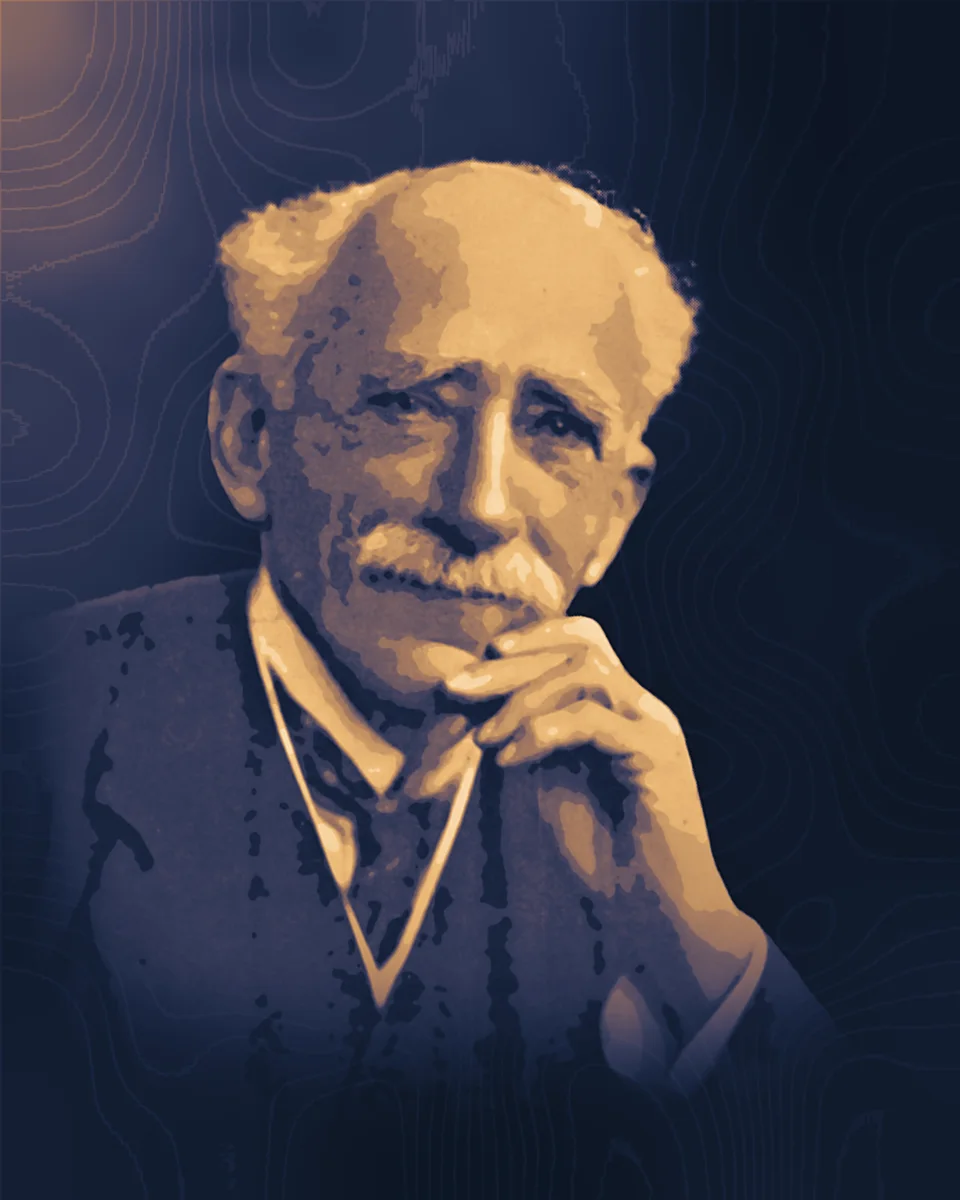
John Ambrose Fleming
He turned a light bulb with an extra plate into the oscillation valve of 1904, a vacuum tube that passes current one way only, which the Computer History Museum calls the first practical electronic device.
1849–1945
What they changed
1889
The Edison effect studied
Thomas Edison's laboratory had found in 1883 that a current would cross the empty space inside a light bulb from the hot filament to an extra metal plate. Fleming, then adviser to the Edison lamp company in London, had such lamps made and measured the effect. In December 1889 he read a paper to the Royal Society showing that the current crossed in one direction only.
1901
A power station for radio
Guglielmo Marconi asked Fleming in 1900 to help design a stronger transmitter for an attempt to signal across the Atlantic. It was built at Poldhu in Cornwall, and signals from it were reported received in Newfoundland on 12 December 1901.
1904
The oscillation valve
Radio signals swing back and forth too fast for a meter to follow. Fleming wired one of his old lamps into a receiving circuit and found that it let the signal through in one direction only, so a meter or a telephone earpiece could register it. He applied for a British patent on 16 November 1904. An IEEE Milestone plaque says the valve "laid the foundation for the field of electronics".
1905
The valve explained in print
Fleming described the valve in a paper to the Royal Society in 1905 and concluded that a hot carbon filament and a cold metal plate in a very good vacuum would make an ideal rectifier, a device that turns alternating current into direct current. The American engineer Lee de Forest read the paper, and in 1906 he added a third element to the valve, which made a tube that could amplify.
Life
John Ambrose Fleming was born in Lancaster, England, on 29 November 1849, the son of a Congregational minister. He took a science degree at University College London in 1870 and taught for some years. In 1877 he entered St. John's College, Cambridge, where he heard James Clerk Maxwell lecture and worked in the Cavendish Laboratory. He taught briefly at Nottingham from 1881, became electrician to the Edison Electric Light Company in London in 1882, and in 1885 was appointed to the new chair of electrical engineering at University College London, which he held until 1926.
The valve came out of two jobs. The lamp company brought him to the Edison effect in the 1880s. In 1899 he became scientific adviser to Marconi's company, and there he looked for a better way to detect radio waves. He later recalled that he went to a cabinet, took out the lamps of his earlier work, and by about five o'clock one evening saw a galvanometer needle show a steady current. He said the missing link in wireless had been found, "and it was an electric lamp". The patent passed to the Marconi company.
The valve was not his idea alone and was not at first much used. The Computer History Museum credits William J. Hammer, working in Edison's laboratory, with noticing the one-way current in 1883. Ellison Hawks wrote in 1927 that the Fleming valve was no more sensitive than a crystal detector and "did not come into general use", probably because of its cost, until de Forest's third element let it amplify.
Credit for the valve was fought over in court for decades. De Forest claimed to have got there before Fleming, and long litigation followed. American courts found for Fleming, and in 1917 an appeals court said he "was the first to disclose an apparatus for this purpose". In 1943, in a suit by the Marconi company against the United States government, the Supreme Court held Fleming's American patent invalid. Its reason was that the patent's first claim covered more than he had invented, as his own paper of 1890 showed, and that he had waited ten years to correct it. The court did not decide who first used the device to detect radio waves.
Fleming received the Faraday Medal of the Institution of Electrical Engineers in 1928 and was knighted in 1929. In 1930 he became president of the Television Society of London, and in 1933 the Institute of Radio Engineers gave him its Medal of Honor. He died on 18 April 1945, aged 95.
Read more
5 accounts
The Thermionic Valve and Its Developments in Radio-telegraphy and Telephony, John Ambrose Fleming, The Wireless Press, 1919.
His own book on the valve and what was built on it.
archive.org
Pioneers of Wireless, Ellison Hawks, Methuen, 1927.
A history written while Fleming was alive; chapter 18 quotes his account of the evening the valve first worked and follows the lawsuits.
archive.org
John Ambrose Fleming, 1849–1945, W.
H. Eccles, Obituary Notices of Fellows of the Royal Society, 1945. The Royal Society's memoir of his life and work.
royalsocietypublishing.org
Marconi Wireless Telegraph Co. of America v. United States, United States Supreme Court, 320 U.S. 1, 1943.
The opinion that held the American Fleming patent invalid, with the court's reading of his 1890 paper.
supreme.justia.com
Our weekly biography: Professor John Ambrose Fleming, Page's Weekly, 2 February 1906.
A two-page life printed just over a year after the valve, with a photograph by Elliott and Fry.
archive.org