Industries / Figureheads
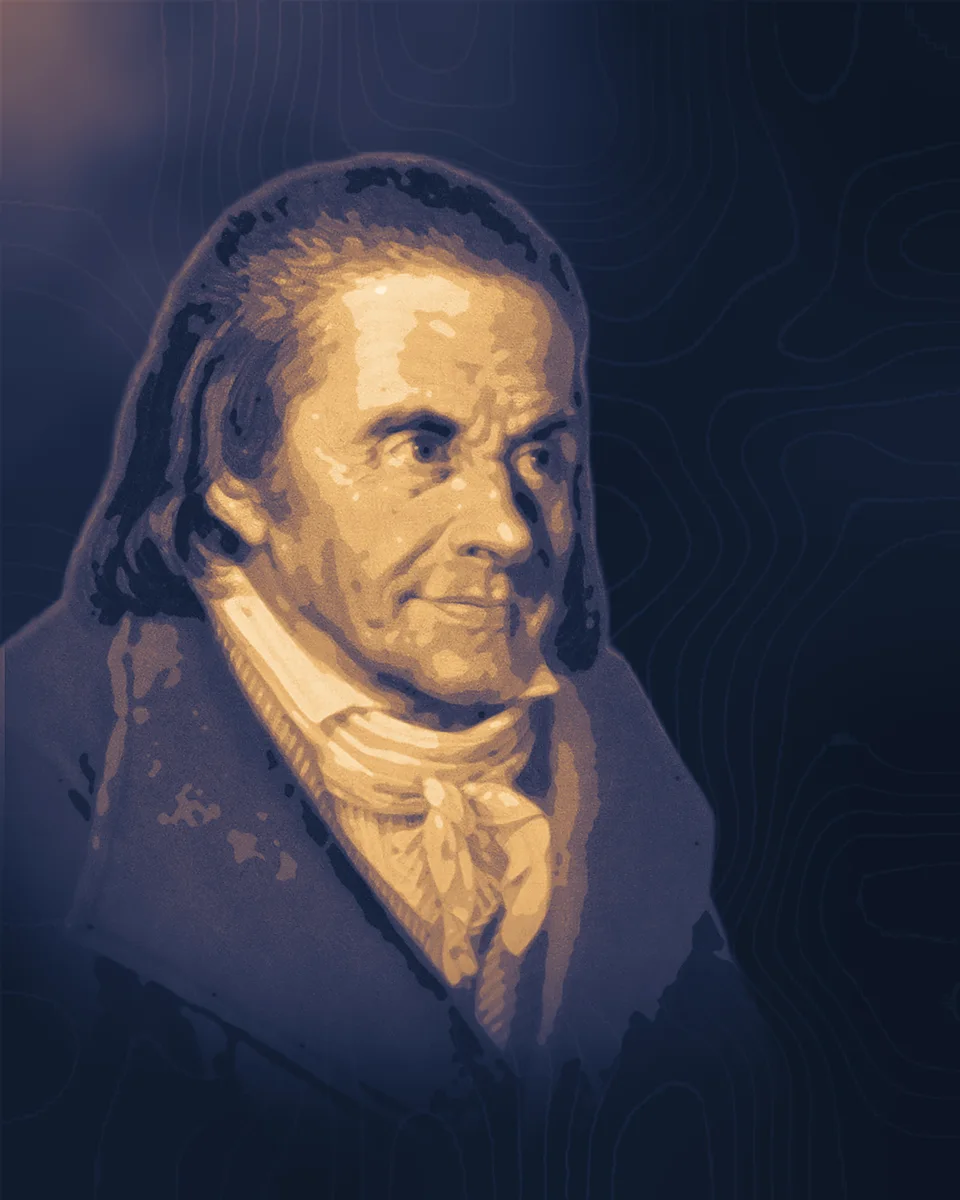
Johann Heinrich Pestalozzi
He taught poor children from what they could see and handle before words and rules, and trained the teachers who carried that method into the public schools of Prussia and beyond.
1746–1827
What they changed
1774
Schooling poor children at work
At his farm, the Neuhof near Brugg, Pestalozzi took in poor children to spin and weave cotton and be taught at the same time, hoping their work would pay for the school. The Neue Deutsche Biographie, Germany's national biography, records that it did not pay and closed in 1780.
1799
Teaching from what children see
Asked by the new Swiss government to care for war orphans at Stans, he ran a home there for seven months, then tried his method in schools at Burgdorf. It started from what children could see and handle, which German calls "Anschauung", and moved step by step to number, form and language. He set it out in 1801 in How Gertrude Teaches Her Children.
1800
A college for teachers
In 1800 he was allowed to open a seminary for teachers in Burgdorf castle. After 1804 his institute at Yverdon became, in the national biography's words, a centre of teacher training in Europe for about twenty years, with 166 pupils of several nations around 1809, and visiting teachers who included Friedrich Froebel.
1808
A state adopts the method
After its defeat by Napoleon, Prussia set out to rebuild its elementary schools. The minister Altenstein wrote to Pestalozzi in September 1808, and Prussia sent seventeen young men to train at Yverdon for three years at state expense, by the account of his biographer Roger de Guimps. The national biography credits Pestalozzi above all with the growth of public elementary schools in Prussia, Bavaria and Württemberg early in the 19th century.
Life
Johann Heinrich Pestalozzi was born in Zürich on 12 January 1746. His father, a surgeon, died when he was five. He went through Zürich's Latin schools and studied philology and philosophy at its Collegium Carolinum from 1763 to 1765. On visits to his grandfather, a pastor in the village of Höngg, he saw how poor the people of the Zürich countryside were. He joined a reforming student society, and in January 1767 he was held for three days on suspicion of joining protests against the city council, which ended his hopes of a public career.
Following Rousseau, he trained as a farmer and in 1769 married Anna Schulthess, a merchant's daughter, and moved to the Neuhof. The farm did badly after the harvest failures of 1771 and 1772, and so did the school for poor children he added to it. He turned to writing. His novel Leonard and Gertrude, whose first volume came out in 1781, told how a village was saved by the good sense of a mother and a fair ruler. It made him known across Europe, and in 1792 the French National Assembly made him an honorary citizen of France, with Friedrich Schiller and others.
When revolution reached Switzerland in 1798, he worked for the new central government. It sent him to Stans, a town that had risen against the revolution and been put down by force, to look after its orphans, and the home closed after seven months under the pressure of war. At Burgdorf from 1799 he gathered colleagues to work with him: Hermann Krüsi, Johann Tobler, Johann Christoph Buss, and later Johannes Niederer and Joseph Schmid.
Yverdon was paid for mostly with private money. It declined after 1814, and quarrels among its teachers, Niederer and Schmid above all, sped the decline. He dissolved the institute in 1825 and went back to the Neuhof. He died at Brugg on 17 February 1827 and was buried at Birr. The national biography judges that, however dated some of his positions now seem, no other educator gave the public elementary school so much or shaped the schools of central Europe in the 19th and 20th centuries so lastingly. Its principle of teaching that engages "head, heart, hand" is still quoted.
Read more
5 accounts
Pestalozzi, Johann Heinrich, Max Liedtke, Neue Deutsche Biographie 20, 2001.
The German national biography's account of his life, work and influence, in German.
deutsche-biographie.de
Pestalozzi: His Life and Work, Roger de Guimps, translated by J. Russell, D. Appleton, 1890.
A full biography by a Swiss writer, with long quotations from letters and reports.
archive.org
How Gertrude Teaches Her Children, Johann Heinrich Pestalozzi, translated by Lucy Holland and Frances Turner, Swan Sonnenschein and C. W. Bardeen, 1894.
His own account of the method, written as letters in 1801.
archive.org
Pestalozzi: The Man and His Work, Kate Silber, Routledge and Kegan Paul, 1960.
A modern scholarly biography in English.
archive.org
Leonard and Gertrude, Johann Heinrich Pestalozzi, translated and abridged by Eva Channing, D. C. Heath, 1885.
The novel of 1781 that made his name.
archive.org