Industries / Figureheads
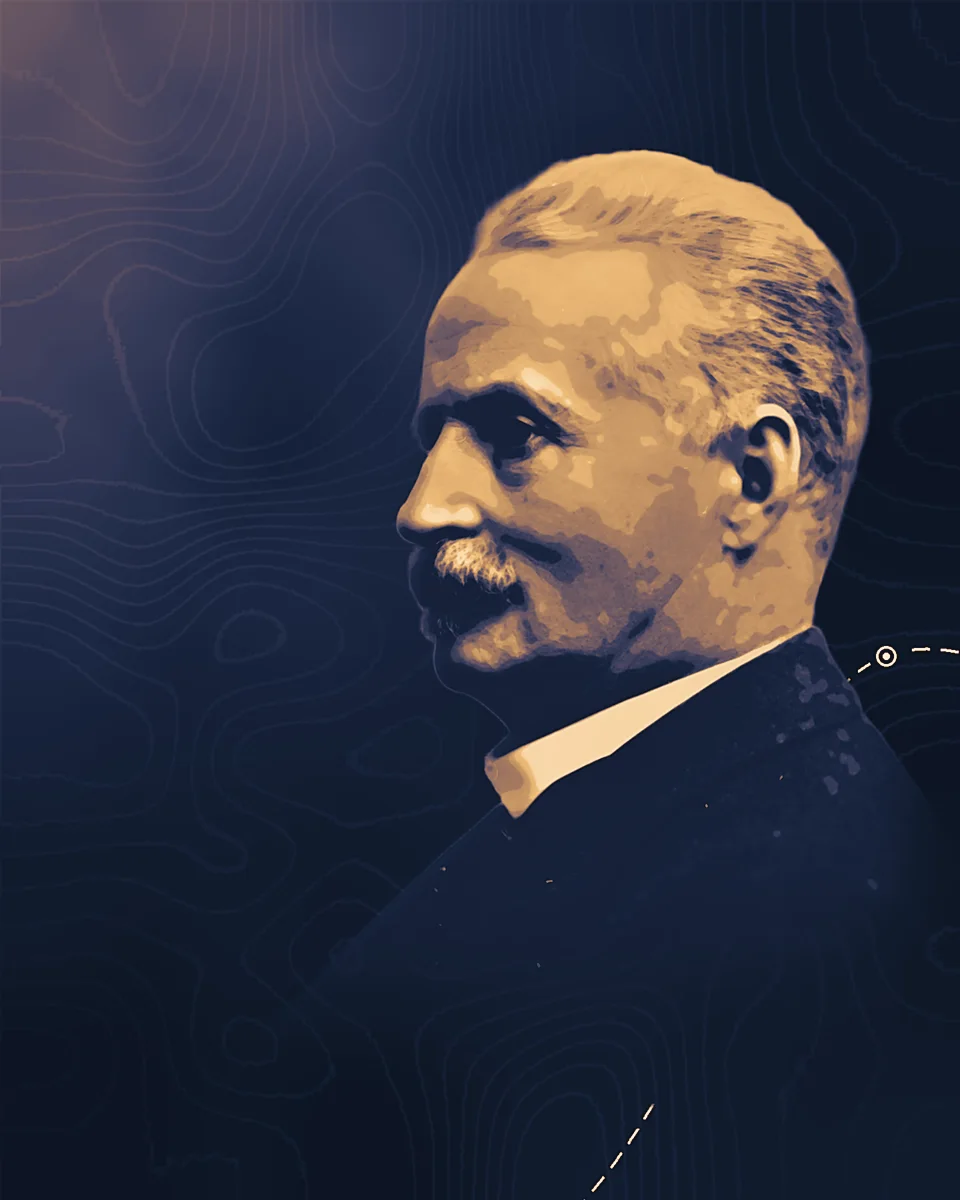
Johan August Brinell
He gave metal hardness a number, by pressing a steel ball into the surface under a known load and measuring the dent.
1849–1925
What they changed
1885
Steel's changes read from fractures
As chief engineer at the Fagersta ironworks in Sweden, Brinell heated and cooled steel in many ways, broke the pieces and compared the look of the broken faces. His paper in Jernkontorets Annaler, "Changes in the Texture of Steel during Heating and Cooling", set out the temperature at which the structure changes and what that means for hardening. The Iron and Steel Institute's obituary says the paper "has since been regarded as a classic on the subject".
1900
Ball hardness test
At the Paris Exhibition of 1900 Brinell first showed his way of measuring hardness. A hardened steel ball 10 mm across is pressed into the metal under a load of up to 3,000 kg, and the hardness number is the load divided by the area of the dent. The historian Eugene Ferguson wrote that the procedure, "not essentially modified, is still one of the most widely used tests of hardness".
1901
The method goes abroad
A full report on the ball test was printed in 1901 in Jernkontorets Annaler and in the Journal of the Iron and Steel Institute in London. Axel Wahlberg compiled the English report and presented it in Brinell's name, and technical papers in many countries reprinted it.
1903
Engineer to a whole industry
Brinell became the first chief engineer of Jernkontoret, the Swedish ironmasters' association, and held the post until 1914. There he worked on using the ores of northern Sweden, on the electric blast furnace and on peat as fuel, and helped edit the association's journal.
Life
Johan August Brinell was born in June 1849 at Bringetofta in Småland, southern Sweden, the son of a farmer, Johannes Månsson, and Katarina Jonasdotter. He went to school in Jönköping and graduated from the technical school at Borås in 1871. After four years as a draughtsman he was taken on in 1875 at the Lesjöfors ironworks, then directed by Gustaf Ekman, and there he turned to the making of iron and steel. He married Selma Nilsson in 1880.
In 1882 he became chief engineer of the Fagersta ironworks and stayed until 1903. His study of heated and cooled steel came out in 1885. He was not the first to find that steel changes at a set temperature: Dmitry Chernov had told a Russian society so in 1868. And the microscope work of the Frenchman Floris Osmond, published the same year as Brinell's paper, drew more notice. Ferguson suggests the trade may have accepted Osmond's conclusions more readily because Brinell's fractures backed them up. The metallurgist Cyril Stanley Smith called Brinell's paper "a monument of imaginative and careful work".
Fagersta showed his results at Stockholm in 1897 and at Paris in 1900. The Paris jury gave a Grand Prix for his experiments on iron and steel, and the Swedish Society of Technologists gave him its Polhem medal that year for the paper on hardness. A short life of him printed in the American Iron and Steel Magazine in 1904 already called it "his well-known ball test". He kept using it: in 1905 the same magazine carried his study of how the hardness of two open-hearth steels changes with temperature, measured by "ball-testing".
He was elected to the Swedish Academy of Sciences in 1902. In 1907 the Iron and Steel Institute gave him its Bessemer medal and Uppsala University an honorary doctorate. He chaired the board at Fagersta from 1915 to 1923, and in 1920 Jernkontoret gave him its Rinman medal for a study of how bodies resist wear. He died of pneumonia at his home in Stockholm on 17 November 1925. C. Benedicks, who wrote his obituary for the Institute of Metals, remembered him as "very unpretentious".
Read more
4 accounts
John August Brinell, editorial sketch, The Iron and Steel Magazine, October 1904.
A short life printed while he was at work, with his posts, papers and prizes to that date and a portrait as frontispiece.
archive.org
Obituaries of Johan August Brinell, C. Benedicks for the Institute of Metals and an unsigned notice for the Iron and Steel Institute, 1926.
Two accounts by people in the trade, transcribed by Grace's Guide.
gracesguide.co.uk
Researches on the comparative hardness of acid and basic open-hearth steel at various temperatures by means of ball-testing, J. A. Brinell, The Iron and Steel Magazine, 1905.
One of his own papers in English, showing the test in use.
archive.org
Brinell, Johan August, Eugene S. Ferguson, Dictionary of Scientific Biography. A historian of technology on the fracture study, the test and where to read more, including the Swedish national biography.
encyclopedia.com