Industries / Figureheads
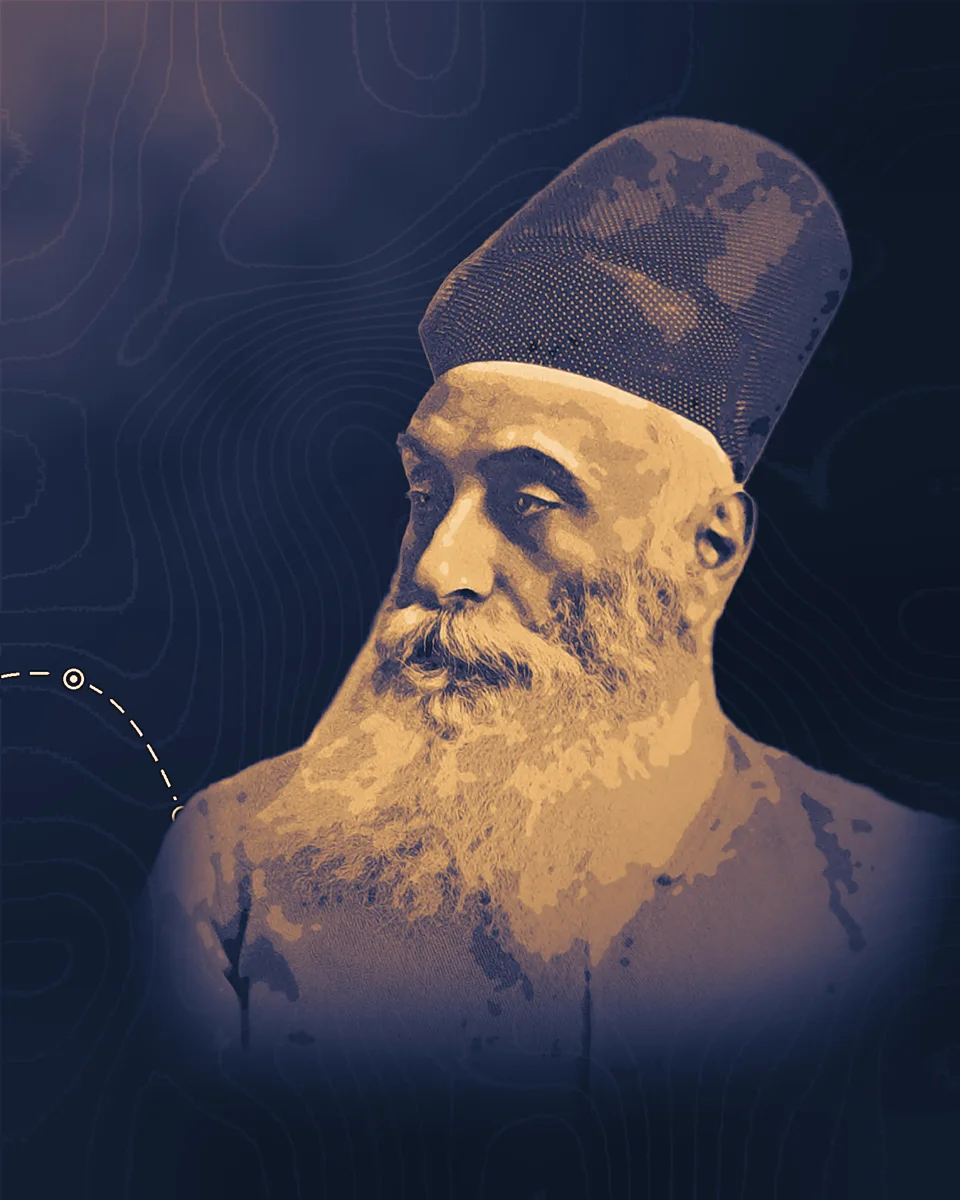
Jamsetji Tata
He built India's model cotton mill at Nagpur, where he was the first Indian mill owner to spin on the ring frame and to set up pension and provident funds for mill workers.
1839–1904
What they changed
1877
The Empress Mills open
Tata chose Nagpur, in the cotton country of central India, over Bombay, where the mills then stood. His Empress Mills opened there on 1 January 1877, the day Queen Victoria was proclaimed Empress of India, with 15,552 throstle spindles, 14,400 mule spindles and 450 looms. His biographer F. R. Harris says they were the first mills in India to give proper care to ventilation and the first to install apparatus to humidify the air, needed because the air at Nagpur is drier than at Bombay.
1883
Ring spinning comes to India
A ring frame twists and winds yarn in one continuous motion, where a mule works in a back-and-forth cycle. In 1883 James Brooksby, the mills' technical expert, sent two short ring frames to Nagpur for trial, and Tata then ordered full-length frames from Manchester. The historian Dwijendra Tripathi calls Tata "the first Indian industrialist to appreciate the merit of the American technology".
1880s
Funds for mill workers
At the Empress Mills a provident scheme, a savings fund to which the company adds, and a pension fund paid for wholly by the company were built up over the years. Harris calls the pension fund "the first of its kind in any Indian mill". The mills also trained apprentices to rise through the firm.
1886
A mill for finer yarn
Indian mills then spun coarse yarn, and finer cloth was nearly all imported. Tata registered the Svadeshi Mills Company on 13 September 1886 to spin finer yarn, and bought the failed Dharamsi Mill at Kurla, near Bombay, to do it. From 1892 the mill spun fine yarn from Egyptian cotton.
Life
Jamsetji Nusserwanji Tata was born at Navsari, in what is now Gujarat, on 3 March 1839, the only son of Nusserwanji Tata, a Parsi merchant. He joined his father in Bombay at thirteen and entered Elphinstone College in 1856. He then worked in his father's trading firm, including four years in England, where he often visited the mills of Manchester.
In 1869 he bought a bankrupt oil mill at Chinchpoogly in Bombay, turned it into a cotton mill named the Alexandra, ran it for two years and sold it. He went back to England to study the Lancashire trade, and in 1874 formed the Central India Spinning, Weaving and Manufacturing Company, with a capital of 1.5 million rupees, to build at Nagpur. By Harris's count the mills' first eighteen yearly reports showed an average profit of close to 20 per cent.
The credit for the ring frame is shared, and its effect was slow. The idea came from Brooksby, who had seen ring spindles tried while on leave, and Harris says Tata was the first to admit what the mills owed to Brooksby and to their manager, whom Harris calls Mr. Bezonji. Tripathi notes that few followed: only one other company, the British-owned Connaught Mills in Bombay, took up the ring at first, rings were barely 28 per cent of India's spindles in 1891, and they did not reach half until 1909. He adds that Tata's own firm was as slow as other Indian mills to adopt later machines.
Harris's book is close to the firm's own account. Harris never met Tata, and he writes that Tata's son Sir Dorabji, other members of the family and the firm supplied much of his material. Its picture of the mill hands is an owner's: it calls the labourer of the day casual and untrained and records that 15 to 20 per cent of the workers were absent on an average day.
Cotton made the fortune that Tata then put into three larger plans: an iron and steel works, a hydro-electric scheme to power Bombay, and an institute of science at Bangalore. He died at Bad Nauheim in Germany on 19 May 1904, before any of the three was finished. His sons and colleagues carried them out.
Read more
4 accounts
Jamsetji Nusserwanji Tata: A Chronicle of His Life, F. R. Harris, Oxford University Press, 1925.
The standard life, written with the family's help, with chapters on each mill.
archive.org
The Life and Life Work of J. N. Tata, D. E. Wacha, Ganesh & Co., 1914.
A short memoir by a Bombay mill man and politician who knew him.
archive.org
Colonialism and Technology Choices in India: A Historical Overview, Dwijendra Tripathi, The Developing Economies, 1996.
A business historian on why Indian mills kept the mule after Tata had shown the ring frame worked.
ide.go.jp
For the Love of India: The Life and Times of Jamsetji Tata, R. M. Lala, 2004.
A modern biography for general readers.
archive.org