Industries / Figureheads
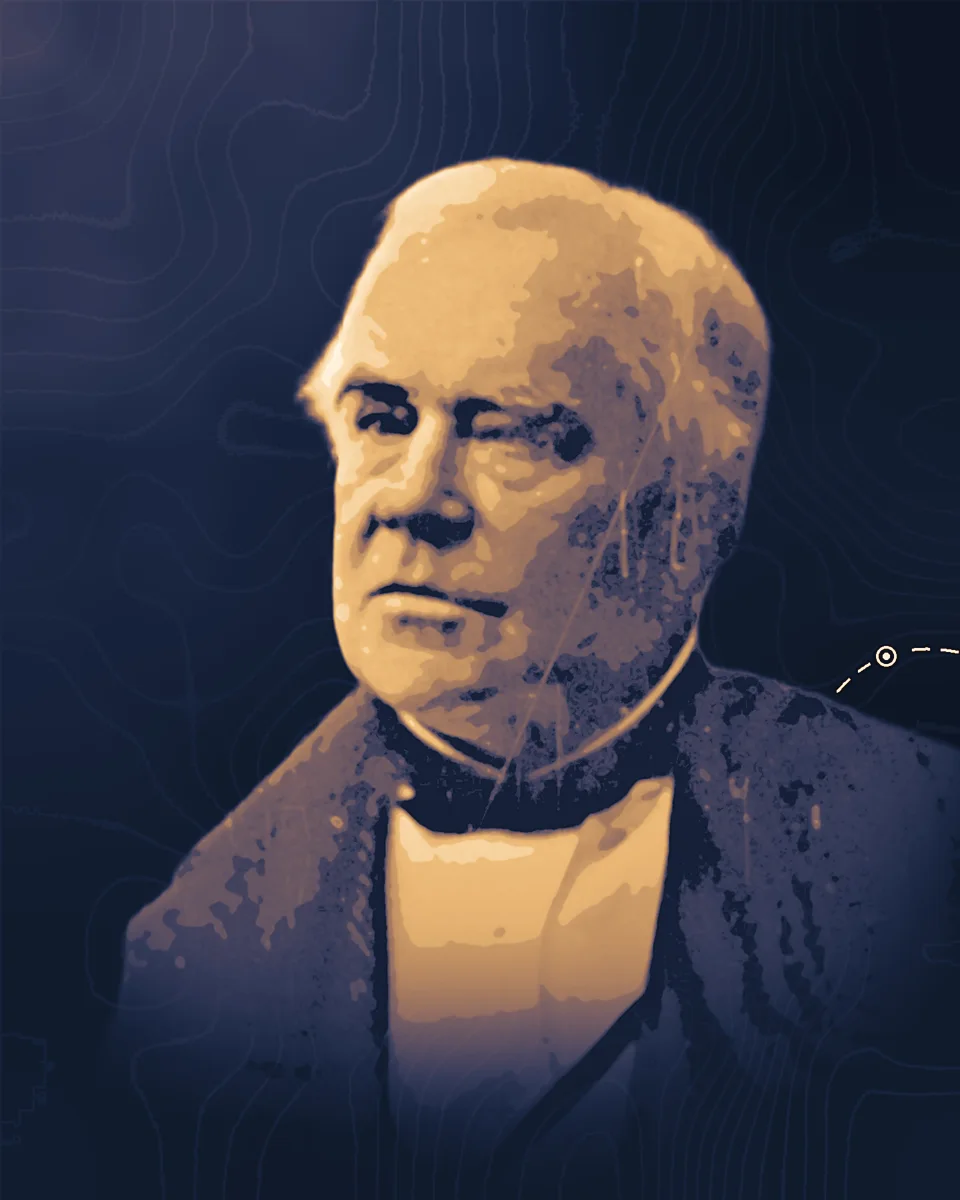
James B. Francis
He designed and measured the inward-flow water turbine that carries his name, the type most hydroelectric plants use today.
1815–1892
What they changed
1848
More water for the mills
As chief engineer of the company that owned the canals of Lowell, Massachusetts, Francis built the Northern Canal between 1846 and 1848. It raised the flow of water to the textile mills by half.
1849
The inward-flow turbine
In a turbine of this kind water enters around the rim and flows inward through curved guides and blades, turning the wheel as it goes. Samuel Howd had patented such a wheel in 1838. Francis built one in 1847, tested it, and used the results to design a much improved wheel for the Boott Mills in 1849. The American Society of Mechanical Engineers says the modern turbine came out of a long process involving many inventors, with Francis early among them.
1852
The gate that saved Lowell
In 1850 he completed a great flood gate on the canal, which was at first thought impractical. At 3:15 on the morning of 22 April 1852 it was dropped, and it saved the city from flooding.
1855
Measurement, published
He published his turbine work as Lowell Hydraulic Experiments in 1855. The Park Service says the mixed-flow turbine he developed became an American standard.
1900s
The standard hydro turbine
The same society says the Francis turbine is "the most widely used water turbine in situations involving medium-head and large-flow rates", and that most turbines now used to make hydroelectric power are called Francis types in his honor. The National Park Service counts 22 of them at Hoover Dam.
Life
James Bicheno Francis was born on 18 May 1815 at Southleigh, Oxfordshire, England. From 1829 he worked under his father, who was superintendent of a railway and harbor works at Porthcawl in South Wales. In the spring of 1833 he emigrated to the United States and found work under the engineer George Washington Whistler on the Stonington Railroad.
In 1834 Whistler became chief engineer of the Proprietors of Locks and Canals at Lowell, the company that owned the canals and leased water power to the mills, and Francis went with him as his assistant. When Whistler resigned in 1837, Francis took his place at the age of 22. He became the company's manager in 1845 and stayed with it for the rest of his working life.
His job was to measure and share out water. He was set in 1841 to measure what each mill drew from the canals, and that work led him to test the wheels themselves. He studied the outward-flow turbine of Uriah Boyden, which reached an efficiency of 88 percent, before turning to the inward-flow design. He also laid out, in 1845, a system of pipes and sprinklers against fire in one of the mills.
Francis built his turbines to drive machinery, not generators. The wheel he installed at the canal's gatehouse, the first of his inward-flow turbines put into service and the oldest that survives, worked the ten head gates by belt until an electric motor replaced it in 1923.
He was a president and honorary member of the American Society of Civil Engineers. He retired as chief engineer in 1884, when his son succeeded him, and remained a consulting engineer until he died on 18 September 1892, aged 77. He is buried in Lowell.
Read more
4 accounts
Lowell Hydraulic Experiments, James B. Francis, 1855.
His own book of experiments on hydraulic motors and the flow of water, in the first edition.
archive.org
James Bicheno Francis, Past President and Honorary Member, Proceedings of the American Society of Civil Engineers, volume 19, 1893.
The society's memoir, printed seven months after his death, with the portrait.
archive.org
James B. Francis, Lowell National Historical Park, National Park Service, undated. A dated life from the park that keeps the canals and the gate.
home.nps.gov
Lowell Power Canal System and Pawtucket Gatehouse, American Society of Mechanical Engineers, landmark 107, 1985.
The landmark brochure, with the history of the turbine and the canals.
asme.org